Choosing between a 445 nm and a 450 nm laser diode? Start with the wavelength range your application can accept. The listed wavelength is nominal: if the beam must pass through a narrowband filter or excite a specific fluorescent dye, check the actual emission specification at your operating current and temperature.
Once you know the wavelength range, work backward from the power and spot size you need at the target. Those requirements help you choose a fiber-coupled module and check whether its driver and cooling requirements fit your system.
What is a blue laser diode?
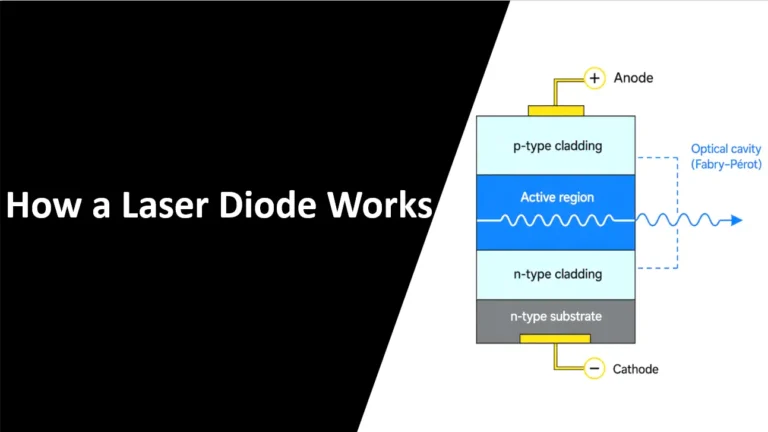
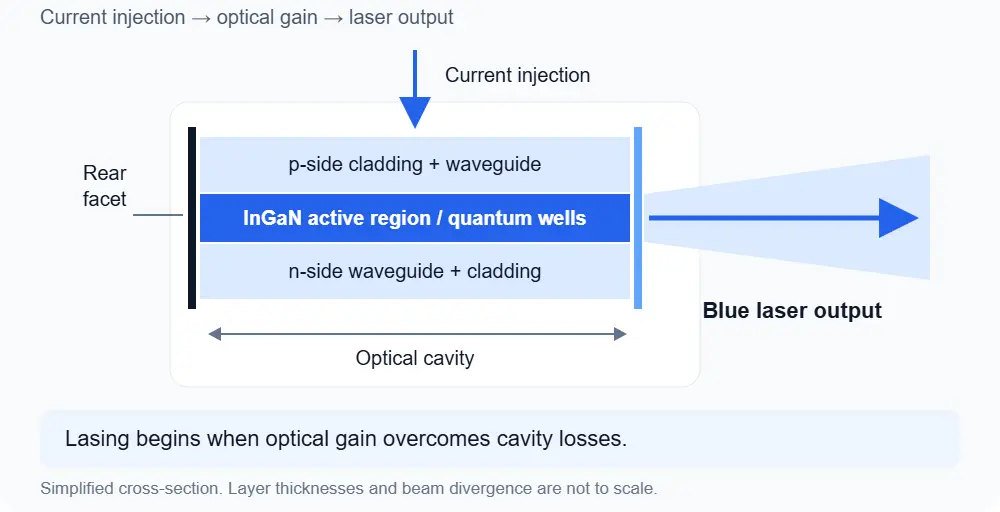
Blue semiconductor lasers commonly use indium gallium nitride, or InGaN, active regions within a nitride semiconductor structure. Current injects electrons and holes into the active region. Optical feedback from the laser cavity allows stimulated emission to sustain lasing once the gain overcomes the losses.
Quantum wells confine carriers within very thin layers, while the waveguide confines the optical field. This distinction matters: producing light efficiently and controlling its propagation are related design tasks. The InGaN quantum-well, waveguide and cladding architecture is documented in Shuji Nakamura’s Nobel lecture.
An edge-emitting diode can have different divergence angles along its two axes. Check both angles and the spatial mode when selecting optics to collimate or focus the beam.
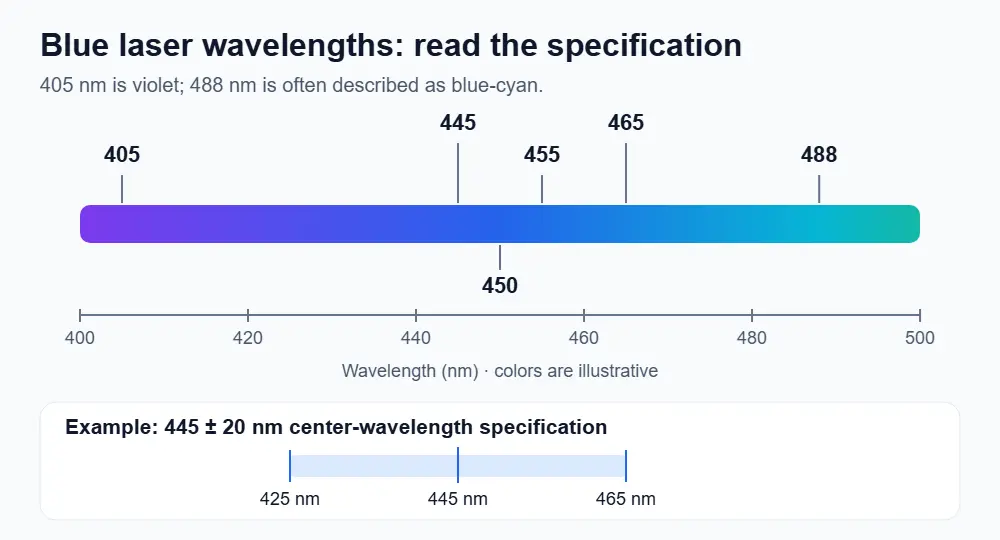
Blue laser diode wavelengths: 445, 450, 455, 465 and 488 nm
445 nm vs 450 nm laser diodes
A 445 nm diode may replace a 450 nm diode if its specified emission range fits the application and the two devices meet the same optical, electrical, and thermal requirements. Check the wavelength tolerance before treating them as interchangeable.
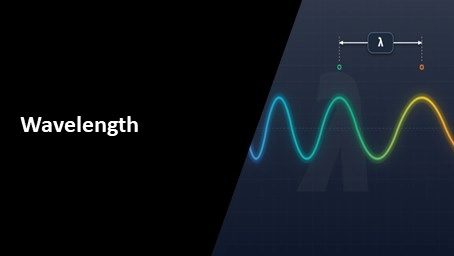
Read the wavelength tolerance as well as the product name. For example, ephotonics’ 4 W module specifies a center wavelength of 445 ± 20 nm and a typical spectral width of 6 nm FWHM. The first describes the allowed center-wavelength range; the second describes the width of the emitted spectrum at half its maximum intensity. They are different specifications. 4 W module datasheet.
If a filter, coating or absorption feature requires a narrow wavelength range, request the appropriate wavelength selection and operating conditions.
455 nm and 465 nm laser diodes
A 455 nm laser diode can supply the blue channel in a projector or excite a phosphor. If the optical design calls for a specific shade of blue, check the wavelength range guaranteed for the selected part.
A 465 nm laser diode emits at a longer blue wavelength. When comparing emitters, check whether the datasheet specifies the spectral peak or the dominant wavelength. The latter describes perceived color and need not coincide with the spectral peak.
488 nm blue lasers and 405 nm violet lasers
A 488 nm laser diode is useful for fluorescence excitation in flow cytometry. A 405 nm diode emits violet light and is used in direct imaging and photopolymerization. Select the wavelength against the response spectrum of the sample or material.
| Wavelength | Application examples | What to check |
|---|---|---|
| 405 nm Violet | Photopolymerization, direct imaging and selected fluorescence applications. | Material or fluorophore sensitivity at 405 nm; required exposure dose. |
| 445 nm Blue | Fiber-delivered material processing and blue illumination. | Center-wavelength tolerance, optical power, beam delivery and cooling. |
| 450 nm Blue | Copper-processing research and industrial blue-laser designs. | Absorption, delivered spot size, process speed and power at the workpiece. |
| 455 nm Blue | Projection and phosphor-converted illumination. | Wavelength bin, efficiency and the optical architecture. |
| 465 nm Blue | Blue illumination and wavelength-specific optical designs. | Whether the stated wavelength is dominant or center wavelength; spatial mode. |
| 488 nm Blue / blue-cyan | Flow cytometry and fluorescence excitation. | Excitation spectrum, filters, beam profile and output stability. |
Swipe horizontally to view all columns.
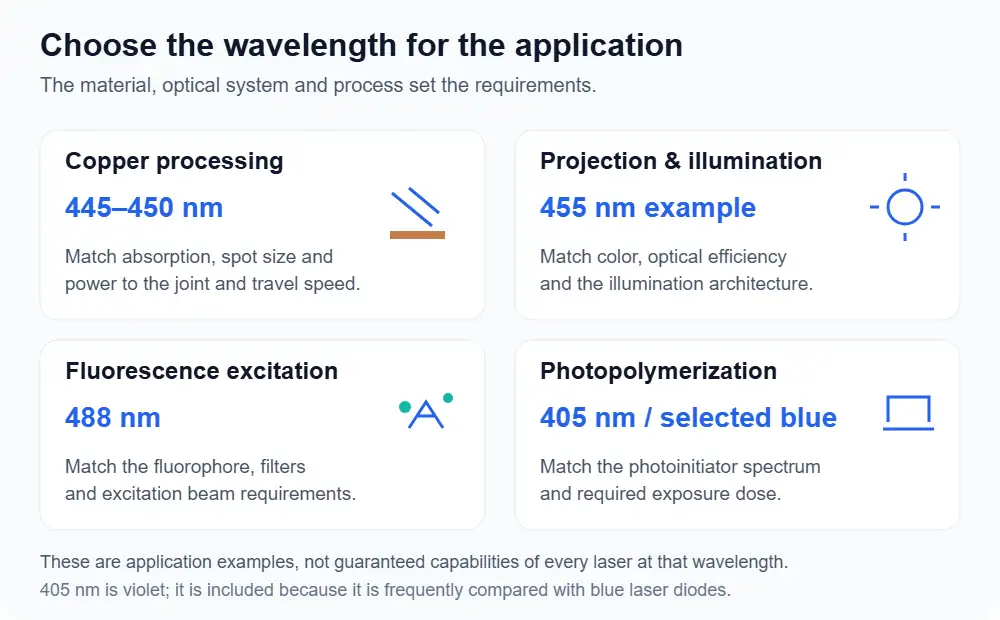
These are application examples. Wavelength alone does not determine suitability, power capability or achievable process results. Color labels are approximate.
What are blue laser diodes used for?
Copper welding and material processing
Blue light can couple more strongly into copper than near-infrared light under comparable initial surface conditions. This can help initiate and control heating, but the result depends on the alloy, surface condition, spot size and process.
Hummel and colleagues investigated a 450 nm, nominally 150 W diode laser for copper micro-welding, including Cu-ETP and CuSn6 specimens. Their study examined absorption, weld geometry and melt-pool behavior rather than treating wavelength as a complete process specification. Original research paper.
The alloy and the condition of its surface affect absorption. When comparing blue, green and infrared lasers for a joint, compare delivered spot size and weld quality on representative samples.
Projection and phosphor-converted illumination
In an RGB projector, the blue laser supplies one of the three primary colors. In a phosphor-based light source, the phosphor absorbs part of the blue light and emits at longer wavelengths. The first design makes the blue color specification particularly important; the second also depends on how well the laser spectrum overlaps the phosphor’s absorption band.
Fluorescence excitation and flow cytometry
In flow cytometry, the excitation wavelength and detection filters work together. In a study using a single 488 nm excitation laser, researchers distinguished two fluorescent proteins by selecting filters for their emission bands. A nearby blue wavelength is useful only if it still excites the intended fluorophore efficiently.
A resin qualified for 405 nm may respond differently at 445 or 450 nm. Check the photoinitiator’s absorption spectrum and the exposure dose needed to reach the desired cure depth. For an experimental example, see measurements of curing parameters in commercial photopolymers.
How to choose a blue laser diode
Specify optical power at the point of use
Start with the optical power you need at the workpiece or sample. Divide that value by the fraction of light your delivery optics transmit:
Required source power = Target optical power ÷ Optical transmission
For example, delivering 24 W through a path with 80% transmission requires 30 W at the source. This is a calculated example; use measured or specified transmission for the actual optics. Keep electrical input watts, optical output watts and heat dissipation separate in your specification.
Compare spot size and beam quality
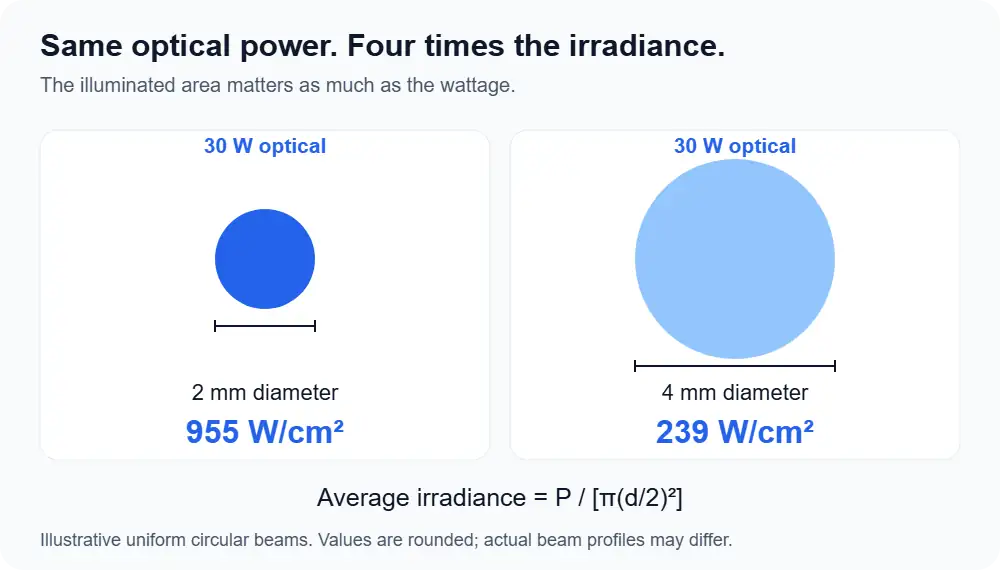
Two blue lasers with the same optical power can produce very different irradiance at the target.
For an illustrative uniform circular beam: Average irradiance = P / [π(d/2)²]
Here, P is optical power and d is beam diameter. At 30 W, a 2 mm diameter gives approximately 955 W/cm². Increasing the diameter to 4 mm reduces the average irradiance to approximately 239 W/cm². Doubling the diameter increases the area fourfold.
Actual beams may be elliptical, Gaussian or multimode, so specify how the beam diameter is measured and obtain beam-profile data where it matters. Our guide to laser beam quality explains how beam quality affects focusing.
Read fiber core and numerical aperture together
Fiber core diameter is a geometric dimension; numerical aperture describes an angular acceptance or output specification. Neither value, alone, gives the focused spot size. The delivery optics and output beam distribution also matter.
Check what an NA value actually describes. The ephotonics 60 W datasheet lists a fiber NA of 0.22 and a separate NA of 0.14 containing 95% of the power. These values describe different properties and should retain their labels in a comparison. 60 W module datasheet.
Confirm stability and operating conditions
Specify wavelength tolerance, spectral width, optical power stability, spatial mode and modulation requirements separately. A “single-mode” label does not automatically establish single-frequency operation. Compare specifications at their stated current and temperature. For a temperature-sensitive optical design, include the expected operating range and review laser diode wavelength and temperature tuning.
Driver and cooling requirements for blue laser diodes
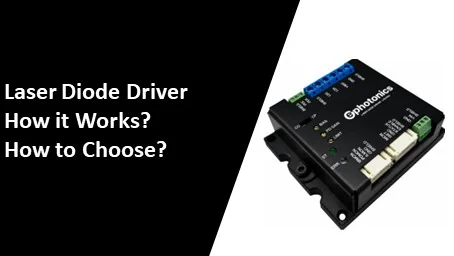
A blue laser diode requires controlled current. Select a driver with the appropriate current range, resolution, noise performance and protection behavior. Constant-current control regulates diode current; constant-power control requires compatible optical feedback and a suitable control loop. Not every diode package includes a monitor photodiode. ephotonics laser diode driver guide.
The driver must also have sufficient compliance voltage: the maximum voltage it can supply to the load while regulating current. Check the diode’s required voltage across operating conditions, the wiring losses and the driver’s input-supply requirements.
Use the laser diode driver compliance calculator as an initial check, then verify the result against the actual datasheets.
Check modulation and protection
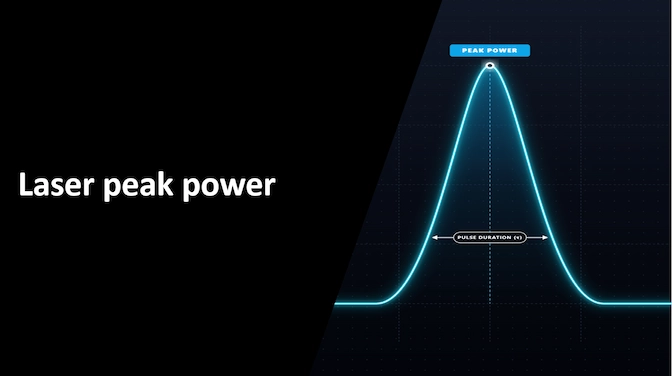
For pulsed or modulated operation, specify peak current, pulse width, repetition rate, duty cycle and required rise and fall times. A TTL or PWM input does not, by itself, establish arbitrary pulse performance or permission to exceed a diode’s current limits.
Review turn-on and turn-off behavior, current limiting, interlocks and fault handling. Brief current overshoot can exceed the diode rating even when the steady current is within limits. See our guide to driver noise and transients.
Size cooling from the thermal load
At steady state, an approximate energy balance at the diode-module boundary is:
Heat to remove ≈ Electrical input power − Optical output power
A hypothetical module taking 100 W electrically and emitting 30 W optically releases approximately 70 W as heat. Driver losses and the cooler’s own electrical consumption are additional system loads.
A thermistor measures temperature; it does not remove heat. A TEC controller regulates a thermoelectric cooler using temperature feedback, and the TEC’s hot side must reject both the pumped heat and its electrical input. Use the cooling method and temperature limits specified for the module.
Compare laser diode drivers and, where appropriate, TEC controllers as parts of the same integration task.
High-power blue lasers also require an appropriate laser safety design. Class 4 beams can injure eyes or skin through direct, reflected or scattered radiation. Incorporate the specified engineering controls and operating procedures into the system design. Health Canada laser safety guidance.
ephotonics blue and violet laser diode comparison
The table compares ephotonics’ 445 nm blue modules by optical output, fiber core, and numerical aperture. It also lists two 405 nm violet options separately. Use the individual product pages to check driver requirements, cooling, and fiber termination before ordering.
| Product code | Wavelength | Catalog power | Fiber core | Fiber NA | Connection |
|---|---|---|---|---|---|
| 445 nm · Blue | |||||
| K445H03FN-4.000WN0N | 445 nm | 4 W | 105 µm | 0.22 | Fiber Out |
| K445HR7FN-50.00W | 445 nm | 50 W | 113 µm | 0.15 | Fiber Out |
| K445HB0FA-60.00W | 445 nm | 60 W | 50 µm | 0.22 | Fiber Out |
| K445HR7FN-75.00W | 445 nm | 75 W | 105 µm | 0.22 | Fiber Out |
| K445HR6FN-100.0WN1N | 445 nm | 100 W | 105 µm | 0.22 | Fiber Out |
| K445HR6FN-150.0WN1N | 445 nm | 150 W | 105 µm | 0.22 | Fiber Out |
| K445HR6FN-200.0WN1N | 445 nm | 200 W | 105 µm | 0.22 | Fiber Out |
| K445HR6FN-250.0W | 445 nm | 250 W | 105 µm | 0.22 | Fiber Out |
| 405 nm · Violet | |||||
| K405E03CN-0.160W | 405 nm | 160 mW | 40 µm | 0.22 | Pluggable |
| K405EMSCN-30.00WN1N-400 | 405 nm | 30 W | 400 µm | 0.22 | Pluggable MF |
Swipe horizontally to view all columns.
Values are from the ephotonics fiber-coupled diode catalog. For the 50 W model, confirm the fiber configuration when ordering: the catalog lists 113 µm and NA 0.15, while other published specifications differ.
When to choose a complete blue diode laser system
A fiber-coupled diode module is a good fit when you want to integrate the laser with your own driver, cooling and controls. If you need a more integrated laser source, compare complete blue diode laser systems. Check the fiber core, cooling requirements and control interfaces for your setup.
| Nominal wavelength | Optical output | Fiber core |
|---|---|---|
| 445 nm | 250 W | 105 µm |
| 445 nm | 500 W, 800 W or 1,000 W | 200 µm |
| 450 nm | Up to 2,000 W | 600 µm |
Frequently Asked Questions
Can I substitute a 445 nm laser diode for a 450 nm laser diode?
Sometimes. Compare the guaranteed wavelength range at the intended operating current and temperature. If the application uses a narrowband filter or depends on a material’s absorption, check that the replacement spectrum still fits.
Is a 405 nm laser diode blue or violet?
405 nm is violet. A resin, optical filter or fluorescent dye selected for 405 nm may respond differently at 445 nm or 450 nm. Use the response spectrum for the specific material or component.
How do I choose a driver for a blue laser diode?
Check the diode’s operating current, the driver’s compliance voltage and the required modulation or pulse timing. For a multi-emitter module, confirm the electrical configuration before choosing the driver. See our laser diode driver guide.
Does fiber core diameter determine the focused spot size?
Core diameter is one input. The delivery optics and the angular distribution of light leaving the fiber also affect the spot. Compare these parameters together in our fiber-coupled laser diode catalog.
Does a blue laser diode need active cooling?
Check the module’s rated operating temperature and how much heat it needs to dissipate. Some modules specify a cold plate or liquid cooling. A thermistor measures temperature; the cooling hardware removes heat.
Did You Know?
- Center wavelength and spectral width are different. A center-wavelength tolerance tells you where the spectrum can be centered; FWHM describes the width of that spectrum at half its peak.
- Two beams with the same power can heat a surface differently. Halving the diameter of a uniform circular spot quadruples its average irradiance at the same power.
- A fiber’s NA and the NA containing 95% of output power can differ. The ephotonics 60 W module datasheet lists 0.22 for the fiber NA and 0.14 for the NA containing 95% of the power.
- Temperature can shift the laser’s wavelength. If the wavelength matters to a filter or excitation band, compare specifications at the intended temperature. See our guide to wavelength and temperature tuning.