
How Snell's Law Calculator Works
Snell's Law (the law of refraction) describes the exact mathematical relationship between the angles of incidence and refraction when light passes across the boundary between two different isotropic media (such as air and glass).
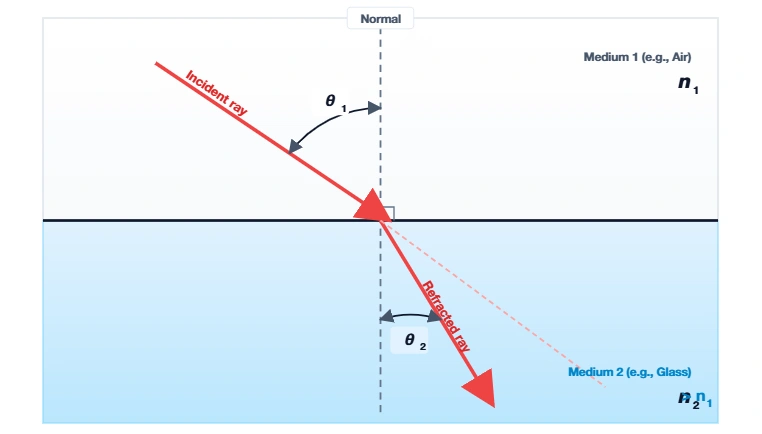
Depending on which three variables are known, the fundamental equation (n1 · sinθ1 = n2 · sinθ2) can be algebraically rearranged to solve for the missing parameter:
θ1 = sin-1 (
1. Incident Angle (θ1)
n2
n1
· sinθ2 )
θ2 = sin-1 (
2. Refracted Angle (θ2)
n1
n2
· sinθ1 )
n1 = n2 ·
3. Incident Index (n1)
sinθ2
sinθ1
n2 = n1 ·
4. Refracted Index (n2)
sinθ1
sinθ2
Understanding the Variables:
- n1 Incident Index: The refractive index of the starting material (e.g., Air ≈ 1.00).
- n2 Refracted Index: The refractive index of the target material (e.g., Fused Silica ≈ 1.45).
- θ1 Incident Angle: The angle of the incoming ray, measured relative to the surface normal (perpendicular axis).
- θ2 Refracted Angle: The angle of the transmitted ray, measured relative to the surface normal.
Total Internal Reflection (TIR)
If light attempts to travel from a high-index material to a low-index material (n1 > n2) at a very steep angle, the calculated refracted angle (θ2) may become mathematically impossible (sinθ > 1). In this scenario, the calculator will return an error because the light cannot exit the material; 100% of it reflects backward, acting as a perfect mirror.