Laser Beam Expander Calculator

Magnification Ratio · Output Beam Diameter

X

mm
mrad
m
Output Diameter
---mm
Output Divergence
---mrad
Magnification
---X
Dia. at Target Dist.
---mm
Waiting for distance input...

ephotonics

linkedin.com/company/ephotonics

Follow our page for weekly laser engineering guides, photonics tutorials, and new calculator releases directly in your feed.

Follow on LinkedIn

How the Laser Beam Expander Works

A laser beam expander is essentially a reversed telescope. Its primary function in optical engineering is to take a collimated input beam and increase its diameter, resulting in a larger collimated output beam.

The fundamental rule of Gaussian optics dictates that beam diameter and beam divergence are inversely related. By actively expanding the beam diameter, you proportionally reduce its divergence angle, which allows the laser beam to travel significantly longer distances without spreading out and losing power density.

$$ D_{out} = M \cdot D_{in} $$

$$ \theta_{out} = \frac{\theta_{in}}{M} $$

Beam Expansion & Divergence Equations

Where:

  • \(M\) (Magnification Power): The expansion ratio. This is calculated by taking the absolute ratio of the output to input lens focal lengths (\(|f_2 / f_1|\)).
  • \(D\) (Beam Diameter): The width of the beam at the lens, typically measured at the 1/e² intensity clip level.
  • \(\theta\) (Beam Divergence): The full-angle spread of the laser beam, usually measured in milliradians (mrad).
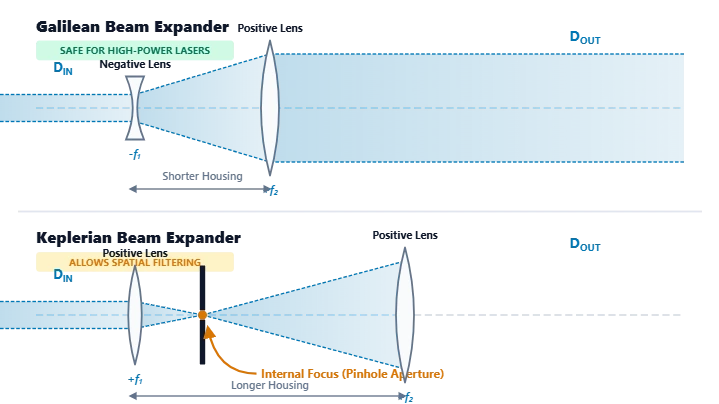
Schematic diagram comparing Galilean and Keplerian laser beam expander optical designs
Figure 1: A comparison of Galilean and Keplerian beam expander designs. The Galilean design avoids an internal focal point, making it safer for high-power lasers.

Galilean vs. Keplerian Expander Designs

There are two primary optical designs used to construct a beam expander. Your choice dictates the physical length of your optical train and its power handling limits:

  • Galilean Telescope: Uses one negative (concave) input lens and one positive (convex) output lens. Because it does not create an internal focal point, the physical length is shorter. It is heavily preferred for high-power lasers because avoiding an internal focus prevents air breakdown (plasma arcing) inside the expander housing.
  • Keplerian Telescope: Uses two positive (convex) lenses, which creates an internal focal point between the lenses. While this makes the housing physically longer, it allows engineers to perform spatial filtering. By placing a microscopic pinhole exactly at the internal focal point, you can strip away stray light and "clean up" the Gaussian beam profile.

Why Use a Laser Beam Expander?

At first glance, it seems completely counterintuitive to take a precisely collimated laser beam and intentionally make it larger. However, in optical engineering, a laser beam expander is the fundamental tool required to achieve incredibly tight focal spots and to propagate beams over vast, multi-kilometer distances.

The Engineering Purpose of Beam Expansion
  • Reduced Spot Size: Expanding a beam prior to a focusing lens allows for a drastically smaller final focal spot.
  • Long-Range Pointing: Increasing beam diameter proportionally decreases beam divergence, keeping the beam tight over long distances.
  • Protecting Optics: Spreading the beam's energy over a larger area reduces the power density (W/cm²), protecting downstream mirrors from thermal damage.
  • Aperture Matching: Sizes the beam perfectly to fill the clear aperture of optical modulators or galvo scanners.

Critical Applications in Optical Engineering

1. Achieving Micron-Scale Spot Sizes

According to Gaussian beam physics, the focused spot size is inversely proportional to the input beam diameter. If you use a 5x beam expander to enlarge your laser, your final focusing lens will generate a spot that is exactly 5 times smaller.

2. LiDAR & Aerospace Targeting

For long-range propagation, natural beam divergence causes lasers to spread out too much. A beam expander acts as a collimator, reducing the divergence angle by the exact magnification factor (M), maintaining signal strength over kilometers.

3. High-Power Laser Safety (LIDT)

Industrial cutting lasers have immense raw power. By expanding the beam, the optical energy is distributed across a larger surface area, keeping the peak Irradiance below the Laser-Induced Damage Threshold (LIDT) of expensive internal mirrors.

4. Laser Scanning & Marking

To maximize the resolution of a laser marking system, the beam must perfectly fill the mirrors of the galvanometer scanner. Beam expanders act as the "sizing adapter" between the raw laser diode and the scanning head.

Master your optical engineering workflow. Follow ephotonics on LinkedIn for weekly tutorials and new calculator releases.
in
Follow ephotonics
Related Optical Calculators

Consult with an Expert

Get a formal quote