Why Calculating Laser Spot Size is Critical
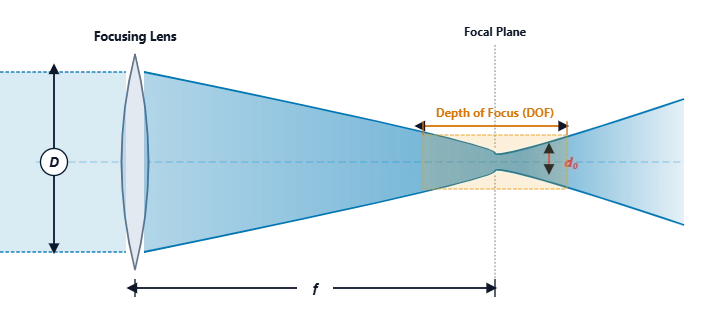
In precision optical engineering, determining the exact laser spot size is the most fundamental step in designing a beam delivery system. A laser beam does not focus to an infinitely small mathematical point; rather, it converges to a finite "waist" dictated by the laws of diffraction. This minimum waist diameter (\(2w_0\)) directly governs the maximum optical power density your system can achieve.
The Engineering Impact of Spot Size- Exponential Irradiance: Halving the laser spot size increases the power density (fluence) by exactly 400%.
- Thermal Management: A tighter focused spot minimizes the Heat Affected Zone (HAZ) in adjacent materials.
- Fiber Coupling: Maximizing insertion efficiency requires matching the spot size to the fiber's Mode Field Diameter (MFD).
- Diffraction Limits: Helps verify if your optical train is operating near the theoretical physical limit.
The Physics of the Focused Laser Beam
Understanding the theoretical laser beam spot size allows engineers to predict real-world material interactions. Whether you are ablating steel in an industrial setting or utilizing two-photon excitation in a laboratory, the entire process is governed by spatial energy confinement.
The tradeoff for extreme energy confinement is the Rayleigh Range. The tighter you focus the laser spot size, the shorter your Depth of Focus (DOF) becomes. This strict inverse relationship means optical engineers must constantly balance peak intensity against Z-axis alignment tolerances using a laser spot size calculator.
High-Precision Applications
1. Industrial Material Processing
In laser cutting, welding, and engraving, throughput is driven by power density. Calculating a smaller laser spot size guarantees a narrower kerf width and cleaner edge quality.
2. Biomedical & Laser Surgery
In precision biomedical applications like ophthalmology, surgeons rely on specific localized fluences that are only safely achievable with a rigidly verified focal spot size.
3. Microscopy & Imaging
In confocal microscopy, the laser spot size dictates the absolute resolution limit. A diffraction-limited spot ensures high-fidelity cellular data and a superior Signal-to-Noise Ratio (SNR).
4. Fiber Optics & Photonic ICs
To prevent signal loss and back-reflection, the focused laser spot size must perfectly overlap with the target waveguide's core diameter.
What determines your minimum Laser Spot Size?
According to Gaussian propagation equations, three primary optical parameters restrict how tightly you can focus a beam:
1. Input Beam Diameter (\(D\)): Counterintuitively, expanding the incoming beam diameter *reduces* the final focused spot size.
2. Lens Focal Length (\(f\)): Short focal length lenses generate smaller spots, but severely compress the usable Depth of Focus.
3. Beam Quality (\(M^2\)): An \(M^2\) of 1.0 represents a perfect Gaussian beam. Higher \(M^2\) values (typical in multimode diodes) geometrically inflate the final spot size.
Master your optical engineering workflow.
Follow ephotonics on LinkedIn for weekly tutorials and new calculator releases.
Related Optical Calculators