
How the Duty Cycle Calculator Works
Duty Cycle represents the fraction of time a system is activ or "on" compared to the total duration of a single cycle. It is a fundamental concept used in both electronics (Pulse Width Modulation) and photonics (pulsed lasers) to determine how much average power is being delivered over time.
$$D = \left( \frac{\tau}{T} \right) \times 100\% \quad \text{or} \quad D = \left( \frac{P_{avg}}{P_{peak}} \right) \times 100\%$$
Duty Cycle Formulas (Time-Based & Power-Based)Where:
- \(D\) Duty Cycle (%).
- \(\tau\) Pulse Width or On-Time (seconds).
- \(T\) Total Period (seconds), which equals \(1 / \text{Frequency}\).
- \(P_{avg}\) Average Power (Watts).
- \(P_{peak}\) Peak Power (Watts).
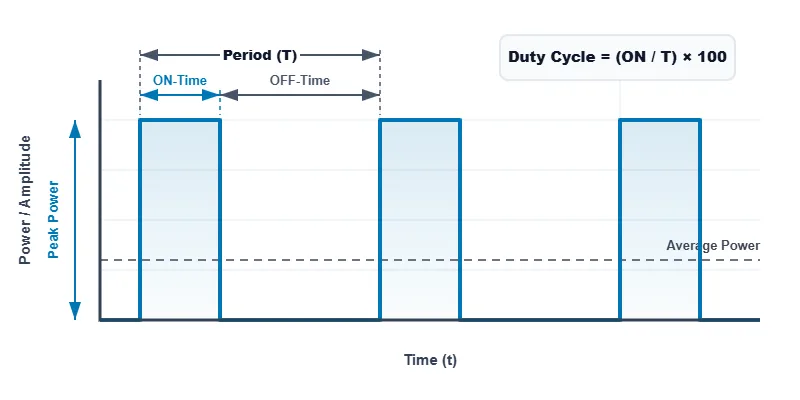
Figure 1: A visual representation of a pulse train. The Duty Cycle is the ratio of the Pulse Width (\(\tau\)) to the Total Period (T). If the pulse is on for 2ms and off for 8ms, the total period is 10ms, resulting in a 20% duty cycle.
Quick Reference
- 0% DC: The system is completely off (no power delivered).
- 50% DC: A perfect square wave. The system is active exactly half the time.
- 100% DC: Continuous operation (Continuous Wave / CW). Average power equals Peak power.
- Thermal Management: In lasers, a very low DC value allows for incredibly high peak powers (megawatts or gigawatts) while keeping average thermal power low enough to avoid melting components.
Typical Duty Cycles by Application
Linear scale representing the percentage of ON-time vs OFF-time.
0%
20%
40%
60%
80%
100%
Mode-locked Lasers
LIDAR Systems
Servo Motor PWM
Laser Ablation
Square Wave AC
LED Dimming (High)
CW Laser (Always On)
Source: Typical parameters vary heavily depending on specific hardware and configuration.