Wall-Plug Efficiency Calculator
Optical Power · Electrical Input · Conversion Efficiency
Compute the true electro-optical efficiency of your laser diode.
High-Efficiency Laser Diodes
Browse the catalog
ephotonics
@ephotonics
Weekly laser engineering guides and new calculators released directly in your feed.
Follow on LinkedInHow the Wall-Plug Efficiency Calculator Works
Wall-Plug Efficiency (WPE), also known as overall electro-optical efficiency, measures the ability of a laser diode to convert electrical input power directly into useful optical output power.
Because energy cannot be destroyed, any electrical energy that is not converted into light is expelled as Waste Heat. Calculating the WPE is a critical first step in sizing laser diode drivers and thermal management systems.
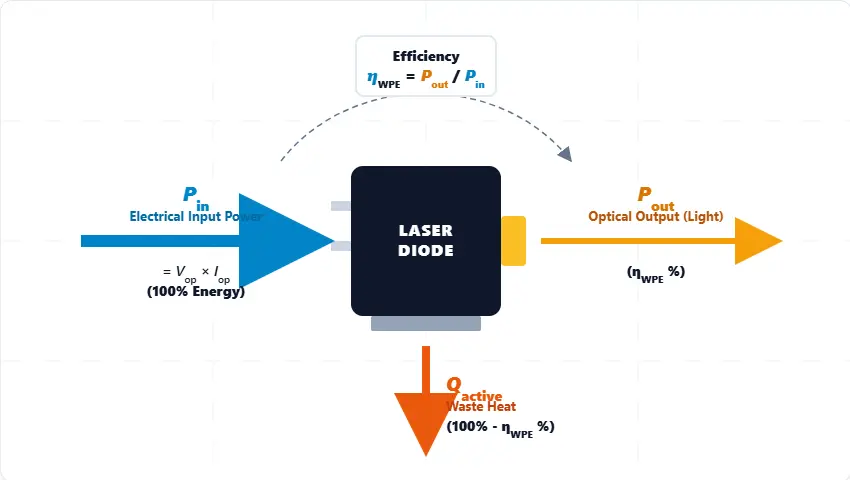
Understanding the Variables:
- ηWPE Wall-Plug Efficiency: The percentage of electrical power converted to light. (e.g., modern high-power diode lasers often range from 40% to 60%).
- Pout Optical Output Power: The actual laser beam power emitted (in Watts).
- Vop Operating Voltage: The forward voltage drop across the diode at the operating current.
- Iop Operating Current: The drive current supplied to the laser diode.
- Qactive Waste Heat: The thermal load generated by the inefficiency of the diode.
Why Calculate Wall-Plug Efficiency?
In laser system design, Wall-Plug Efficiency (WPE) is the ultimate metric of performance. While optical output power dictates how well a laser can cut, weld, or transmit data, the WPE dictates the entire electrical and thermal architecture of your system. Understanding your electro-optical conversion efficiency is the only way to accurately size your power supplies and cooling modules.
- WPE vs Waste Heat: Every watt of electrical power that is not converted into light becomes thermal waste.
- Cooling dominates cost: Low-efficiency lasers require massive heatsinks or TECs, significantly increasing system size and cost.
- Thermal Rollover: As lasers heat up, efficiency drops, creating a dangerous feedback loop if uncooled.
- Power supply sizing: You cannot select a laser diode driver without knowing the total electrical input required.
Why Wall-Plug Efficiency Matters
1. Thermal Management & TEC Sizing
A 50W optical laser with 50% WPE generates 50W of waste heat. The exact same 50W laser at 25% WPE generates a massive 150W of waste heat! You must calculate WPE to determine the exact thermal load before selecting a Peltier (TEC) module or designing a heatsink.
2. Avoiding Thermal Rollover
Laser diodes are highly sensitive to temperature. If waste heat isn't extracted fast enough, the diode's internal junction temperature spikes. This causes the threshold current to rise and efficiency to plummet, eventually leading to thermal rollover and catastrophic diode failure.
3. Laser Diode Driver Selection
To produce a specific optical output, you need to know exactly how much voltage and current to supply. Calculating the WPE ensures you select an OEM laser diode driver with the correct compliance voltage and current limits to safely operate the diode without clipping.
4. System Portability & SWaP
For LiDAR, aerospace, and medical devices, Size, Weight, and Power (SWaP) are critical engineering constraints. High wall-plug efficiency allows for smaller battery packs and passive cooling (eliminating noisy fans or water chillers), making compact, portable photonics systems possible.