
How the Photon Energy Calculator Works
Light is fundamentally made up of individual packets of energy called photons. According to the Planck-Einstein relation, the energy of a single photon is directly proportional to its frequency and inversely proportional to its wavelength.
Physical Constants Used
- E Photon Energy: The resulting energy of the light particle, measured in Joules (J).
- h Planck's Constant: A fundamental universal constant, exactly 6.62607015 × 10⁻³⁴ J·s.
- c Speed of Light: The speed at which photons travel in a vacuum, exactly 299,792,458 m/s.
- λ (Lambda) Wavelength: The physical distance between wave peaks.
- f Frequency: The number of wave cycles per second.
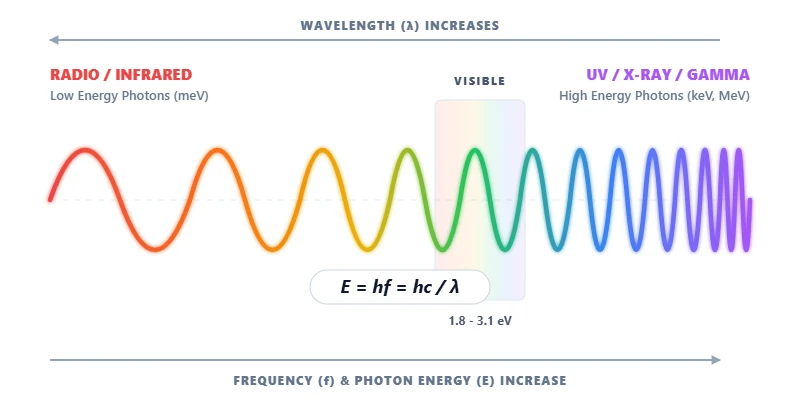
The Electron-Volt (eV) Conversion
Because the energy of a single photon measured in Joules is unfathomably small (usually on the order of 10-19 Joules), physicists and photonics engineers almost exclusively use Electron-Volts (eV) instead. One electron-volt is defined as the amount of kinetic energy gained by a single electron accelerating from rest through an electric potential difference of one volt.
Quick Rule of Thumb: Visible light photons carry energies ranging roughly from 1.8 eV (Red light) to 3.1 eV (Violet light). If your calculated energy is far outside this range, you are likely looking at the infrared or ultraviolet spectrum.