Laser Heat Transfer Calculator
How it works?
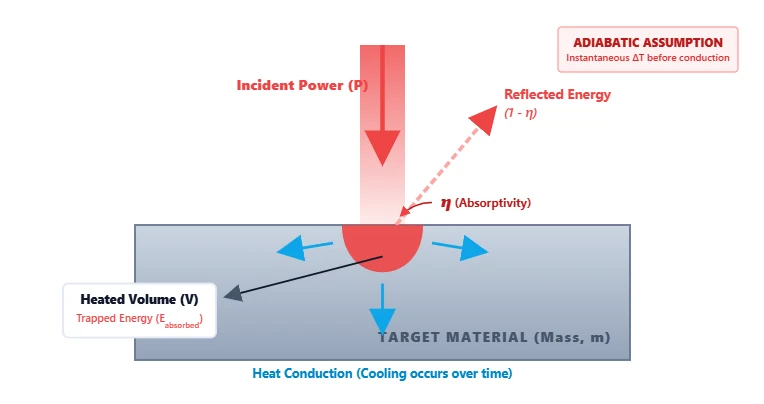
This calculator estimates the temperature rise using the principle of Adiabatic Calorimetry. It assumes that all the absorbed laser energy is trapped within the illuminated volume and does not yet have time to conduct away into the bulk material.
This calculation depends on:
- Absorbed Energy (Q): Total energy ($P \times t \times \eta$) that actually enters the material.
- Mass (m): The heated mass, calculated as $\text{Density} (\rho) \times \text{Volume}$.
- Specific Heat (cp): Energy required to raise 1 gram of material by 1 degree Celsius.
- Absorptivity (η): The percentage of laser light absorbed vs. reflected (e.g., 0.1 for 10%).
By providing these inputs, the calculator approximates the instantaneous temperature rise. Note that in real-world scenarios, thermal conduction begins cooling the spot immediately, so this calculator provides the "Upper Limit" temperature.
Why Calculate Laser Heat Transfer?
- Laser Cutting/Welding: Determine laser power for precise material ablation.
- Additive Mfg.: Optimize laser scan speed for sintering powders.
- Medical Lasers: Control thermal effects for surgery (coagulation vs. ablation).
- Optics Lifetime: Prevent damage to lenses/mirrors from excessive absorption.
Understanding Laser Absorption
The key to laser material processing is how much energy the target absorbs. A highly reflective metal like Copper or Aluminum needs a very different laser setup compared to a highly absorbent material like a semiconductor or black plastic.
The Absorptivity (η) dictates how much of the incident laser power (P) actually contributes to heating. This absorbed energy (Q = P × t × η) is then distributed throughout the heated volume based on the material's Density (ρ) and Specific Heat (cp).
1. Machining Precision
To achieve a clean laser cut vs. a molten blob, you need to exceed the material's vaporization point within the laser's spot size. This calculator helps determine if your parameters are correct for high-aspect ratio features.
2. Thermal Management
Even a small absorption percentage (e.g., 0.1%) can drastically increase optic temperatures. Knowing the expected heat load is essential for designing cooling systems or selecting optics with sufficient damage thresholds.
3. Medical Ablation
In laser eye surgery (LASIK) or skin resurfacing, the goal is precise material removal via rapid vaporization. This requires delivering enough energy density to reach the boiling point without causing collateral thermal damage.
4. 3D Printing (Additive Mfg)
Selective Laser Melting (SLM) or Sintering (SLS) requires careful control. You need enough energy to fuse the powder, but not so much that it vaporizes or causes excessive thermal stress and warping.
Thermal Lensing Note
When a high-power laser passes through a lens, even 0.1% absorption heats the glass. This slight temperature rise changes the refractive index (dn/dT) and expands the lens, creating a "Thermal Lens" that shifts the focus and degrades beam quality (M²).