How the dBm to Watts Calculator Works
In radio frequency (RF) and telecommunications, power levels span massive ranges. To avoid writing out dozens of zeros, engineers use dBm a logarithmic unit that indicates power ratio in decibels (dB) referenced to exactly 1 milliwatt (mW).
This calculator reverses that logarithm to output the linear physical power.
P(mW) = 10 (P(dBm) / 10)
Step 1: Convert to MilliwattsKey Variables
- P(dBm) Input Power: The logarithmic power level provided by your measurement equipment.
- P(mW) Linear Milliwatts: The physical power in thousandths of a Watt.
- P(W) Linear Watts: The standard SI unit for measuring absolute physical power.
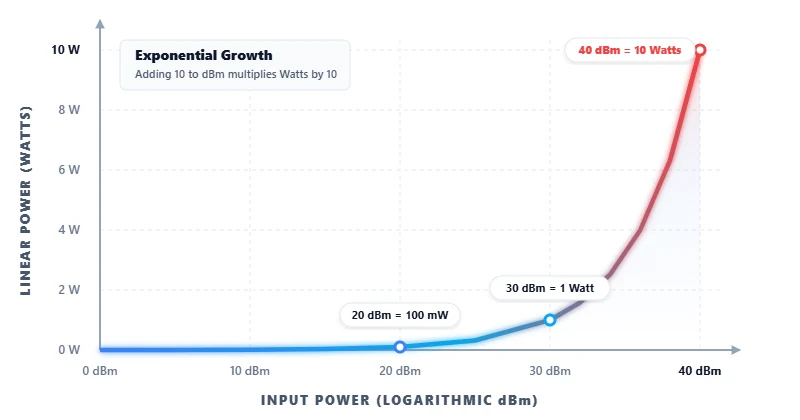
Figure 1: Visual representation of the exponential relationship between dBm and Watts. A steady linear increase on the dBm scale results in a massive exponential increase in physical output power (Watts).
Quick Mental Math Reference
Because the dBm scale is logarithmic, you can memorize a few simple rules of thumb to do conversions in your head without a calculator:
- 0 dBm = exactly 1 mW (the baseline reference point).
- +10 dBm = 10× the power. (e.g., 10 dBm = 10 mW; 20 dBm = 100 mW; 30 dBm = 1 W).
- +3 dBm = double the power. (e.g., 3 dBm ≈ 2 mW; 33 dBm ≈ 2 Watts).
- -3 dBm = half the power. (e.g., -3 dBm ≈ 0.5 mW).
