
How the Rayleigh Range Calculator Works
In Gaussian beam optics, lasers do not focus down to an infinitely small point, nor do they stay perfectly collimated forever. Instead, they focus down to a narrow Beam Waist (w0) and then slowly expand.
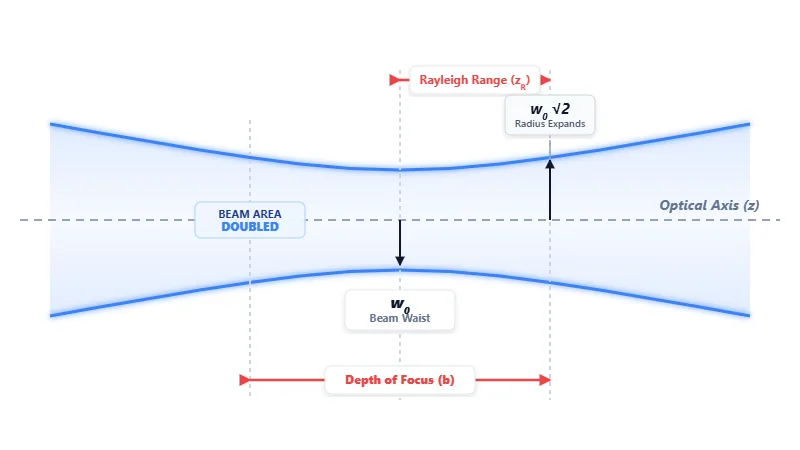
The Rayleigh Range (zR), also called the Rayleigh Length, is the distance along the beam axis from the narrowest focal point to the place where the cross-sectional area of the beam has doubled. Practically, it defines the zone where a laser beam is considered "collimated" or usable for cutting and precision imaging.
Key Variables
- zR Rayleigh Range: The distance from the focal waist to the point where the beam area is exactly doubled.
- w0 Beam Waist Radius: The radius of the laser at its narrowest point. (Note: Many beam profilers output the Spot Diameter [2w0], so be sure to divide by two or use our calculator toggle to avoid errors).
- λ Wavelength: The wavelength of the laser light. Shorter wavelengths result in longer Rayleigh ranges.
- n Refractive Index: If the laser is traveling through a vacuum or air, this is ~1.0. If focused inside glass, water, or crystal, the Rayleigh range scales linearly with the index of the material.
- b Depth of Focus: Twice the Rayleigh range. Also known as the confocal parameter.
The Resolution vs. Depth Trade-off
In laser processing and optical microscopy, engineers face a constant battle with the physical limits of diffraction. Looking at the formula above, you can see that the Rayleigh range is proportional to the square of the beam waist (w02).
If you try to focus a laser to be extremely tiny (small waist) to get higher precision, the Rayleigh Range shrinks drastically. This means the beam expands very quickly after focusing, resulting in a microscopic Depth of Focus. If your target material shifts by just a fraction of a millimeter, the laser will be completely out of focus.