
How the Ohms to Volt-Ampere Calculator Works
In electrical engineering, Apparent Power is measured in Volt-Amperes (VA). Converting Resistance (Ohms) directly to VA requires a second variable—either Voltage or Current. This calculation is essential for sizing electrical infrastructure like transformers, UPS systems, and power supplies for industrial laser systems.
$$S = \frac{V^2}{R} \quad \text{or} \quad S = I^2 \times R$$
Apparent Power (VA) FormulasWhere:
- \(S\) Apparent Power in Volt-Amperes (VA).
- \(V\) Root Mean Square (RMS) Voltage in Volts (V).
- \(I\) RMS Current in Amperes (A).
- \(R\) Resistance in Ohms (Ω).
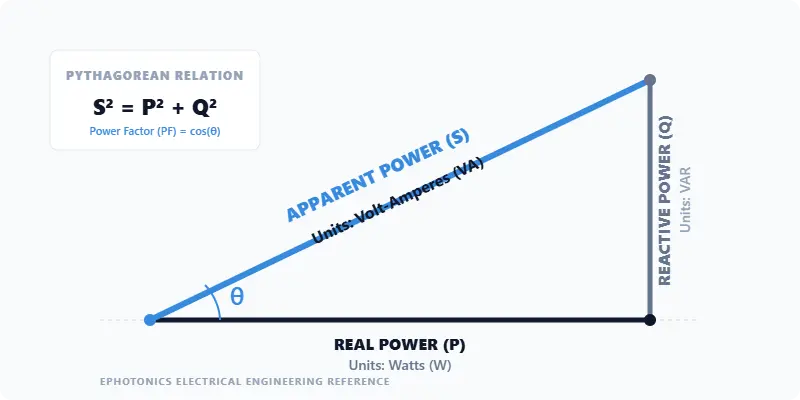
Figure 1: The Electrical Power Triangle. While Ohms relate to the resistance of the load, the VA value represents the total "apparent" load seen by the power source. In AC circuits, this value is often higher than the actual Watts consumed due to reactive components.
VA vs. Watts: The Difference
- Real Power (Watts): The actual energy performing work (e.g., turning a motor, heating a laser facet).
- Apparent Power (VA): The total product of Voltage and Current. It is used to specify the capacity of wires, circuit breakers, and transformers.
- Purely Resistive: In a DC circuit or a purely resistive AC load, VA is equal to Watts.
- Efficiency: Equipment with a low "Power Factor" draws more VA than the Watts it actually uses, requiring thicker cables.
Typical Apparent Power (VA) Requirements
Logarithmic scale of power capacity for common hardware
VA
kVA
MVA
Optical Receiver
Server / Workstation
CW Fiber Laser (2kW)
Industrial Laser Cell
Distribution Transf.
Source: standard industrial equipment ratings and NEC electrical guidelines.