RLC Circuit Calculator
Resonance · Impedance · Quality Factor · Phase
ephotonics
linkedin.com/company/ephotonics
Follow our page for weekly engineering guides, photonics tutorials, and new calculator releases directly in your feed.
Follow on LinkedInHow the RLC Circuit Calculator Works
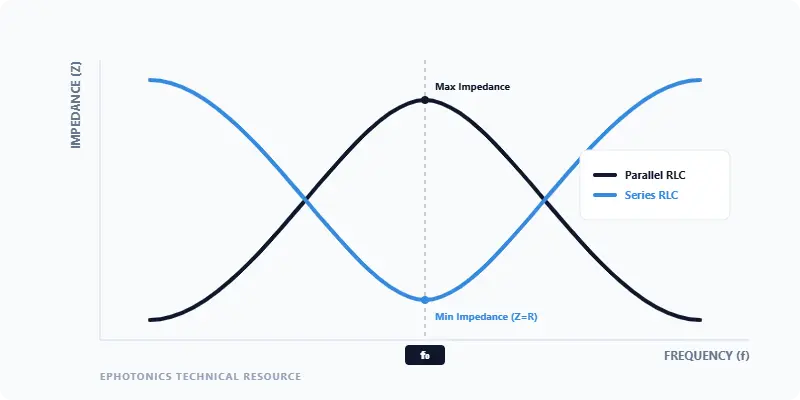
An RLC circuit is an electrical circuit consisting of a Resistor (R), an Inductor (L), and a Capacitor (C). Unlike simple resistive circuits, RLC circuits are frequency-dependent. This calculator determines the resonant frequency where the inductive and capacitive reactances cancel each other out, as well as the total impedance and quality factor.
Where:
- \(f_0\) Resonant frequency in Hertz (Hz).
- \(L\) Inductance in Henries (H).
- \(C\) Capacitance in Farads (F).
- \(\pi\) Mathematical constant approx. 3.14159.
Quick Reference
- Resonance: Occurs when Inductive Reactance (\(X_L\)) equals Capacitive Reactance (\(X_C\)).
- Quality Factor (Q): A dimensionless parameter that describes how under-damped an oscillator is. Higher Q means a sharper resonance peak.
- Phase Angle: Represents the shift between voltage and current. At resonance, the phase angle is 0° (purely resistive).
- Bandwidth: The range of frequencies for which the power is at least half the peak power.
Typical RLC Operating Frequencies by Application
Logarithmic scale showing the vast range of RLC circuit utility
Why Calculate RLC Circuit Parameters?
In the world of high-speed photonics and RF engineering, RLC circuits are the building blocks of signal processing. While a simple resistor limits current, the addition of Inductors (L) and Capacitors (C) introduces frequency-dependent behavior. Calculating resonance and impedance is critical to ensuring your system filters out noise or oscillates at the exact frequency required.
- Resonance Frequency (\(f_0\)): The specific point where Inductive and Capacitive reactances cancel out, resulting in a purely resistive load.
- Impedance (\(Z\)): Unlike pure resistance, impedance changes with frequency. Our calculator helps you visualize this for both series and parallel configurations.
- Quality Factor (Q): High Q-factors indicate low energy loss and a sharper resonance peak—vital for precision filtering.
- Phase Shift: Understanding the lead or lag between voltage and current is essential for timing in high-speed optical modulators.
The Role of Resonance in Engineering
1. Band-pass Filtering
RLC circuits are used to create filters that allow only a specific range of frequencies to pass. In telecommunications, this is how a receiver "tunes" into a specific channel while rejecting all other interference.
2. Impedance Matching
To maximize power transfer between a source and a load (like a laser diode driver and the diode itself), the impedances must be matched. RLC networks are used to bridge these gaps and prevent signal reflections.
3. Pulse Shaping
In pulsed laser systems, the electrical drive circuit often behaves like an RLC network. Proper damping (avoiding "ringing") is necessary to ensure the electrical pulse is clean, preventing damage to the laser facet.
4. Energy Storage
Inductors and capacitors store energy in magnetic and electric fields, respectively. An RLC circuit acts as a harmonic oscillator, swinging energy back and forth, which is the foundation of almost all clock generators.