
How the SAG Calculator Works
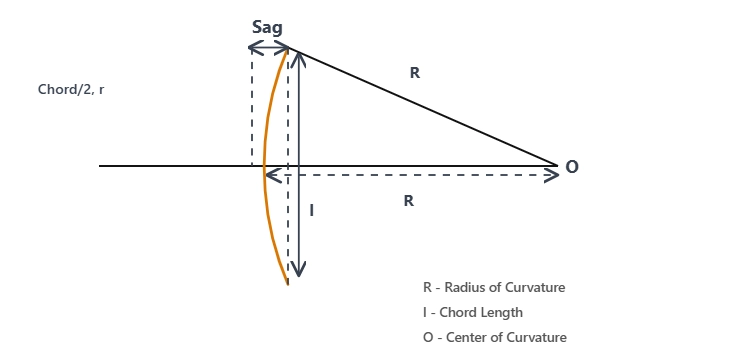
The sagitta (SAG) of a spherical optical surface is the axial depth from the vertex of the curved surface down to the plane of its clear aperture. It is the fundamental parameter that connects the radius of curvature and the aperture diameter of a lens — without it, center thickness, edge thickness and minimum blank size cannot be determined.
Where:
- s Sagitta (SAG) : the axial depth of the surface in mm.
- R Radius of curvature : the radius of the sphere that best fits the surface in mm.
- r Half-diameter : the semi-aperture, equal to half the clear aperture diameter D.
This is the exact formula, valid for any ratio of aperture to radius. The paraxial approximation s ≈ D² / 8R is commonly used in first-order design but introduces significant error when the aperture is large relative to the radius — typically when D/2R exceeds 0.1. This calculator always uses the exact formula.
Sign convention: For a convex surface the SAG is positive. For a concave surface the SAG is negative. The magnitude is identical for both, only the direction of the depth changes.