
Understanding NOHD and Laser Safety Zones
When integrating Class 3B and Class 4 laser diodes into industrial or scientific systems, establishing the Laser Controlled Area (LCA) is a regulatory requirement. The Nominal Ocular Hazard Distance (NOHD) calculation tells safety officers exactly how far a beam can travel before its power density dissipates to safe levels for the human eye.
ANSI Z136.1 and IEC 60825-1 standards dictate that if the beam can travel beyond the controlled room boundaries while still exceeding the Maximum Permissible Exposure (MPE), physical barriers, interlocks, or beam dumps must be installed to contain it.
IEC 60825-1 — Safety of Laser Products (Official Standard)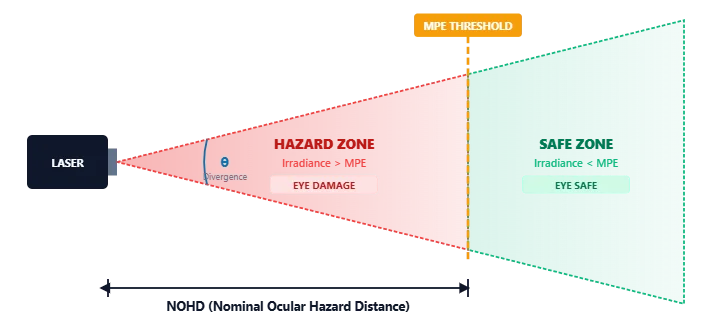
1. The Variables: What Drives Hazard Distance?
The NOHD is not static. It depends entirely on three physical properties of your light source. Understanding these allows system integrators to minimize the "danger zone" of their products.
A. Optical Power (\(\Phi\))
This is linear. More watts equals more danger. A 5W laser will obviously have a longer NOHD than a 500mW laser, assuming beam quality is identical. However, power is often the variable you cannot change, as your application requires it.
B. Beam Divergence (\(\theta\))
This is the most critical variable for safety.
- High Divergence (Safer): Raw laser diodes (without lenses) or fiber tips emit light in a wide cone (e.g., 200 mrad). The energy spreads out rapidly, meaning the NOHD might be only a few meters.
- Low Divergence (Dangerous): Collimated beams maintain their density over long distances. A perfectly collimated beam (e.g., 0.5 mrad) can remain hazardous for kilometers. This is why collimators are treated with extreme caution in regulatory classifications.
C. Maximum Permissible Exposure (MPE)
The MPE is not a fixed number; it is a biological threshold determined by the laser's wavelength and exposure duration.
- Retinal Hazard Region (400nm – 1400nm): Visible and Near-IR light passes through the cornea and focuses on the retina, amplifying the energy density by 100,000x. The MPE here is extremely low (very dangerous).
- Corneal Hazard Region (>1400nm): Wavelengths like 1550nm (Telecom) or CO2 lasers are absorbed by the cornea and lens. They do not reach the retina, so the MPE is often higher, though corneal burns are still a major risk.
2. The "Binocular Hazard": Extended NOHD
Standard NOHD calculations assume the "naked eye" (a 7mm aperture pupil). However, if a user views the beam through optics—such as binoculars, telescopes, or survey theodolites—the light collection area increases dramatically.
This is known as the Extended Nominal Ocular Hazard Distance (ENOHD). Optically aided viewing can increase the hazard distance by a factor of 7x to 10x (depending on the magnification optics). For outdoor laser rangefinders or LIDAR systems, safety officers must calculate the ENOHD to ensure public safety.
3. Laser Safety Classifications
High-power laser diodes from ephotonics typically fall into Class 3B or Class 4. Here is how they are defined by potential injury.
| Class | Typical Power | Safety Description |
|---|---|---|
| Class 1 | < 0.4 mW | Inherently safe. No NOHD calculation needed. (e.g., CD players). |
| Class 2 | < 1 mW | Visible lasers only. Protected by the blink reflex (0.25s). |
| Class 3B | 5 - 500 mW | Hazardous to the eye if viewed directly. Diffuse reflections are usually safe. |
| Class 4 | > 500 mW | Dangerous. Causes instant eye/skin damage. Fire hazard. Even diffuse reflections are hazardous. Strict LCA and interlocks required. |
4. Designing the Nominal Hazard Zone (NHZ)
The NHZ is the physical space where the level of direct, reflected, or scattered radiation exceeds the MPE.
When you install an ePhotonics Class 4 laser diode system, you must ensure that all points accessible to personnel are outside the NHZ. If the calculated NOHD is 10 meters, but your lab is only 5 meters long, the beam will be hazardous at the wall. You must use:
1. Beam Dumps: To terminate the beam safely within the optical table.
2. Laser Curtains: Certified to withstand the specific wavelength power density.
3. Door Interlocks: To cut power to the laser driver immediately if the lab door is opened.
Related Engineering Tools
Calculate the spread of your beam (mrad) based on diameter and wavelength.
Power Density (Fluence)Find the Watts/cm² at a specific target distance to see if it exceeds safety limits.
Optical Density to TransmissionVerify your safety goggles. Convert OD ratings into actual percentage transmission.