Laser Peak Power Calculator
Pulse Energy · Peak Intensity · Gaussian Correction
Calculate laser peak power and laser pulse energy. Select your pulse shape then the correction factor is applied automatically.
* Ppeak = (Pavg / frep × τ) × K · Full derivation →
ephotonics
linkedin.com/company/ephotonics
Follow our page for weekly laser guides, photonics tutorials, and new calculator releases directly in your feed.
Follow on LinkedInHow the Laser Peak Power Calculator Works
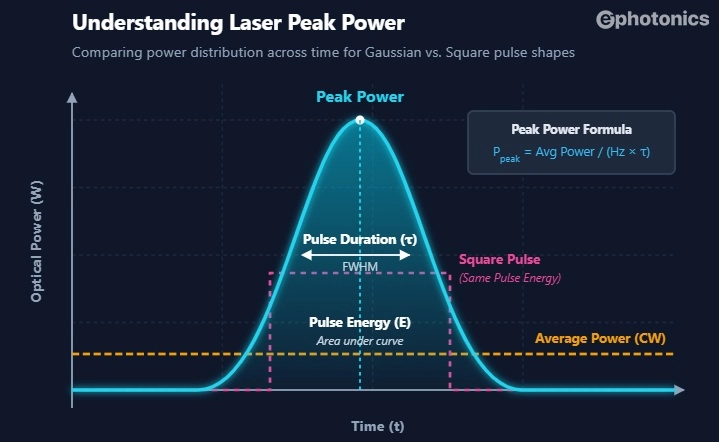
Peak power is calculated by dividing the pulse energy by the effective pulse duration. The key variable is K — the pulse shape correction factor — which accounts for the fact that real laser pulses are not perfect rectangular boxes.
- \(P_{avg}\) Average power in Watts.
- \(f_{rep}\) Repetition rate in Hz.
- \(\tau\) Pulse duration — FWHM in seconds.
- \(K\) Pulse shape correction factor (see table below).
| Pulse Shape | K factor | Typical source |
|---|---|---|
| Top Hat (Rectangular) | 1.0000 | Ideal assumption, Q-switched Nd:YAG at long pulses |
| Gaussian | 0.9394 | Most CW-pumped pulsed lasers, Ti:Sapphire amplifiers |
| Sech² (Hyperbolic secant) | 0.8826 | Mode-locked oscillators — fiber lasers, Ti:Sapphire, frequency combs |
The Gaussian K = 0.9394 comes from integrating \(e^{-t^2}\) over its FWHM. The sech² K = 0.8826 is derived from \(\text{sech}^2(t/\tau_0)\) — the physically correct temporal profile for mode-locked pulses. Using the wrong shape overestimates peak power by up to 13%.
Why calculate Laser Peak Power?
- Optic Safety: Prevents catastrophic damage to mirrors, fibers, and lenses.
- Processing Quality: High peak power enables clean "cold" ablation vs. messy melting.
- Non-Linear Effects: Critical for applications like microscopy and harmonic generation.
- Cost Efficiency: Avoiding equipment failure from unknown power spikes.
The "Hidden" Power of Pulsed Lasers
Laser peak power calculator is a critical tool for the safe and efficient operation of pulsed laser systems. While a thermal power meter might read a modest 5 Watts of Average Power, the actual energy is often delivered in pulses lasting only femtoseconds or nanoseconds. This compression creates instantaneous Peak Power levels that can reach Megawatts or Gigawatts.
Without calculating this value, engineers risk "flying blind." A setup that handles the thermal load perfectly might explode instantly due to the electric field intensity of a single pulse. Understanding peak power is the difference between a functional laser system and a damaged optical bench.
Key Applications & Risks
1. Protecting Optical Components
Every optical component (lens, mirror, fiber tip) has a Laser Induced Damage Threshold (LIDT). For pulsed lasers, this limit is defined by peak fluence, not average power.
If your peak power exceeds the dielectric breakdown threshold of your coating, the optic will be instantly pitted or cracked. Calculating the peak power allows you to select optics that are rated correctly for your specific pulse width, saving thousands in replacement costs.
2. "Cold" Ablation vs. Melting
In industrial cutting and drilling, the goal is often to remove material without heating the surrounding area (Heat Affected Zone). This requires Peak Power.
When peak power density is high enough, the material state changes directly from solid to plasma (sublimation) before heat can conduct away. This enables the precise manufacturing of stents, electronics, and OLED screens. Low peak power results in messy melting and recasting.
3. Non-Linear Optics (NLO)
Many modern photonics applications rely on non-linear effects, such as Second Harmonic Generation (turning green light into UV) or Two-Photon Microscopy.
The efficiency of these processes is often proportional to the square or cube of the Peak Intensity. A laser with high average power but low peak power (long pulses) will fail to generate these effects efficiently.
4. Medical Safety & Efficacy
In dermatology and ophthalmology, controlling peak power is vital for patient safety. High peak power allows for the breakdown of pigments (tattoo removal) or tissue (cornea reshaping) via acoustic shockwaves rather than thermal burning.
This minimizes scarring and pain. Using this calculator helps biomedical engineers tune the laser parameters to the "therapeutic window" where treatment is effective but safe.
The most dramatic factor in this calculation is Pulse Duration (τ).
Consider a 1 Watt laser pulsing at 1 kHz:
- At 1 ms pulse width, Peak Power is just 1 Watt.
- At 1 fs pulse width, Peak Power becomes 1 Terawatt.
This illustrates why ultrafast lasers require entirely different handling procedures than CW or long-pulse lasers.
Note on Pulse Shape: The standard formula assumes a Rectangular ("Top Hat") pulse shape. Most real-world lasers emit Gaussian pulses. For a Gaussian pulse with the same FWHM duration, the Peak Power is typically ~94% of the value calculated here.