
How the Gaussian Beam Divergence Calculator Works
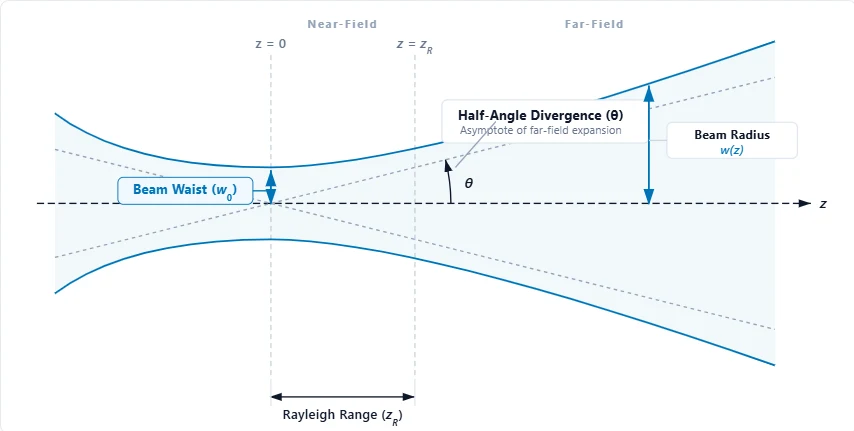
Unlike a perfect theoretical ray of light, real laser beams expand as they propagate through space due to diffraction. Beam divergence defines the angular measure of this spread as the beam travels into the far-field (far away from its narrowest point, the beam waist).
$$\theta = M^2 \frac{\lambda}{\pi \cdot w_0}$$
Half-Angle Divergence EquationUnderstanding the Variables:
- \(\theta\) Divergence Half-Angle: The angle between the central beam axis and the expanding beam edge (measured at the \(1/e^2\) intensity point). Usually expressed in milliradians (mrad).
- \(\lambda\) Wavelength: The emission wavelength of the laser in a vacuum.
- \(w_0\) Beam Waist Radius: The radius of the beam at its focal point, where it is at its absolute narrowest.
- \(M^2\) Beam Quality Factor: A dimensionless parameter representing how close the laser is to an ideal, theoretically perfect Gaussian beam. For a perfect single-mode laser, \(M^2 = 1\).
Engineering Note: Half-Angle vs. Full-Angle
Be careful when reading laser specification sheets! Many manufacturers specify the Full-Angle Divergence (\(\Theta\)), which is simply \(2 \times \theta\). Always verify whether a spec sheet is referencing the half-angle or the full-angle before computing spot sizes.