F Number to Numerical Aperture Calculator
F Number · Numerical Aperture · Optics
Enter a value in either field to convert instantly.
ephotonics
linkedin.com/company/ephotonics
Follow us for weekly imaging engineering guides, f-stop tutorials, and new optics tools directly in your feed.
Follow on LinkedInHow the F-Number to NA Converter Works
F-Number (f/#) and Numerical Aperture (NA) both describe the light-gathering capability of an optical system, but they are used in different industries. Photography typically uses f-numbers to describe lens speed, while Microscopy and Fiber Optics use NA.
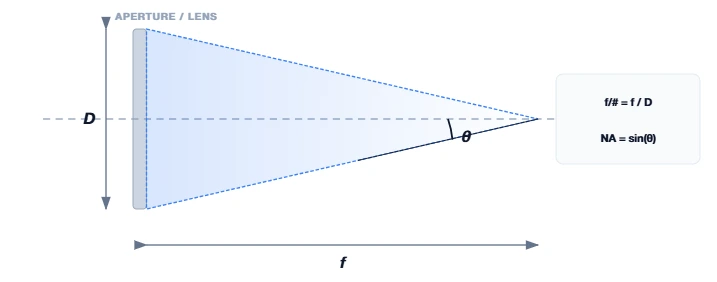
For most paraxial optical systems in air, the conversion between these two values is a simple inverse relationship:
Why convert F-Number to NA?
- Compatibility: Match camera lenses (f/#) to fiber optics (NA).
- Resolution: Determine the theoretical limit of your imaging system.
- Laser Focusing: Accurately calculate the spot size of a focused beam.
- Light Gathering: Compare brightness between different optical systems.
Optical engineers often find themselves translating between two different worlds. If you buy a lens for a machine vision camera, it is specified in f-numbers (e.g., f/1.4). If you buy a lens for a microscope or fiber coupler, it is specified in Numerical Aperture (e.g., NA 0.5).
While they essentially measure the same thing—the light-gathering cone angle—they use different mathematical conventions. This tool allows you to instantly translate system requirements between these two standards to ensure your optical components will work together.
Quick Conversion Table
Typical values for common optical systems (assuming air medium).
| Optic Type | F-Number (f/#) | Num. Aperture (NA) |
|---|---|---|
| Standard Zoom | f/4.0 | 0.125 |
| Prime Lens | f/2.8 | 0.18 |
| Fast Lens | f/2.0 | 0.25 |
| Low-Power Objective | f/1.4 | 0.36 |
| Ultra Fast / Fiber | f/1.0 | 0.50 |
| Theoretical Limit (Air) | f/0.5 | 1.00 |
The Physics: Angle vs. Ratio
F-Number is defined geometrically as the ratio of focal length to diameter (f/# = f / D). It assumes the lens is "thin" and far from the object.
Numerical Aperture is defined trigonometrically (NA = n · sin θ). It measures the actual angle of the light cone. For "slow" lenses (f/2.0 and above), the two concepts map linearly (NA ≈ 1 / 2 × f/#). However, for very "fast" lenses (f/0.7), the geometry curves, and the linear approximation fails. This calculator uses the precise trigonometric relationship for high-speed optics.
1. Fiber Coupling
To launch a laser into an optical fiber, the focusing lens must have an NA equal to or less than the fiber's NA. If your lens is f/4 (NA 0.125) and your fiber is NA 0.14, you are safe. If your lens is f/2 (NA 0.25), you will lose light.
2. Microscope Resolution
In microscopy, brightness is not the only factor. The resolution is directly tied to NA (δ = λ / 2NA). Converting a camera lens f-number to NA helps you determine if that lens can physically resolve the micron-scale defect you are inspecting.
3. Laser Intensity
For laser cutting, you want the highest intensity possible. This requires the smallest spot size, which in turn requires the highest possible NA (lowest f-number). Engineers swap f-numbers to calculate the trade-off between spot size and depth of field.
4. Camera Sensor Matching
Machine vision sensors have a maximum acceptance angle for their pixels. If you use a lens with an f/# that creates a cone steeper than the pixel can accept (pixel vignetting), you waste light. Matching the NA of the lens to the sensor micro-lenses ensures maximum efficiency.