Critical Angle Calculator (TIR)
Refractive Index · Incident Angle · Total Internal Reflection
ephotonics
linkedin.com/company/ephotonics
Follow our page for weekly laser engineering guides, photonics tutorials, and new calculator releases directly in your feed.
Follow on LinkedInHow the Critical Angle (TIR) Calculator Works
Total Internal Reflection (TIR) occurs when light attempts to travel from a medium with a higher refractive index to one with a lower refractive index (e.g., from Glass into Air). At a specific incident angle known as the Critical Angle (θc), the refracted light runs exactly along the boundary of the two media.
If the incident light strikes the boundary at any angle steeper than this critical angle, the light can no longer escape the denser medium and is reflected entirely back inside.
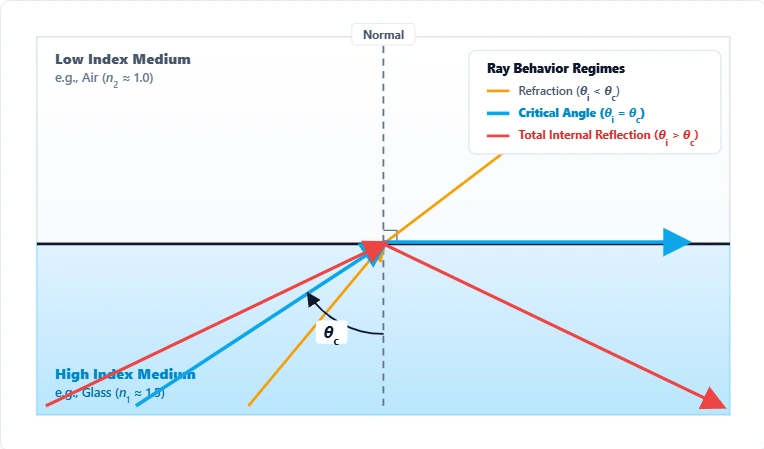
Required Conditions for TIR:
- n1 > n2 : Light must attempt to travel from a denser medium (higher index) into a rarer medium (lower index).
- θi ≥ θc : The incident angle must be equal to or greater than the critical angle.
Why calculate the Critical Angle?
- 100% Reflection: TIR is more efficient than any mirror (no absorption loss).
- Fiber Optics: The mechanism that traps light inside the core of a fiber.
- Sensing: Used in rain sensors and fingerprint scanners to detect surface contact.
- Prisms: Enables image inversion in binoculars and cameras without coatings.
The "Perfect Mirror" Effect
Normally, when light hits a boundary (like glass-to-air), some reflects and some refracts out. However, if the light hits the boundary at a steep enough angle—past the Critical Angle—Refraction becomes mathematically impossible.
At this point, nature forces 100% of the energy to reflect back into the dense medium. This phenomenon, Total Internal Reflection (TIR), allows us to guide light over thousands of kilometers in fiber optic cables with minimal loss.
1. Fiber Optics
Optical fibers work because the Core has a slightly higher index (n₁) than the Cladding (n₂). This creates a critical angle. Any light entering the fiber within the acceptance cone hits the wall at an angle > θc and is trapped, bouncing down the line indefinitely.
2. Gemology & Diamonds
Why do diamonds sparkle? Diamond has a very high refractive index (2.42), resulting in a small critical angle (~24°). This means light that enters a cut diamond is likely to bounce around inside via TIR and exit through the top face, creating brilliance.
3. Prism Binoculars
Binoculars use Porro prisms to flip the image right-side up. These prisms don't use silvered mirror coatings; they rely entirely on TIR to reflect the image. This results in a brighter image and a more durable optical system.
4. Automotive Rain Sensors
Modern cars use an IR LED bouncing inside the windshield via TIR. When rain hits the glass, the water (n=1.33) changes the critical angle condition at that spot, allowing light to escape. The sensor detects this drop in reflection and triggers the wipers.