
Coherence Length Calculator
Laser Coherence · Spectral Linewidth · Optical Interference
ephotonics
linkedin.com/company/ephotonics
Follow our page for weekly laser engineering guides, photonics tutorials, and new calculator releases directly in your feed.
Follow on LinkedInHow the Coherence Length Calculator Works
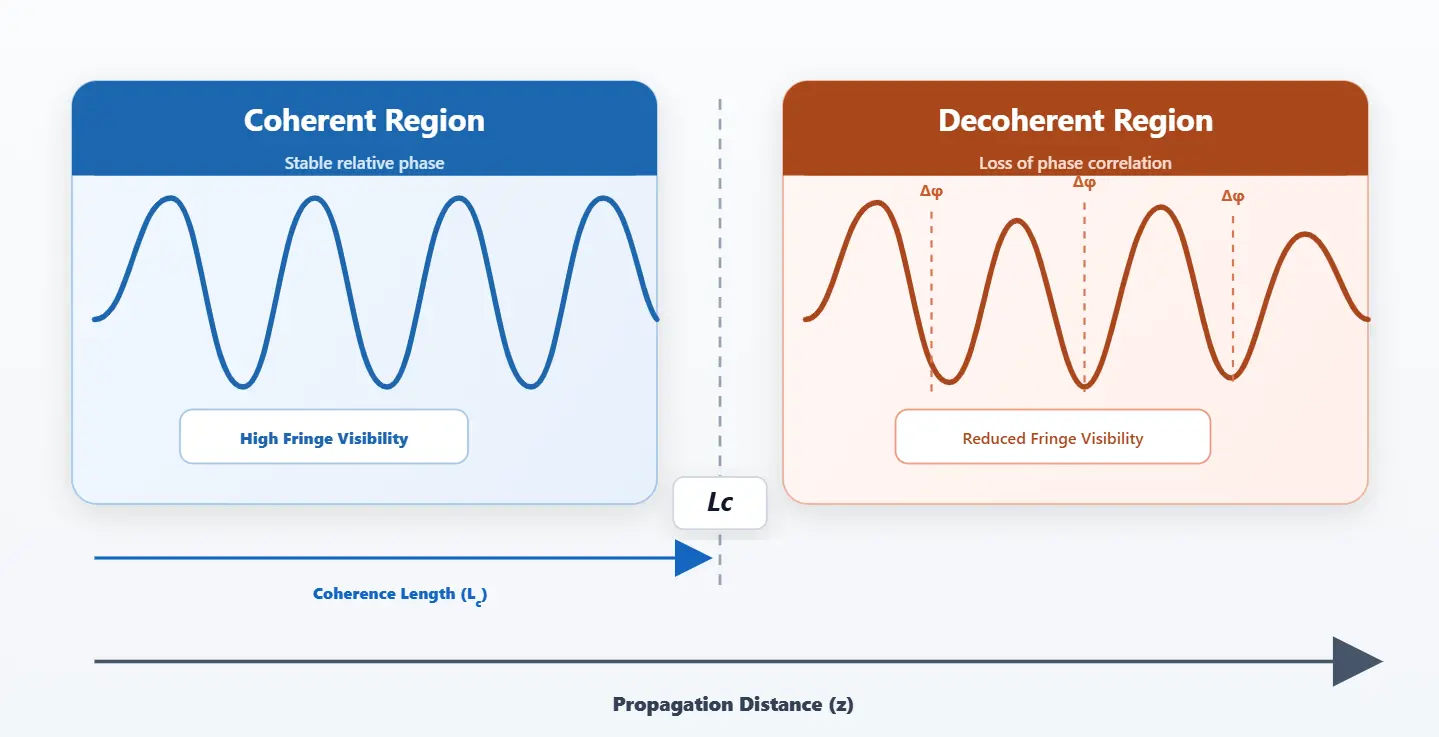
The Coherence Length (\(L_c\)) describes the propagation distance over which a laser beam maintains a predictable and fixed phase relationship. In optical engineering, this determines how far a beam can travel before it loses its ability to produce high-contrast interference fringes.
This calculator determines the coherence length using the fundamental inverse relationship between the center wavelength of the laser and its spectral linewidth (bandwidth).
$$ L_c \approx \frac{\lambda_0^2}{\Delta \lambda} $$
$$ L_c \approx \frac{c}{\Delta \nu} $$
Coherence Length EquationsWhere the variables are:
- \(\lambda_0\) (Center Wavelength): The nominal emission wavelength of the laser source (e.g., 1550 nm for telecom C-band).
- \(\Delta \lambda\) (Spectral Linewidth): The Full-Width at Half-Maximum (FWHM) of the source's spectrum, measured in wavelength units (nm).
- \(\Delta \nu\) (Frequency Bandwidth): The linewidth expressed in frequency (Hz). Narrower linewidths (kHz) yield much longer coherence lengths than broad sources.
- \(c\) (Speed of Light): A physical constant, approximately \(3 \times 10^8\) m/s in a vacuum.
Engineering Tip: The actual geometric shape of the laser's spectrum (e.g., Lorentzian vs. Gaussian) introduces a small mathematical pre-factor (such as \(2\ln(2)/\pi\) or \(1/\pi\)). However, the standard approximation formulas provided above are universally used for specifying industrial lasers and designing standard interferometric setups.
Why Calculate Coherence Length?
- Interferometry: Ensure path length differences stay within the coherent range for fringe visibility.
- Holography: Required depth of field is directly limited by the laser's coherence length.
- OCT (Medical Imaging): Low coherence length allows for high-resolution depth sectioning (Optical Coherence Tomography).
- LiDAR: Affects the precision and range of FMCW and coherent detection systems.
Understanding Bandwidth & Phase
Coherence length is essentially the "memory" of a light wave. If a laser has a very narrow linewidth (e.g., a few kHz), it "remembers" its phase for a long distance (kilometers). If it has a broad bandwidth (e.g., LED or SLD), the phase relationship is randomized after just a few micrometers.
1. High-Coherence Lasers
Narrow-linewidth lasers (DFB, External Cavity) are used for coherent communications and sensing. Their coherence lengths can exceed 100 meters, allowing for sensitive phase measurements over long distances.
2. Low-Coherence Sources
Sources like Superluminescent Diodes (SLDs) have very short coherence lengths (microns). This is critical for OCT medical imaging, where you only want interference signal from a specific depth slice of tissue.
3. Holography
To capture a 3D hologram, the reference beam and object beam must interfere. If the object is deeper than the laser's coherence length, the hologram will be dark or blurry.
4. Fiber Sensing
In Distributed Acoustic Sensing (DAS), the coherence length dictates the spatial resolution and maximum range. Balancing linewidth vs. noise is a key system tradeoff.