How the Frequency & Wavelength Calculator Works
In the vacuum of space, all electromagnetic radiation—from radio waves to visible lasers to gamma rays—travels at the speed of light. Because this speed is constant, a wave's frequency and its wavelength are perfectly inversely proportional.
The Fundamental Wave Equations Key Variables
- c Speed of Light: A universal constant equal to exactly 299,792,458 meters per second (often approximated as 3 × 10⁸ m/s).
- λ (Lambda) Wavelength: The physical distance between two consecutive peaks of a wave. In photonics, it is typically measured in nanometers (nm) or micrometers (µm).
- f (or ν) Frequency: The number of wave cycles that pass a fixed point in one second. Measured in Hertz (Hz), though Terahertz (THz) is common for optics.
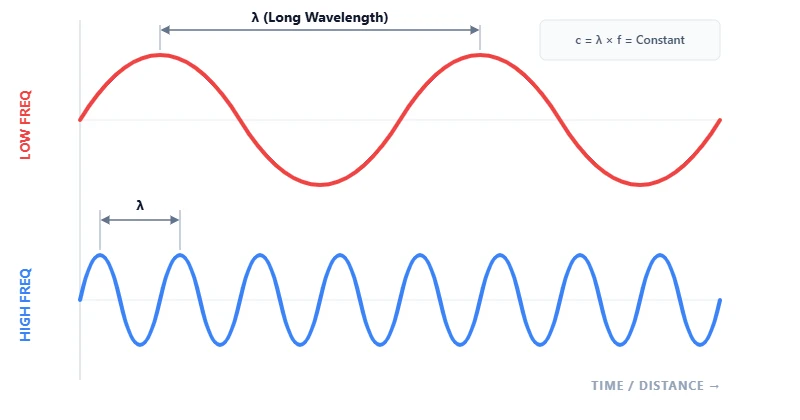
Figure 1: The inverse relationship between Wavelength and Frequency. A low-frequency wave (top) naturally stretches out, resulting in a long wavelength. A high-frequency wave (bottom) is tightly compressed, resulting in a short wavelength.
Adding Photon Energy to the Mix
In quantum mechanics and photonics, it is often necessary to know the energy of a single photon. Because energy is directly proportional to frequency, shorter wavelengths (like UV or X-Rays) carry much more energy than longer wavelengths (like Infrared). This is calculated using Planck's constant (h):
Quick Rule of Thumb: If the frequency goes up, the wavelength goes down, and the photon energy goes up.
