If ever reflection and polarization of light puzzled you, you probably have heard something about Brewster’s angle. In fact, such an interesting optical effect has found broad application in quite a few fields of activity, beginning with laser systems and photography, and ending with many others. In the following article, we will explain what Brewster’s angle is, how it works, and why it is so important.
What is Brewster’s Angle?
Brewster’s angle, also called polarization angle, is that particular angle at which light of a certain polarization passes through a transparent surface without reflection. In other words, it is an angle at which light approaches a surface and reflects from it so that the light becomes completely polarized. This means the reflected light vibrates in only one direction rather than in several directions.
A good visual representation to understand the concept of this angle and polarization of light. The image demonstrates how reflections and glare can be minimized using polarization.

How Does Brewster’s Angle Work?
When light hits the boundary between two different materials, part of it reflects back while the rest passes through. However, the reflected light becomes polarized unless the incident light hits the surface at exactly Brewster’s angle.
Brewster’s angle is calculated using this formula:
Where:
- tan(θB) is Brewster’s angle.
- n1 is the refractive index of the first medium (e.g., air).
- n2 is the refractive index of the second medium (e.g., glass).
This equation tells us that Brewster’s angle depends entirely on the refractive indices of the materials. In most standard cases—like light transitioning from air (n≈1) to glass (n≈1.5) where the Brewster’s angle is approximately 56 degrees.
If you need to find this angle for your specific setup, try our Brewster’s Angle Calculator.
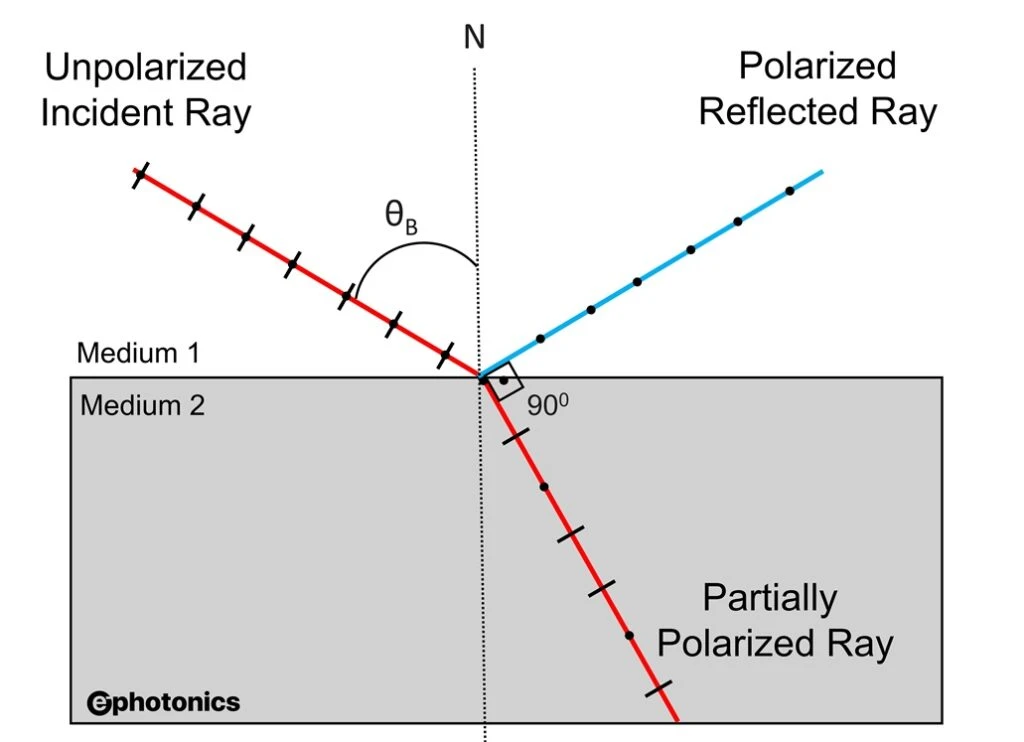
, the reflected ray is perfectly polarized (s-polarization), and the angle between the reflected and refracted rays is exactly 90°.Applications of Brewster’s Angle
In photography, photographers often use polarizing filters to reduce glare and reflections from water or glass surfaces. The filter works best at Brewster’s angle, allowing you to capture clearer and more vivid images.
In laser technology, it is used in laser cavities to maximize output power by eliminating unwanted reflections, especially in polarized light lasers.
Many optical coatings are designed to work at Brewster’s angle to reduce the amount of reflection from lenses, improving the performance of devices like cameras and microscopes.
Why is Brewster’s Angle Important?
It has far-reaching implications in science and technology. By understanding this angle, scientists and engineers can control the polarization of light, which is essential for various types of optical measurements and experiments. It also helps minimize light loss and improve the efficiency of optical systems.
Frequently Asked Questions
Did You Know?
- Brewster’s angle is named after the Scottish physicist Sir David Brewster, who first discovered this phenomenon in 1815.
- In laser optics, this angle is strictly used to design windows and mirrors that ensure the laser beam remains perfectly polarized, optimizing performance and reducing light losses to near zero.
- It plays a major role in reducing glare on water surfaces. It is the reason why sunsets over the ocean look so good with that perfect, smooth reflection and also why polarized sunglasses work so well at the beach.