How the Angstrom to Nanometer Converter Works
This calculator bridges the gap between atomic-scale measurements (Angstroms) and optical-scale measurements (Nanometers). Because both units are direct metric subdivisions of the meter, the relationship is a simple decimal shift.
1 nm = 10 Å
Multiply by 10
1 Å = 0.1 nm
Divide by 10Units Defined
- Å Angstrom: Exactly 10-10 meters. Named after the Swedish physicist Anders Jonas Ångström, this unit is commonly used in crystallography and solid-state physics to measure atomic radii and chemical bond lengths.
- nm Nanometer: Exactly 10-9 meters. This is the standard international unit used in photonics, optics, and spectroscopy to describe the wavelength of light.
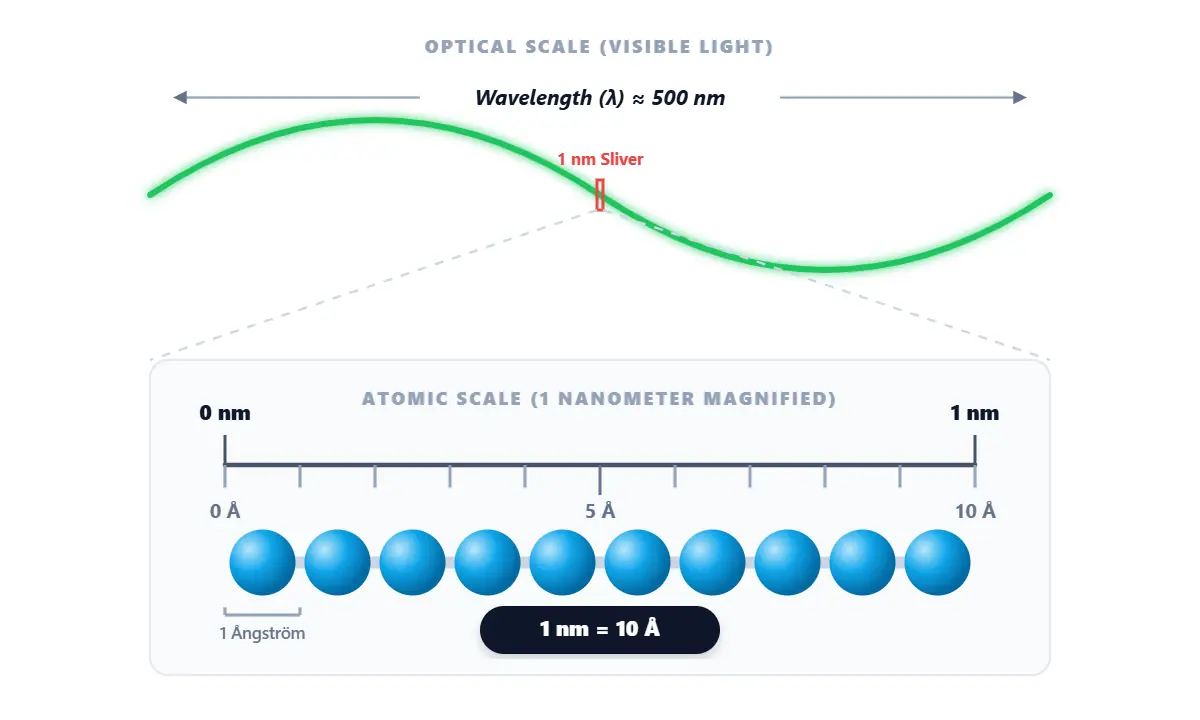
Figure 1: A visual comparison of scale. An individual atom is typically measured in Angstroms (Å), whereas the waves of visible light that interact with those atoms are much larger, measured in hundreds of Nanometers (nm).
Quick Mental Math Reference
Because the conversion is a strict factor of 10, it is very easy to convert between the two units without a calculator by simply moving the decimal point one place:
- 0.1 nm = 1 Å (Approximate radius of a Hydrogen atom)
- 1 nm = 10 Å (Approximate size of a Glucose molecule)
- 532 nm = 5320 Å (Wavelength of a green laser)
- 1064 nm = 10640 Å (Wavelength of an Nd:YAG infrared laser)
