Raman Shift Calculator
Wavelength Conversion · Stokes & Anti-Stokes · Raman Spectroscopy
Convert between Raman shift and scattered wavelength using your laser excitation wavelength.
Enter the measured scattered wavelength. All wavelengths are vacuum wavelengths.
Δν̃ = 10⁷ × (1/λ₀ − 1/λ), with λ₀ and λ in nm.
Positive: Stokes · Negative: anti-Stokes · Zero: Rayleigh
ephotonics
linkedin.com/company/ephotonics
Follow our page for weekly laser engineering guides, photonics tutorials, and new calculator releases directly in your feed.
Follow on LinkedInHow the Raman Shift Calculator Works
The Raman shift is the difference between the wavenumber of an excitation laser and the wavenumber of the light scattered by a sample. It is normally reported in inverse centimeters (cm⁻¹) and represents the vibrational, rotational, or other molecular energy exchanged during Raman scattering.
This Raman shift calculator converts an excitation wavelength and a measured Raman wavelength into a Raman shift. It can also perform the inverse calculation, converting a known Raman shift in cm⁻¹ into the corresponding scattered wavelength in nanometers. Because Raman shift is calculated from reciprocal wavelength, it cannot be found by simply subtracting two wavelength values in nm.
$$ \Delta\tilde{\nu} = 10^7\left(\frac{1}{\lambda_0}-\frac{1}{\lambda_s}\right) $$
$$ \lambda_s = \frac{10^7}{\frac{10^7}{\lambda_0}-\Delta\tilde{\nu}} $$
$$ \Delta E\,(\mathrm{meV}) \approx 0.123984\,\Delta\tilde{\nu}\,(\mathrm{cm}^{-1}) $$
Raman Shift, Scattered Wavelength and Energy EquationsWhere the variables are:
- \(\Delta\tilde{\nu}\) (Raman Shift): The difference between the excitation and scattered-light wavenumbers, expressed in cm⁻¹.
- \(\lambda_0\) (Excitation Wavelength): The wavelength of the incident laser, entered in nanometers. Common Raman excitation wavelengths include 405, 488, 532, 633, 785, and 1064 nm.
- \(\lambda_s\) (Scattered Wavelength): The measured or calculated wavelength of the Raman-scattered light, expressed in nanometers.
- \(10^7\) (Unit Conversion Factor): Converts reciprocal nanometers into reciprocal centimeters because 1 cm equals 10⁷ nm.
- \(\Delta E\) (Energy Shift): The energy transferred between the photon and the sample, displayed by the calculator in millielectronvolts (meV).
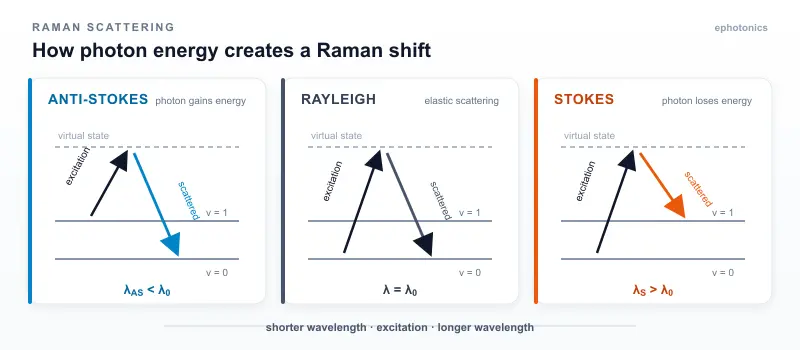
Spectroscopy Tip: A positive Raman shift corresponds to Stokes scattering, where the scattered photon has a longer wavelength and lower energy than the excitation laser. A negative Raman shift corresponds to anti-Stokes scattering, where the scattered photon has a shorter wavelength and higher energy. Raman spectra are normally plotted using the magnitude of the Stokes shift because it produces the stronger signal under typical laboratory conditions.
Why Calculate Raman Shift?
- Chemical Identification: Match Raman peaks with reference spectra to identify unknown compounds and verify raw materials.
- Material Characterization: Study molecular bonds, crystal phases, lattice vibrations, defects, and structural changes without damaging the sample.
- Stress and Temperature Analysis: Track small Raman peak shifts that reveal strain, pressure, local heating, or changes in a material's environment.
- Process and Quality Control: Monitor reactions, coatings, pharmaceuticals, polymers, and semiconductor materials in laboratories or production lines.
Understanding Raman Shift and Spectral Peaks
When a laser illuminates a sample, most photons scatter without changing energy. A very small fraction interacts with molecular vibrations and returns at a slightly different energy. The separation between the excitation laser and this scattered light is called the Raman shift, normally expressed as a wavenumber in cm⁻¹.
A Raman spectrum is more than a collection of peaks. Each peak points to a specific vibration in a molecule or crystal, creating a recognizable chemical fingerprint. Because the Raman shift is based on the difference in wavenumber rather than a simple wavelength difference, the same vibration appears at approximately the same cm⁻¹ position even when a different excitation wavelength is used.
1. Molecular Fingerprints
Bonds and molecular groups vibrate at characteristic energies. Converting a measured Raman wavelength into a Raman shift makes it easier to compare peaks with spectral libraries and identify chemicals, minerals, pigments, polymers, and biological samples.
2. Stokes Raman Scattering
In Stokes scattering, the photon transfers energy to the sample. The scattered light therefore has lower energy, a longer wavelength, and a positive Raman shift. Stokes peaks are usually stronger and are the values most commonly reported in Raman spectroscopy.
3. Anti-Stokes Raman Scattering
Anti-Stokes scattering begins with a molecule that is already vibrationally excited. The photon gains energy from the sample and leaves at a shorter wavelength. These peaks are generally weaker, but the Stokes-to-anti-Stokes intensity ratio can provide useful temperature information.
4. Choosing an Excitation Wavelength
The laser wavelength affects signal strength, fluorescence, penetration depth, and detector choice. A 532 nm laser can produce a strong Raman signal, while 785 nm and 1064 nm excitation are often selected to reduce fluorescence in organic or strongly colored samples.
Raman Shift FAQ
What does Raman shift mean?
Raman shift is the difference in wavenumber between the excitation laser and the Raman-scattered light. It represents the energy exchanged between a photon and a molecular vibration, so each measured peak can reveal something about the sample's chemical bonds or crystal structure.
How do you calculate Raman shift from wavelength?
Convert the excitation and scattered wavelengths into reciprocal centimeters, then subtract the scattered-light wavenumber from the excitation wavenumber. When both wavelengths are entered in nanometers, the equation is Δν̃ = 10⁷(1/λ₀ − 1/λs). A Raman shift calculator performs the reciprocal conversion automatically.
Why is Raman shift measured in cm⁻¹?
Wavenumber is directly proportional to photon energy, making cm⁻¹ a convenient unit for molecular vibrations. It also lets researchers compare Raman peaks collected with different excitation lasers because the vibrational shift remains approximately constant even though the detected wavelength changes.
What is the difference between Stokes and anti-Stokes Raman scattering?
In Stokes scattering, the photon loses energy to the sample and appears at a longer wavelength. In anti-Stokes scattering, the photon gains energy from an already excited vibration and appears at a shorter wavelength. Stokes signals are usually stronger at ordinary temperatures.
Does changing the laser wavelength change the Raman shift?
The detected Raman wavelength changes when a different laser is used, but an ideal vibrational Raman peak stays at approximately the same shift in cm⁻¹. Small changes can still occur because of calibration, sample heating, stress, temperature, or resonance effects.
Should I use a 532 nm, 785 nm, or 1064 nm Raman laser?
There is no single best wavelength. A 532 nm laser often gives a stronger Raman signal but may produce more fluorescence. A 785 nm laser is a common balance for many organic samples, while 1064 nm excitation can suppress fluorescence further but usually requires different detectors and longer acquisition times.