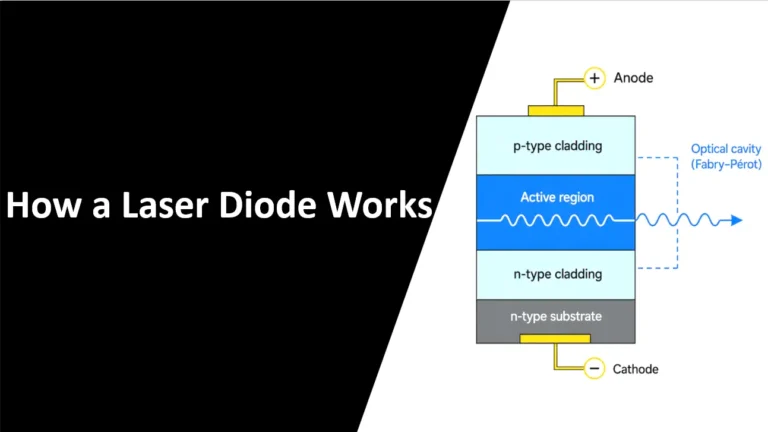
How a laser diode works starts with current injection into a semiconductor junction. When you drive the device, electrons and holes enter the active region, where they recombine and generate photons. As the carrier density rises, stimulated emission and optical feedback inside the cavity produce the coherent, directional beam you recognize as laser light.
That transition matters. A laser diode does not behave like an ordinary LED, and its output can change quickly with current and temperature.
If you want to use one reliably, you need to understand more than the semiconductor itself. In this article, you’ll see how carrier injection, stimulated emission, the optical cavity, and threshold current work together, and why a properly designed laser diode driver plays such an important role in stable operation.
What Is a Laser Diode?
A laser diode is a semiconductor device that converts electrical current directly into laser light.
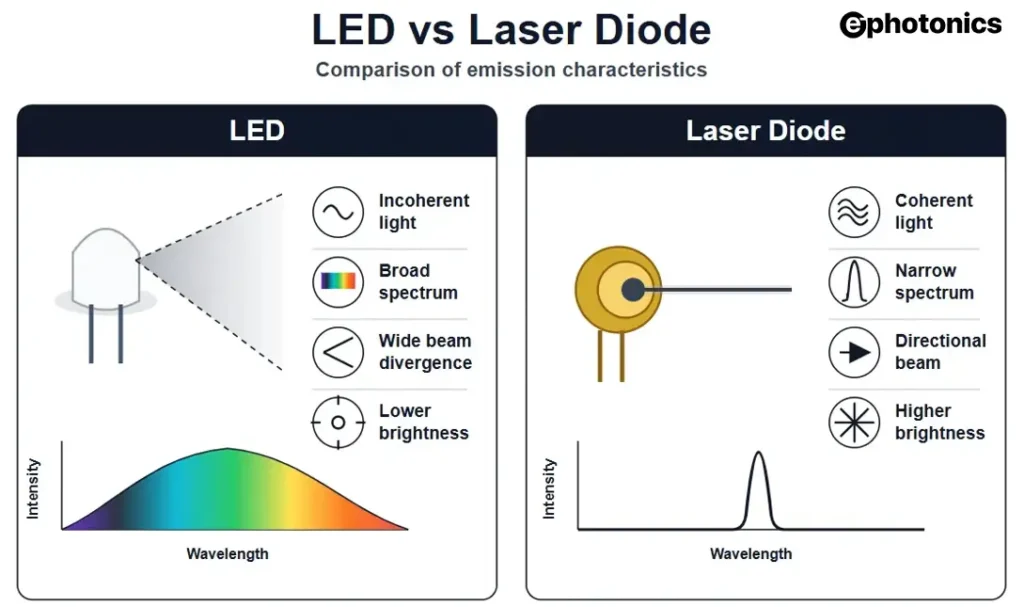
At first glance, it looks similar to an LED. The physics starts in a similar place too: you inject carriers into a semiconductor junction, and electron-hole recombination produces photons. The difference comes from what happens next.
It confines that light inside an optical cavity. As the current increases, stimulated emission begins to dominate and the cavity amplifies the light until the device reaches its lasing threshold.
That gives you the properties you normally associate with a laser: a much more directional beam, higher brightness, and a narrower spectrum than a standard LED.
How a Laser Diode Works: The Basic Process
A laser diode works by injecting electrical current into a semiconductor junction and converting that energy into light.
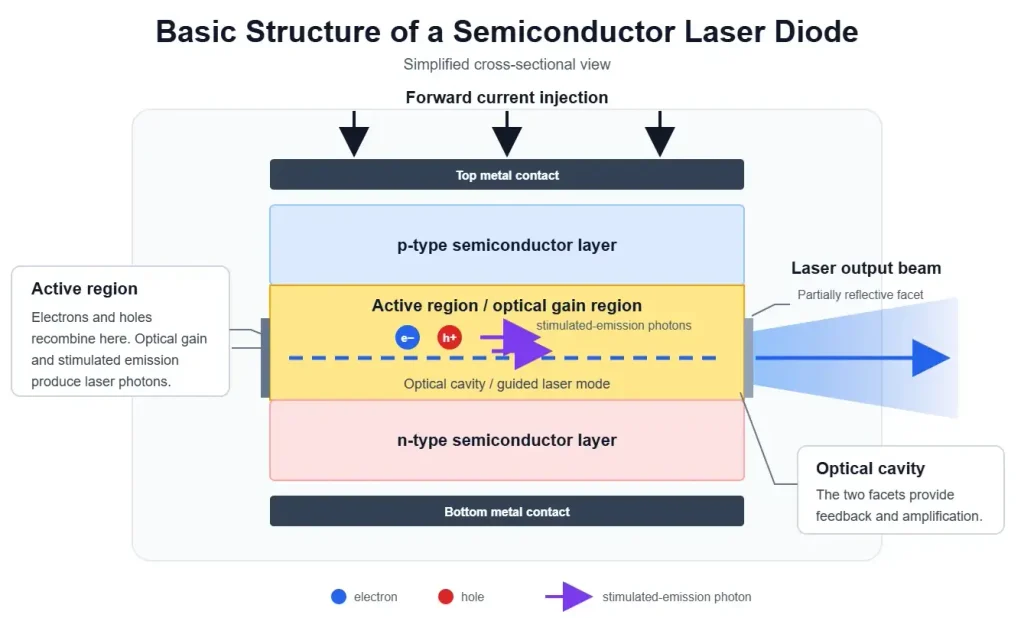
The process starts when electrons and holes enter the active region from opposite sides of the junction. When they recombine, they release energy as photons. At low current, most of this light comes from spontaneous emission, much like in an LED.
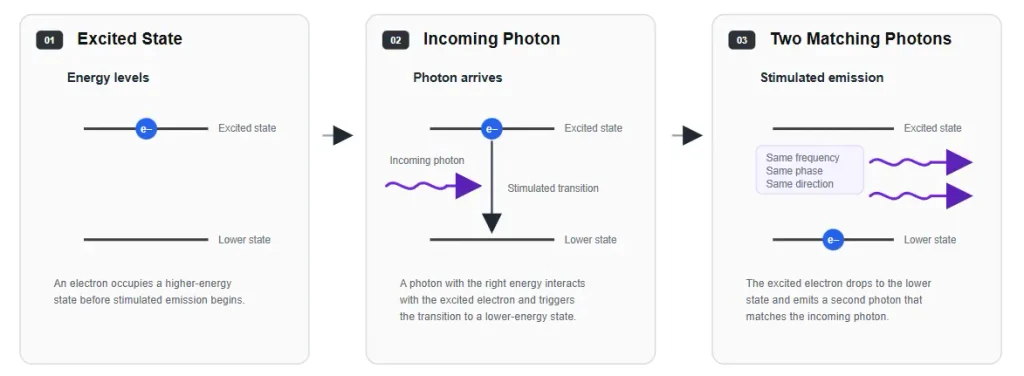
As you increase the current, the carrier density inside the active region rises. Eventually, the optical gain becomes high enough for stimulated emission to dominate. An existing photon can then trigger the emission of another photon with the same frequency, phase, and direction.
The optical cavity makes this process much stronger.
Two partially reflective facets at the ends of the semiconductor structure send light back and forth through the active region. Each pass creates more stimulated emission and increases the optical intensity inside the cavity.
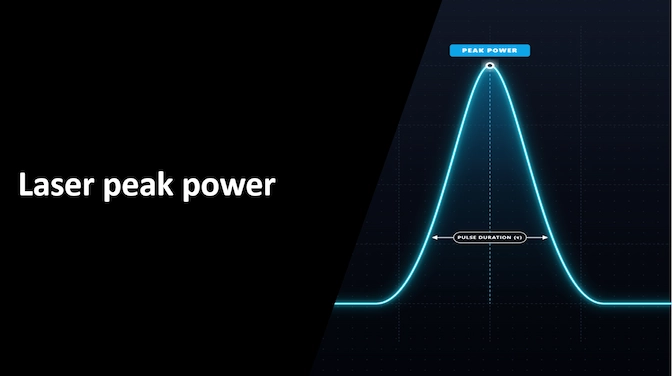
Once the gain exceeds the internal losses, the laser reaches its threshold current. Above this point, the optical output rises rapidly with drive current.
A portion of the light leaves through the output facet and becomes the useful laser beam.
How Laser Emission Develops
From electrical injection to useful optical output, a diode reaches lasing through six basic steps.
Carrier Injection
Electrical current injects electrons and holes into the semiconductor active region.
Photon Generation
Electrons and holes recombine inside the active region and release energy as photons.
Optical Propagation
The generated photons travel through the semiconductor optical cavity.
Stimulated Emission
Existing photons stimulate the generation of additional photons with matching optical properties.
Threshold & Optical Gain
Optical gain builds inside the cavity until the laser reaches its threshold condition.
Laser Output
Part of the amplified light exits through the output facet and forms the useful laser beam.
The Active Region and Stimulated Emission
The active region is where the laser actually generates light.
When you drive the diode forward, electrons and holes enter this thin semiconductor region from opposite sides of the junction. They recombine and release energy as photons. At low current, spontaneous emission dominates, so the device behaves much more like an LED.
As you increase the drive current, more carriers accumulate in the active region. Once the carrier density becomes high enough, an existing photon can trigger another electron-hole recombination and produce a second photon with the same frequency, phase, polarization, and direction.
This process is stimulated emission, and it gives laser light its characteristic coherence and directionality.
One photon can trigger another. Those photons can then stimulate further emission as they travel through the active region, allowing the optical field inside the diode to grow rapidly.
The laser still needs feedback for this amplification to build efficiently. That comes from the optical cavity formed by the two end facets of the semiconductor chip.
The Optical Cavity and Laser Threshold
The optical cavity gives the laser diode the feedback it needs to build useful laser output.
The semiconductor chip has two end facets that act as mirrors. Light travels back and forth between them, passing repeatedly through the active region. Each pass gives stimulated emission another chance to amplify the optical field.
One facet usually reflects more light back into the cavity, while the output facet allows part of the light to escape as the laser beam.
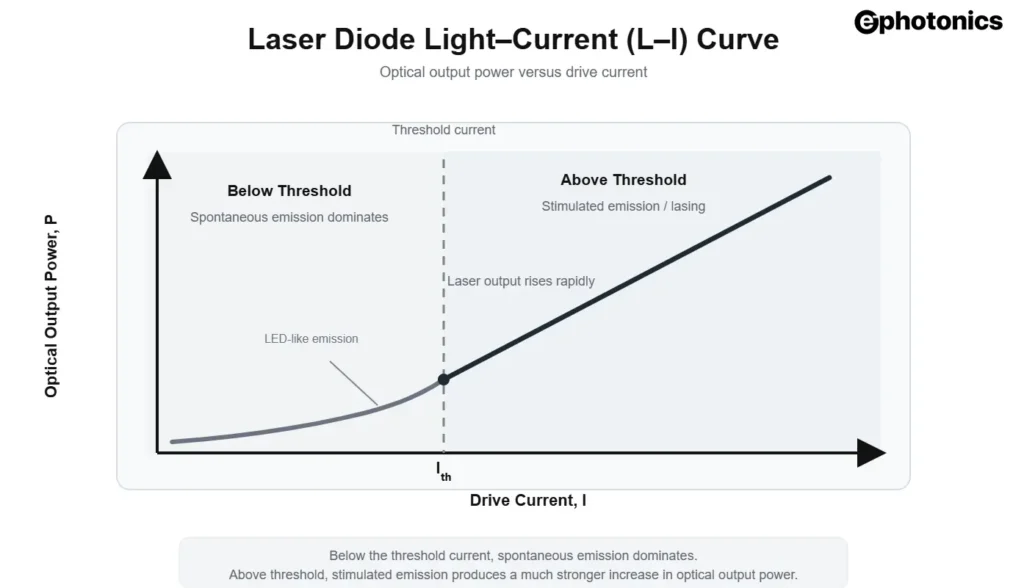
The diode does not lase immediately when you apply current. At lower current, spontaneous emission still dominates and the optical output remains relatively weak.
As you increase the drive current, the optical gain rises. Once the gain becomes high enough to overcome the internal and mirror losses, the device reaches its threshold current.
Above threshold, the behavior changes quickly. Stimulated emission dominates, and the optical output power increases much more strongly with current.
Why a Laser Diode Needs a Driver
A laser diode needs precise current control.
You should not treat it like a simple lamp or power it directly from a basic voltage source. Its optical output depends strongly on drive current, and even a relatively small current change can shift the operating point significantly once the diode reaches threshold.
A laser diode driver regulates that current and keeps the device operating inside a controlled range. It also helps protect the diode from current spikes, switching transients, and unstable startup conditions that can damage the semiconductor junction.
A good laser diode driver does more than supply current. It manages the electrical conditions around the diode so the laser starts cleanly, operates predictably, and shuts down safely.
What a Laser Diode Driver Actually Does
A good driver does more than supply current. It manages the electrical conditions around the diode so the laser starts cleanly, operates predictably, and shuts down safely.
Current Control
Keeps the laser current stable and prevents the diode from operating above its safe range.
Startup & Protection
Soft-start behavior, current limiting, and fault handling reduce the risk of damaging electrical transients.
Control & Modulation
Enable inputs and analog or digital modulation let you switch or vary the laser output when the application requires it.
Thermal Management
Some drivers integrate or interface with TEC control to help stabilize diode temperature and wavelength.
Looking for a Laser Diode Driver?
Explore our compact laser diode drivers for CW and pulsed operation, with solutions available for high-current and high-voltage laser diode applications.
Explore Laser Diode DriversTemperature and Wavelength Stability
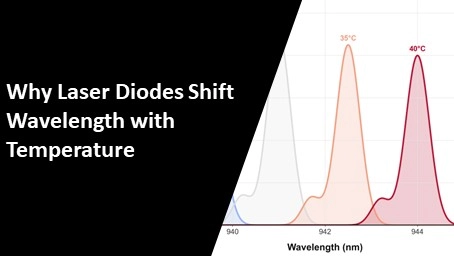
Temperature also affects a laser diode’s threshold, efficiency, and emission wavelength. For applications where wavelength stability matters, you need to consider thermal management alongside current control.
We cover this topic in detail in Why Laser Diodes Shift Wavelength with Temperature, including temperature tuning, typical wavelength-shift rates, TEC control, and wavelength-stabilized laser diodes.
Common Laser Diode Package Types
The package determines how easily you can integrate a diode into your system.
It affects heat removal, electrical connection, beam delivery, mechanical mounting, and the amount of additional optics you may need. A compact TO-can can work well for lower-power applications, while higher-power or wavelength-sensitive systems often need more specialized packaging.
The table below compares the most common laser diode package types and shows where each one makes the most sense.
| Package Type | Best For | Main Advantages | Typical Considerations |
|---|---|---|---|
| TO-Can | Lower-power diodes, sensing, alignment, and instrumentation | Compact protected housing and straightforward electrical connection | More limited thermal handling than higher-power package formats |
| C-Mount | Higher-power free-space laser diodes | Strong thermal contact and direct mounting to a heat sink | Requires careful mechanical integration and free-space beam handling |
| Butterfly | Telecom, spectroscopy, and wavelength-sensitive systems | Can integrate a TEC, thermistor, monitor photodiode, and fiber output | More complex package architecture and typically higher cost |
| Fiber-Coupled | Fiber-based systems, remote beam delivery, and high-power modules | Simplifies optical delivery and provides a defined fiber output | Fiber core size, numerical aperture, connector, wavelength, and power must match the application |
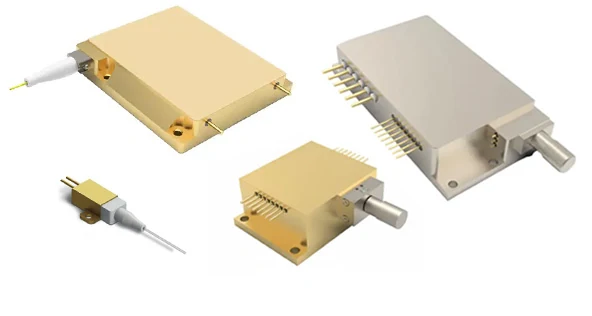
Fiber-coupled laser diodes simplify beam delivery and system integration. Explore our fiber-coupled laser diode solutions across different wavelengths, power levels, fiber core sizes, and numerical apertures.
Find the Right Source for Your System
Explore laser diode solutions for scientific, industrial, and medical applications, from fiber-coupled modules to high-power stacks and integrated laser systems.
Explore ProductsFrequently Asked Questions
Did You Know?
- A laser diode does not suddenly produce full laser output as soon as current flows. Below the threshold current, spontaneous emission dominates and the device behaves more like an LED. Once the optical gain becomes high enough to overcome cavity losses, stimulated emission takes over and the output power begins to rise much more rapidly. Learn more about laser diode operation .
- The ends of the semiconductor chip can form the laser cavity themselves. Because semiconductor materials have a much higher refractive index than air, the chip facets naturally reflect part of the light back into the active region. Manufacturers can also apply optical coatings to control the reflectivity of each facet and determine how much light remains in the cavity or leaves as useful laser output.
- The laser diode’s optical output is controlled mainly by drive current rather than voltage. Once the device operates above threshold, relatively small changes in current can produce significant changes in optical power. This is one reason a dedicated laser diode driver is so important for stable and repeatable operation.
- Temperature changes more than just how warm the package feels. It can alter the threshold current, efficiency, and emission wavelength of the laser diode. In wavelength-sensitive systems, designers often use a TEC and thermistor to keep the diode near a controlled operating temperature. You can read more in our guide to laser diode wavelength and temperature tuning .