The V number is one of the most basic concepts in optical fibers. In fact, this concept has stayed so far very important, it determined performances and behavior of fiber optic systems. This basic insight into the nature of the V number opens up a very deep insight into how in fact optical fibers work-a very important question if one wants to design efficient high-performance communication systems and fiber lasers. The article presents the value of the V number, its origin, and its main applications in a manner that is easy to comprehend for the understanding of this important feature of fiber optics.
What is the V Number?
V number is a dimensionless quantity characterizing the mode structure of an optical fiber. It will tell how the light will travel in the fiber, the number of modes the fiber will support either single or multi mode. It is an important parameter with which fibers can be explained for different applications in telecommunications and sensors.
Origin of the V number
Actually, the use of the V number is borrowed from the so-called waveguide theory, dealing with the propagation of electromagnetic waves in structures of different refractive index. In the context of optical fibers, the V number also called as V parameter has been derived from the solution to the wave equation for cylindrical waveguides.
An optical fiber is essentially a cylindrical waveguide with a core and cladding of different refractive indices. In such a case, light, as it travels through this fiber, undergoes total internal reflection at the interface between the core and cladding, hence guiding the light along the fiber. The V number is deduced from these and gives an indication of how well the fiber will guide light.
How to Calculate the V Number
The V number is calculated using the following formula:
\[ V = \frac{2 \pi a}{\lambda} \sqrt{n_1^2 – n_2^2} \]
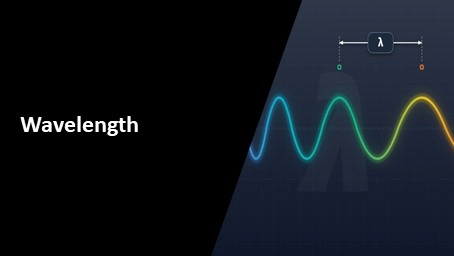
In this formula, a is the radius of the fiber core, λ (lambda) is the wavelength of the light in a vacuum, n1 is the refractive index of the core and n2 is the refractive index of the cladding.
This formula gives a dimensionless number which helps us know about the modal properties of the fiber. The larger the V number, the more modes it will be able to support; the smaller the V number, the closer to single-mode operation.
Need to calculate V-Number?
Don’t guess. Use our online tool to instantly determine if your fiber is Single Mode or Multimode based on core radius and wavelength.
Open Calculator →Why can’t you just use standard telecom fiber for a blue laser? The graph below visualizes the physics behind this common engineering problem. By plotting the V-Number against wavelength, we can compare Standard SMF-28 (8.2 µm fiber core size) against specialized visible spectrum fiber (2.5 µm fiber core size ). Notice how the standard fiber shoots up into the multimode region at 450nm, while the smaller core successfully forces the light to stay within the Single Mode limit.

Interactive V-number visualizer
You could use the slider below to simulate how the V-Number changes the physics of an optical fiber. Drag the value past the critical cutoff of 2.405 to watch the transition from a clean Single Mode Gaussian beam to a chaotic Multimode speckle patter
Interactive V-Number Visualizer
2.405
Drag slider to change V-Number. Note how the core size increases and light becomes chaotic (Multimode) after 2.405.
Principal usage of V number
The V number thus becomes an important factor in the design of optical fibers and their optimizations, using which the desired parameters in the fibre may be obtained by changing the core diameter and the refractive indices. This makes it helpful in developing fibers with specific properties and performance desired in modal characteristics. Hence, the first and foremost application of the V-number is the identification of the mode of fiber, which means identifying whether an optical fiber will act as a single mode or multimode. If the V number is less than 2.405, then it acts like a single-mode fiber. Single-mode fibers can propagate only one mode of light and are quite essential to be used for communication at high bandwidths for longer distances and also in certain high precision material processing. This is because single-mode fibers have very low modal dispersion, hence increasing the data transmission rate with good signal quality. If it is is greater than this threshold value, then the fiber becomes a supporter of multiple modes. Multi-mode fibers normally find their applications in cases where high data rates are not crucial with relatively small lengths of fiber.
The V number is closely related to the cutoff wavelength, the wavelength above which a particular mode cannot propagate in the fiber.
Conclusion
The V number is considered the most basic parameter in the process of optical fiber design, which, in fact, essentially ascertains how fibers guide the light and what propagation modes they can support. Calculating the V number allows the fine-tuning of fibers, by engineers and scientists, to fit a wide range of application demands.
Frequently Asked Questions
Did You Know?
- The precise cutoff value of 2.405 is not a random number; it is mathematically derived as the first zero (root) of the Bessel function J₀(x). This mathematical root defines the exact physical boundary where the fiber transitions from supporting a single mode to multiple modes.
- The V number is a critical predictor for how sensitive a fiber will be to physical bending. Fibers operating with a V parameter very close to 2.405 have weaker mode confinement, making them significantly more susceptible to signal loss from macro-bending.
- This single equation was instrumental in standardizing optical fiber manufacturing globally. By clearly defining the “Single Mode Cutoff” based on core radius and refractive index, it allowed manufacturers to produce compatible cables at scale, leading directly to the explosion of the optical telecommunications industry.