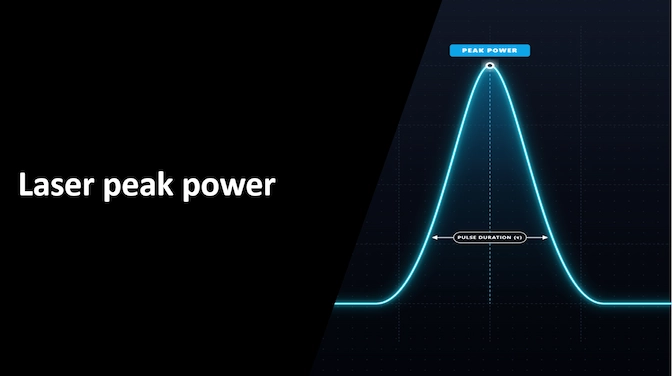
In the world of photonics, not all watts are created equal. While average power tells you how much energy a laser delivers over time, Laser Peak Power tells you the intensity of the blow.
Defined as the highest power level achieved during a single optical pulse, peak power is the critical parameter that determines whether a laser will gently warm a surface or instantly vaporize it. Whether you are performing delicate LASIK surgery, conducting high-harmonic generation research or cutting industrial steel, accurate calculation of peak power is the difference between success and catastrophic component failure.
How to Calculate Peak Power
To accurately calculate peak power, you first need to understand that most pulsed lasers don’t output energy in a continuous, flat stream. Instead, they pack their energy into incredibly brief, intense bursts.
To find the peak power of a laser pulse, you need to know three fundamental parameters of your laser system:
The basic mathematical formula to calculate peak power is:
💡 Real-World Example
To illustrate, consider a laser with the following parameters:
- Average Power: 10 W
- Repetition Rate: 1 kHz (1,000 pulses per second)
- Pulse Duration: 100 ns (100 × 10-9 seconds)
Step 1: Convert units to standard seconds and Hz
100 ns = 0.0000001 seconds
Step 2: Plug into the formula
Peak Power = 10 W / (1,000 Hz × 0.0000001 s)
Peak Power = 10 W / 0.0001
*This example underscores that even with a modest average power of just 10W, the peak power can be massive due to the incredibly short duration of the pulses.
Verify your laser intensity and pulse energy using our free calculator below. Simply enter your average power, repetition rateand duration.
⚡ Laser Peak Power Calculator
Enter your laser parameters and select your units below.
The Pulse Shape Factor
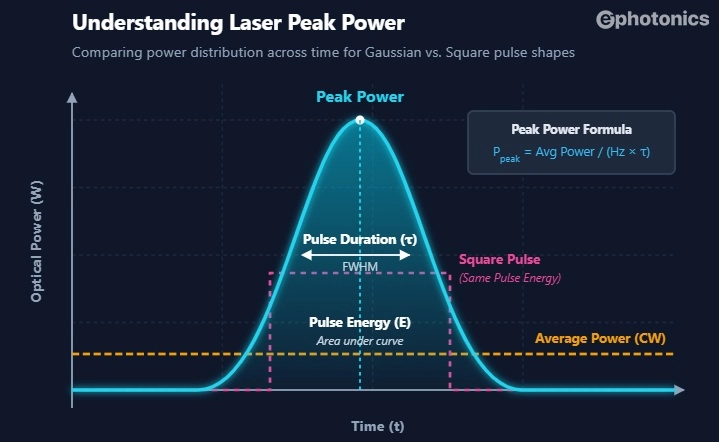
As shown in the graph at the top of this article, the standard formula assumes an ideal Square Pulse (the pink dashed line) where the laser turns on instantly, maintains a flat peak, and turns off instantly. However, in reality, most practical lasers produce a Gaussian Pulse (the glowing blue curve). Because a Gaussian pulse tapers off at the edges, its energy is more concentrated in the temporal center.
This means that for two pulses with the exact same total energy, the true peak of a Gaussian pulse will be approximately 6.4% higher than that of a square pulse. To account for this in the field, engineers use a correction factor (often ~0.94 for FWHM measurements) to determine the absolute highest power level reached at the very tip of the pulse.
Calculating Peak Power for Gaussian Pulse Shapes
In the real world, most lasers do not produce a Top-Hat (Square) pulse. Instead, they follow a Gaussian distribution, a bell-shaped curve where energy is most concentrated in the center. Because the power level rises and falls gradually, the standard Peak Power formula requires a correction factor to account for the integration of the area under the curve.
The first step in calculating the peak power for a Gaussian pulse shape is to identify the fundamental parameters: the pulse energy (E), pulse duration (τ), and beam characteristics. The mathematical expression for Gaussian pulses draws on these parameters. For a Gaussian pulse, the peak power (Ppeak) can be derived by understanding the relationship between pulse energy and the temporal profile of the pulse. The temporal profile for a Gaussian pulse is given by the equation:
Gaussian-Specific Formula (FWHM)
The “Magic Constant”: While a square pulse is simple division, a Gaussian pulse integrated over time yields a coefficient of approximately 0.9394. For practical engineering, multiplying your standard result by 0.94 gives you the true maximum amplitude at the FWHM center.
Non-Gaussian Pulse Shapes: Chirped Pulses
While Gaussian and Square profiles dominate standard industrial lasers, high-performance ultrafast systems utilize a far more complex distribution: the Chirped Pulse.
These are the important components of Chirped Pulse Amplification (CPA), the Nobel Prize-winning technology used to create the world’s most powerful lasers. In a chirped pulse, the frequency (color) changes across the pulse duration. By “stretching” the pulse in time, engineers can amplify the laser energy without destroying the optical crystals, before “compressing” it back down to achieve massive, petawatt-level peak powers.
To determine the instantaneous peak intensity of a chirped pulse, we must model the temporal distribution using a specialized intensity function (I(t). This mathematical profile accounts for the time-dependent phase shift and central frequency as shown below:
Importance of Calculating Laser Peak Power
In high-precision photonics, an error in peak power calculation isn’t just a mathematical mistake—it’s a risk to your equipment, your project, and your safety. Understanding the intensity of the “blow” is essential for four primary reasons given below
Protecting Optical Longevity
Every lens and coating has a Damage Threshold (LIDT). If peak power exceeds this, you risk instantaneous coating delamination or bulk failure, causing permanent hardware destruction.
Precision Material Processing
In cutting and engraving, the ratio of peak-to-average power determines the Heat-Affected Zone (HAZ). Proper control ensures vaporization over melting, delivering much cleaner edges.
Operational & Lab Safety
Accurate peak power data is the foundation of every Laser Safety Officer’s (LSO) nominal ocular hazard distance (NOHD) calculation. Errors here lead to direct biological safety risks.
Ensuring Research Reproducibility
Experiments such as Multi-photon Microscopy rely on non-linear effects that are exponentially dependent on peak intensity. Precise math is required to ensure consistent, valid data.
Protecting Components from Potential Damages
In sensitive laser systems especially in the high-power or high-energy laser architectures, overexposure to uncalculated peak power often leads to catastrophic, irreversible damage. When the peak intensity of a pulse exceeds a component’s Laser-Induced Damage Threshold (LIDT), the physical structure of the optic begins to break down. This degradation typically manifests as surface pitting where micro-craters permanently scatter the beam’s energy or as coating ablation, which violently strips away critical anti-reflective (AR) layers. In extreme cases involving ultra-high peak powers, the sheer force of the pulse can even cause bulk failure, creating internal stress fractures deep within the glass or crystal substrates.
The threat of excessive peak power extends far beyond passive optics; it actively degrades the driving electronics and the laser diodes themselves. Sudden, unmanaged high-energy spikes can trigger Electrical Overstress (EOS), leading to instantaneous junction breakdown within the semiconductor material. Even if a pulse does not cause an immediate catastrophic failure, repeated exposure to these aggressive, high-intensity thermal cycles induces thermal drift and accelerates facet degradation, drastically reducing the operational lifespan of your laser source.
Eliminating these multi-faceted risks requires a proactive approach to optical design, precise peak power calculations, and real-time system monitoring. By selecting optical materials with sufficiently high damage thresholds and pairing them with highly stable, regulated laser diode drivers, engineers can effectively safeguard their hardware. Ultimately, anticipating the true peak intensity of every pulse is the only way to ensure the long-term reliability and safety of advanced photonic systems.
Technical Note: Thermal Lensing
Beyond physical damage, excessive peak power causes the refractive index of a lens to change locally due to rapid heat absorption. This Thermal Lensing effect severely distorts the beam path, creating unintended focus shifts and degrading the optical performance of your entire system even if the glass itself does not break.
Conclusion
In conclusion, while a laser’s average power measures its total energy over time, its peak power dictates the true intensity and physical impact of each individual pulse. As we have seen, relying on average power alone or failing to account for the exact shape of a Gaussian or chirped pulse is a fast track to exceeding your equipment’s damage thresholds.
Whether you are optimizing the heat-affected zone in industrial manufacturing or protecting sensitive optical coatings in a research lab, precision is non-negotiable. By accurately calculating and controlling your laser’s peak power, you eliminate the guesswork, safeguard your hardware, and ensure the consistent, high-quality results your applications demand.
Need precise control over your laser pulses?
Explore ephotonics’ line of ultra-stable laser diode drivers and TEC controllers, built for demanding industrial and scientific integration.
Frequently Asked Questions
Ppeak = Pulse Energy (E) / Pulse Duration (τ)
If you only know the average power, the formula expands to: Average Power / (Repetition Rate × Pulse Duration). For real-world Gaussian pulses, engineers multiply the final result by a shape factor (approx. 0.94) to find the exact peak at the FWHM center.
Did You Know?
- For a fraction of a second, a laser can outpower the entire Earth. The world’s most powerful lasers (like those at the Extreme Light Infrastructure) reach peak powers of 10 Petawatts (1016 W). During that femtosecond pulse, the laser generates more than 1,000 times the electrical power produced by the entire global power grid combined!
- In delicate eye surgeries like LASIK, extremely high peak power is used for “Cold Ablation.” By packing energy into ultrafast femtosecond pulses, the peak intensity becomes high enough to strip electrons directly from tissue molecules. Because the average power remains incredibly low, the surrounding eye tissue doesn’t have time to heat up or burn.
- If laser peak power is high enough, it can ignite thin air. When peak intensity exceeds approximately 1011 W/cm², the electric field of the light literally rips electrons away from oxygen and nitrogen molecules in the room. This creates a miniature lightning bolt in mid-air, a phenomenon known as Laser-Induced Breakdown.
- In 2018, the Nobel Prize in Physics was awarded for the invention of Chirped Pulse Amplification (CPA). To safely create massive peak powers, scientists had to stretch the laser pulse over time, amplify it, and then re-compress it. Without this trick, the extreme peak power would instantly shatter the laser’s own internal mirrors and crystals. Read the Nobel Prize Physics Background.