Spectral Range Calculator
Free Spectral Range · Cavity Length · Optical Frequency
ephotonics
linkedin.com/company/ephotonics
Follow our page for weekly laser engineering guides, photonics tutorials, and new calculator releases directly in your feed.
Follow on LinkedInHow the Spectral Range (FSR) Calculator Works
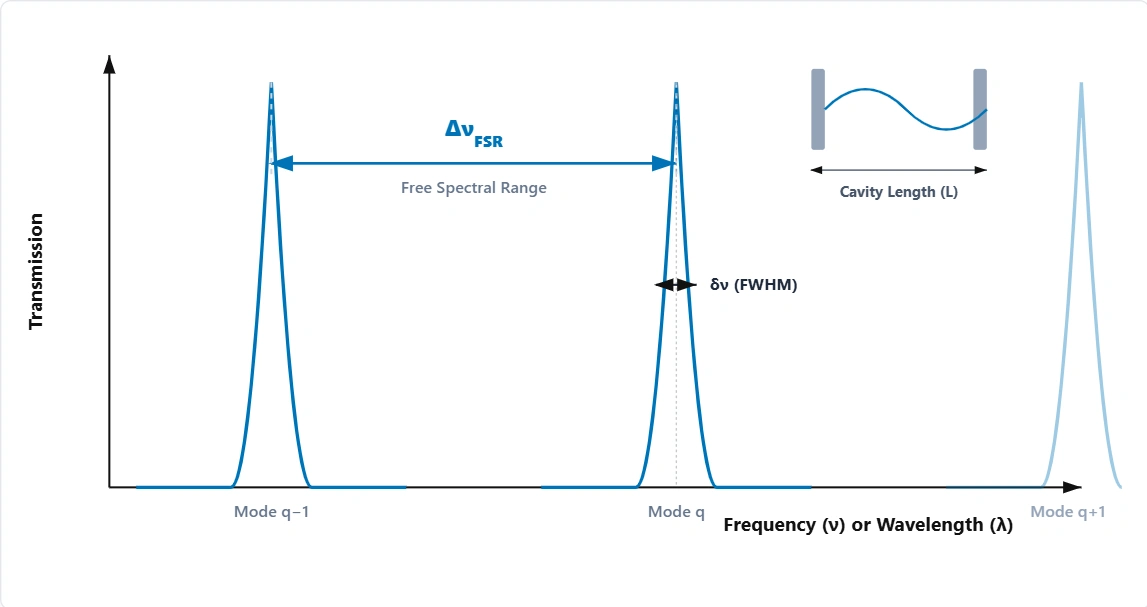
The Free Spectral Range (FSR) represents the axial spacing between two consecutive longitudinal modes (resonances) of an optical cavity. In laser physics and interferometry, this value determines the maximum frequency range over which a device can operate without overlapping spectral orders.

Where the variables are:
- c Speed of Light: $\approx 2.99 \times 10^8$ m/s.
- L Cavity Length: Physical distance between resonator mirrors.
- n Refractive Index: Index of the medium inside the cavity.
- \(\lambda_0\) Center Wavelength: Operating wavelength of the source.
Why calculate Free Spectral Range?
- Laser Design: Determines the spacing of longitudinal cavity modes.
- Spectroscopy: Defines the bandwidth of Fabry-Perot etalons.
- Telecom: Essential for Wavelength Division Multiplexing (WDM) filter design.
- Sensing: Used in ring-resonator gyroscopes and sensors.
Understanding Cavity Resonances
An optical cavity (resonator) acts like a filter that only allows certain wavelengths to exist inside it. These allowed wavelengths are called Longitudinal Modes. The spacing between these modes—in frequency or wavelength—is the Free Spectral Range (FSR).
If the FSR is large (short cavity), the modes are widely spaced, making it easier to select a single mode for "Single Frequency" laser operation. If the FSR is small (long cavity), many modes can oscillate simultaneously, leading to mode-hopping or chaotic output.
Applications in Optics
1. Single Mode Lasers
To build a single-mode laser, the gain bandwidth of the medium must be narrower than the FSR. If the FSR is too small, multiple modes will fit under the gain curve, resulting in multimode operation. Engineers use this calculator to shorten the cavity length (L) until only one mode survives.
2. Fabry-Perot Etalons
Etalons are used to fine-tune wavelengths in spectroscopy. The FSR defines the "spectral window" you can scan before the transmission peaks repeat (overlap). Knowing the exact FSR ensures you don't confuse one order of interference with another.
3. Telecom WDM Filters
In fiber optics, Dense Wavelength Division Multiplexing (DWDM) packs many signals into one fiber. Optical filters (like Arrayed Waveguide Gratings) are designed with a specific FSR to separate these channels (e.g., 50 GHz or 100 GHz spacing).
4. Micro-Resonators
In integrated photonics (silicon chips), ring resonators have extremely small lengths (L < 1 mm). This results in a huge FSR (TeraHertz range), which is useful for creating wide-bandwidth filters and non-linear optical signal processing.