
How the Parallel Circuit Calculator Works
A parallel circuit connects every branch across the same two electrical nodes. The voltage is therefore identical across each resistor, while branch current depends on resistance. This parallel circuit calculator finds equivalent resistance, total conductance, source current, total power, and the current and power of every branch.
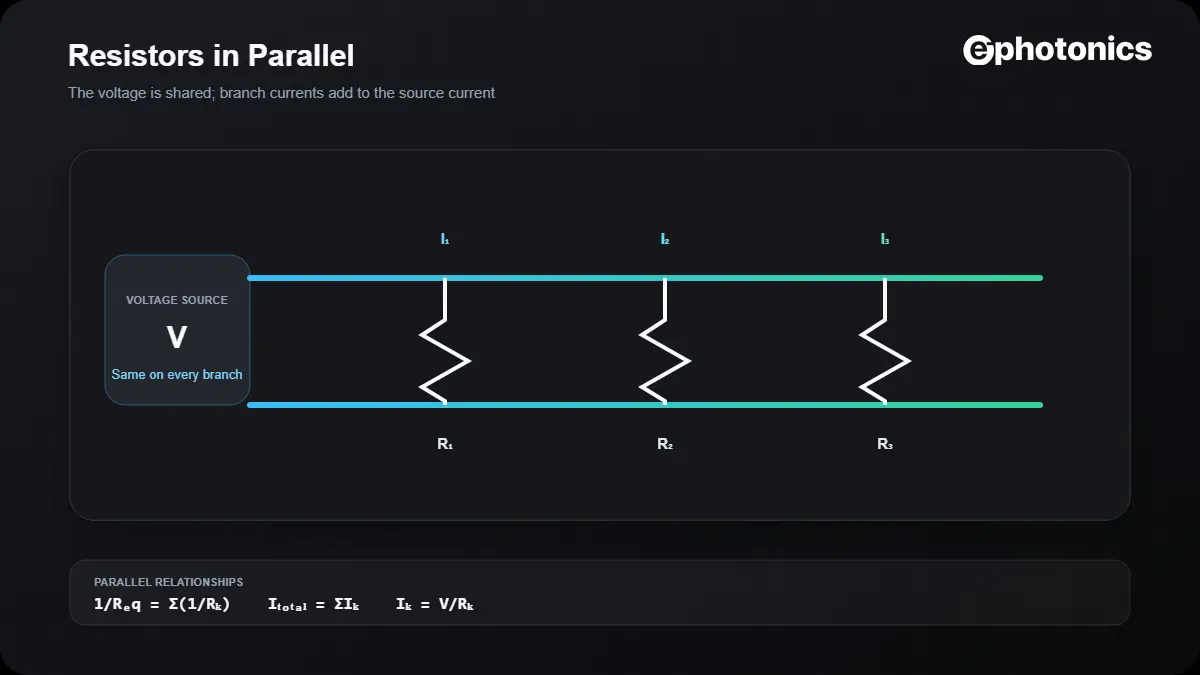
Parallel conductances add directly. Equivalent resistance is the reciprocal of total conductance.
Conservation of charge requires source current to equal the sum of all branch currents.
Each ideal resistor sees the full source voltage.
How to Use the Parallel Circuit Calculator
- Enter the voltage across the parallel network.
- Enter each branch resistance and select ohms, kilohms, or megohms.
- Add or remove branches as needed.
- Review equivalent resistance, total current, total power, and current sharing.
- Check each resistor’s required power rating and the source-current capability.
Fast reasonableness check: equivalent resistance must always be lower than the smallest positive branch resistance. Adding another finite parallel branch can only reduce equivalent resistance.
Worked Parallel Circuit Example
10 Ω, 25 Ω, and 15 Ω in parallel at 3 V
- Equivalent conductance:
1/10 + 1/25 + 1/15 = 0.2067 S - Equivalent resistance:
1/0.2067 ≈ 4.84 Ω - Branch currents:
0.30 A, 0.12 A, and 0.20 A - Total current:
approximately 0.62 A - Total power:
V × I ≈ 1.86 W
Why Current Splits in Parallel Branches
The branch with the lowest resistance carries the most current because every branch has the same voltage. Current division follows conductance: a branch that contributes 40% of the total conductance also carries 40% of the total current. This is why unequal wiring or connection resistance can disturb current sharing between nominally identical high-current loads.
| Property | Parallel circuit behavior | Design implication |
|---|---|---|
| Voltage | Same across every branch | Each branch must tolerate full source voltage |
| Current | Splits according to conductance | Lowest resistance carries highest current |
| Equivalent resistance | Below the smallest branch resistance | Source current increases as branches are added |
| Power | Branch powers add | Check each component and total source power |
| Open branch | Other branches can continue operating | Total current decreases |
Equal Resistors in Parallel
For N identical resistors of resistance R, the equivalent resistance is R/N. Their currents and power dissipation are equal only if resistance, wiring, connection resistance, temperature, and voltage are sufficiently matched. Power resistors can heat unevenly and drift, so intentional current sharing may require derating or ballast resistance.
Common Parallel Circuit Mistakes
- Adding resistance values directly as if they were in series.
- Assuming branch currents are equal when resistances differ.
- Forgetting that every branch receives full source voltage.
- Checking total power but not individual resistor power.
- Ignoring source internal resistance and current limit.
- Using nominal resistor values without tolerance or temperature coefficient.
- Parallel-connecting active sources that are not designed to share current.
Frequently Asked Questions
What stays the same in a parallel circuit?
Voltage is the same across every ideal branch connected to the same two nodes.
How do you calculate equivalent parallel resistance?
Add the reciprocal of each branch resistance, then take the reciprocal of that sum.
Why is equivalent resistance lower than the smallest resistor?
Each additional branch creates another current path, increasing total conductance and therefore reducing equivalent resistance.
How is total current calculated?
Add all branch currents, or divide source voltage by the equivalent resistance.
Can batteries or power supplies be placed in parallel?
Only when their design explicitly supports parallel operation and current sharing. This calculator models resistors, not active sources.