
Optical Fiber Latency & Delay Calculator
Fiber Length · Propagation Delay · Refractive Index
Compute signal propagation time or required fiber length.
ephotonics
linkedin.com/company/ephotonics
Follow our page for weekly laser engineering guides, photonics tutorials, and new calculator releases directly in your feed.
Follow on LinkedInHow the Fiber Latency Calculator Works
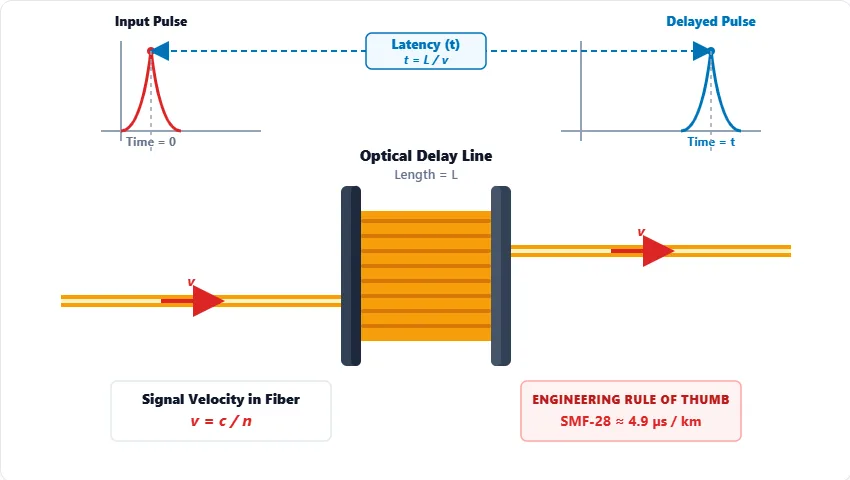
In a vacuum, light travels at an absolute speed of approximately 299,792 km/s. However, when light enters a physical medium like the silica glass core of an optical fiber, it slows down. This reduction in speed is determined by the material's Group Refractive Index (n).
Once the true velocity (v) of the light inside the fiber is known, calculating the latency (delay time) is a simple kinematic equation: Time = Distance / Velocity. Conversely, if an engineer requires a specific time delay, they can calculate the exact physical length of the fiber spool needed.
Understanding the Variables:
- t Latency / Delay (Seconds): The time it takes for an optical signal to travel from the input to the output of the fiber.
- L Length (Meters): The total physical length of the optical fiber link.
- v Velocity (m/s): The actual speed of light propagating through the specific fiber core.
- c Speed of Light in Vacuum: The fundamental physical constant (299,792,458 m/s).
- n Group Refractive Index: A dimensionless number representing optical density. (e.g., Corning SMF-28 fiber has an index of 1.4682 at 1550 nm).
Why Calculate Optical Fiber Latency?
It is a common misconception that data travels at the "speed of light" through telecommunications networks. In reality, light travels approximately 30% slower in optical fiber than it does in a vacuum due to the refractive index of the silica glass core. Calculating this exact propagation delay is critical for high-speed network routing, financial infrastructure, and advanced radar systems.
- The 4.9 µs Rule: Standard telecom fiber (SMF-28) introduces approximately 4.9 microseconds of latency per kilometer of distance.
- Index defines speed: The higher the refractive index (n) of the fiber core, the slower the optical signal travels.
- Optical Delay Lines: You can physically "store" an optical pulse for a fraction of a second by sending it through a massive spool of fiber.
- Path matching is critical: In interferometry, even a few millimeters of length difference between two fiber arms will cause massive phase delays.
Why Delay Lines & Latency Matter
1. High-Frequency Trading (HFT)
In algorithmic trading, milliseconds equal millions of dollars. Financial institutions utilize latency calculators to determine the exact length of optical fiber required to guarantee matching "ping times" between distant servers, ensuring fair algorithmic execution speeds across trading networks.
2. RF-over-Fiber & Radar
Modern phased-array radar systems use optical delay line spools to store microwave and RF signals in the optical domain. By precisely calculating the required length of fiber, engineers can delay returning radar pulses for exact microsecond intervals before routing them into the signal processor.
3. 5G/6G Network Synchronization
Telecommunication network nodes must be perfectly synchronized using the Precision Time Protocol (PTP). Calculating the end-to-end propagation delay of the long-haul fiber links allows engineers to calibrate timing offsets and prevent network data packet collisions.
4. Interferometry (OCT & Sensing)
In Mach-Zehnder interferometers or Optical Coherence Tomography (OCT) setups, the reference arm and the sample arm must have perfectly matched optical path lengths. If the delay difference exceeds the coherence length of the laser source, all interference fringes will be permanently washed out.