How the Laser Diode Lifetime Calculator Works
The Arrhenius Law of Reliability
Semiconductor laser diodes degrade over time due to crystal defects growing within the active region (often called "dark line defects"). Heat acts as a catalyst, significantly accelerating the movement and growth of these defects.
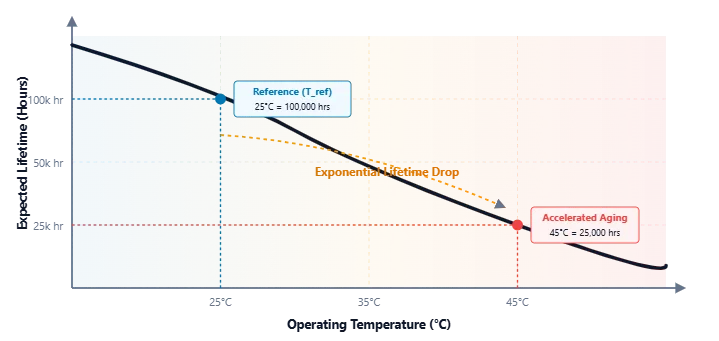
The relationship between operating temperature and diode lifetime follows the Arrhenius Equation. This formula calculates a thermal acceleration factor to predict exactly how much faster a device will fail at elevated temperatures compared to the baseline specification provided on its datasheet.
$$ L(T) = L_{ref} \cdot e^{\left[ \frac{E_a}{k_B} \left( \frac{1}{T} - \frac{1}{T_{ref}} \right) \right]} $$
Arrhenius Thermal Degradation Model
Where:
- \(L(T)\) : Expected lifetime at the new operating temperature.
- \(L_{ref}\) : Base lifetime at the reference temperature (from datasheet).
- \(E_a\) : Activation Energy. A constant describing the material's sensitivity to heat. Typical GaAs laser diodes range from 0.3 eV to 0.7 eV.
- \(k_B\) : Boltzmann's constant (\(8.617 \times 10^{-5}\) eV/K).
- \(T\) & \(T_{ref}\) : Operating and Reference temperatures, converted to Kelvin (K).
Rule of Thumb: For many standard telecom and industrial laser diodes, the operating lifetime is roughly cut in half for every 10°C increase in junction temperature.