Candela to Lumens Calculator
Candela (cd) · Lumens (lm) · Beam Angle
0.00 lm
Solid Angle: 0.00 steradians (sr)
How the Candela to Lumen Calculator Works
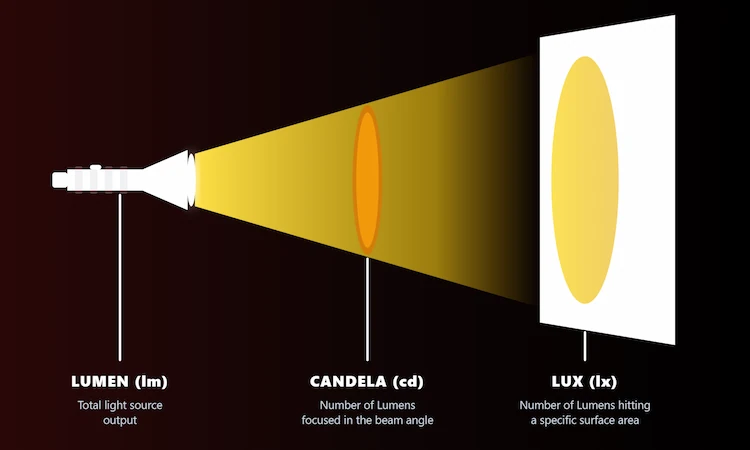
In photometry, a Candela measures how bright a light source appears in one specific direction. A Lumen, on the other hand, measures the total amount of light emitted in a defined beam cone. To convert between the two, you must know the size of the light cone, which is determined by the apex beam angle.
Key Variables
- I Luminous Intensity: Measured in Candelas (cd). It is the amount of light emitted in a specific direction.
- Φ (Phi) Luminous Flux: Measured in Lumens (lm). It is the total visible light emitted over a specific angle.
- Ω (Omega) Solid Angle: Measured in steradians (sr). It represents the 3D geometrical size of the light cone.
How to calculate the Solid Angle (Ω)
The conversion formulas above rely completely on the Solid Angle (Ω). Before converting to lumens or candela, the calculator must convert your 2D beam angle (θ) into a 3D steradian using this geometric formula:
Example: An omnidirectional lightbulb radiates light perfectly in a 360° sphere. If you plug 360° into the formula above, the solid angle is 4π steradians (12.566 sr). Therefore, a 1 candela omnidirectional bulb produces 12.57 lumens of total light.
Why convert Candela to Lumens
In the lighting and photonics industry, measuring brightness can be highly deceptive. A consumer shopping for a lightbulb might only look at the total lumens, but an optical engineer must also care about the candela.
While lumens tell you the absolute total amount of visible light pouring out of a source, the candela tells you how fiercely that light is concentrated in a specific direction. You cannot compare the brightness of a laser pointer to a ceiling lamp without knowing both values and understanding the geometric beam angle between them.
Real World Photometry Examples
Notice how highly focused beams have massive candela ratings but very few total lumens, while omnidirectional bulbs have huge lumens but very low candela.
| Light Source | Beam Angle | Candela (Peak) | Total Lumens |
|---|---|---|---|
| Wax Candle | 360° | 1 cd | 12.5 lm |
| Standard Lightbulb (100W) | 360° | 135 cd | 1,700 lm |
| LED Floodlight | 120° | 1,600 cd | 5,000 lm |
| Tactical Flashlight | 10° | 20,000 cd | 475 lm |
| Handheld Laser Pointer | 0.1° | 1,000,000+ cd | < 5 lm |
Engineering Applications
1. LED Lighting Design
When designing an LED light fixture for a home or office engineers must choose the proper reflector housing. A focused spotlight will require high candela to illuminate a desk while a room dome light requires high total lumens with a wide solid angle to evenly light the walls.
2. Flashlight and Tactical Gear
Manufacturers of searchlights often boast about throwing a beam thousands of meters. To achieve this throw they design custom optical lenses that squeeze a standard lumen output into an incredibly tight beam angle resulting in a massive candela output right in the center.
3. Laser Safety and Visibility
Lasers produce a highly collimated beam with an angle often measured in milliradians. Because the light does not spread out its candela measurement approaches infinity. This calculator helps photonics engineers convert tightly focused beams to gauge apparent brightness compared to ambient lighting.
4. Automotive Headlight Standards
Car headlights must obey strict government regulations. They need enough candela to pierce through fog and hit distant highway signs but the total lumen output and angle must be carefully calculated so they do not blind oncoming drivers.