How the Voltage Drop Calculator Works
Voltage drop is the reduction in voltage caused by current flowing through conductor resistance. This voltage drop calculator estimates round-trip wire resistance, volts lost in the cable, voltage available at the load, percentage drop, cable power loss, and a conductor size that meets the selected design target.
The model is intended for two-wire DC circuits and purely resistive single-phase loops. Enter one-way route length; the calculator automatically includes both outgoing and return conductors.
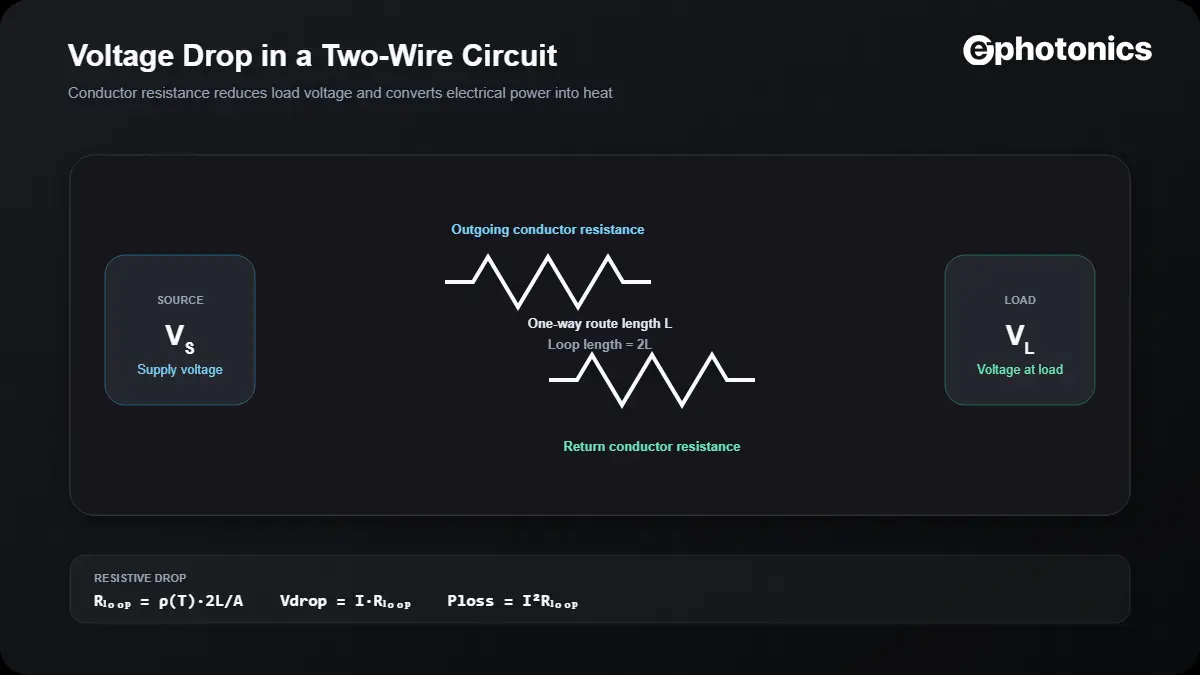
Resistance depends on material resistivity ρ, conductor temperature T, one-way length L, and cross-sectional area A.
Ohm’s law converts loop resistance and load current into conductor voltage drop.
Power dissipated in the cable rises with the square of current.
How to Use the Voltage Drop Calculator
- Enter source voltage and worst-case load current.
- Enter the one-way conductor length and choose metres or feet.
- Select copper or aluminum, conductor size, and estimated conductor temperature.
- Choose the maximum percentage drop allowed by your design.
- Review voltage at the load, power loss, efficiency, and suggested conductor size.
Why Conductor Temperature Matters
Metal resistance increases as temperature rises. A cable selected using only room-temperature resistance can experience more voltage drop after it heats under load or operates in a hot enclosure. The calculator adjusts reference resistivity using a linear temperature coefficient.
Important distinction: voltage-drop sizing and ampacity sizing answer different questions. A conductor can satisfy a voltage-drop target yet still be unsuitable for current capacity, insulation temperature, bundling, terminal rating, or installation code.
Worked Voltage Drop Example
12 V load using 14 AWG copper
Assume 3 A, a 5 m one-way run, and an estimated conductor temperature of 60°C.
- Round-trip length:
10 m - 14 AWG area:
approximately 2.08 mm² - Temperature-corrected loop resistance: calculated from copper resistivity
- Voltage drop:
I × Rloop - Load voltage:
12 V − Vdrop - Cable heating:
I²Rloop
What the Percentage Means
Percentage drop is Vdrop/Vsource × 100. The acceptable value is application-specific. Sensitive electronics, low-voltage lighting, actuators, and laser electronics may have tighter requirements than a load with a wide input range. Use the equipment manufacturer’s allowable input range and the applicable electrical standard rather than assuming one universal percentage.
| Change | Effect on drop | Reason |
|---|---|---|
| Double current | Approximately doubles voltage drop | Vdrop = IR |
| Double route length | Approximately doubles drop | Resistance is proportional to length |
| Double conductor area | Approximately halves drop | Resistance is inversely proportional to area |
| Increase temperature | Increases drop for copper and aluminum | Resistivity rises with temperature |
| Increase source voltage at same power | Can reduce drop | Higher voltage permits lower current |
Common Voltage Drop Mistakes
- Entering round-trip length when the calculator already doubles one-way length.
- Using nominal rather than peak or continuous worst-case current.
- Ignoring terminal, connector, fuse, relay, and PCB-trace resistance.
- Using room-temperature resistance for a hot cable.
- Confusing voltage drop with conductor ampacity.
- Applying a DC resistance model to long AC runs where reactance and power factor matter.
- Ignoring startup current for motors, solenoids, TECs, and capacitive loads.
Safety note: conductor selection must satisfy overcurrent protection, insulation, ampacity, installation method, fault current, and applicable electrical rules. This calculator addresses resistance-based voltage drop only.
Frequently Asked Questions
What is voltage drop?
Voltage drop is the voltage lost when current flows through resistance in conductors, connections, switches, protection devices, and other series elements.
Do I enter one-way or total wire length?
Enter one-way route length. This calculator multiplies it by two for the outgoing and return conductors.
Why is cable power loss proportional to current squared?
Combining P = VI with V = IR gives P = I²R. Doubling current therefore creates four times the resistive heating at the same resistance.
Does this calculator determine safe wire ampacity?
No. Ampacity depends on conductor, insulation, ambient temperature, bundling, installation method, terminals, and governing standards.
Can I use this for three-phase AC?
Not directly. Three-phase and long AC circuits can require phase configuration, power factor, conductor reactance, and code-specific methods.