
How the Beer-Lambert Law Calculator Works
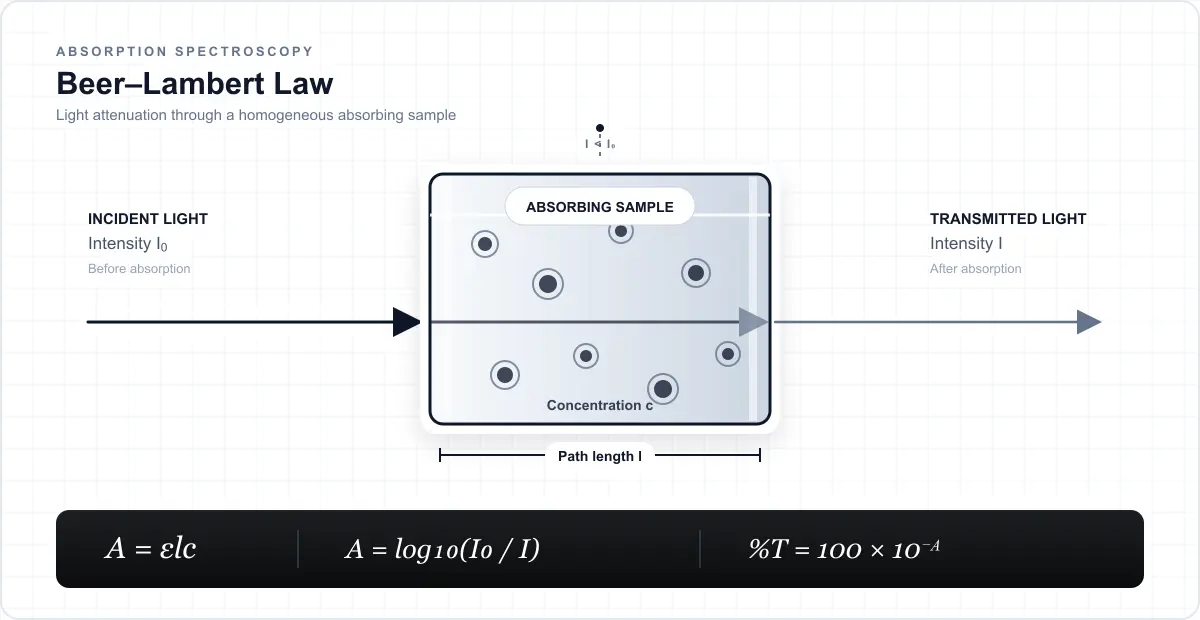
The Beer-Lambert law connects the amount of light absorbed by a sample with the concentration of the absorbing species and the distance the light travels through it. In practical spectroscopy, it turns a measured absorbance into useful information about a solution. If three values are known, the remaining value can be calculated from the relationship (A = \varepsilon lc).
This Beer-Lambert law calculator can solve for absorbance, concentration, molar absorptivity, or optical path length. It also converts between absorbance and percent transmittance, which is helpful when an instrument or datasheet reports one quantity but your calculation requires the other.
$$ A = \varepsilon lc $$
$$ T = \frac{I}{I_0} = 10^{-A} $$
$$ \%T = 100 \times 10^{-A} $$
$$ c = \frac{A}{\varepsilon l} $$
Beer-Lambert, Transmittance and Concentration EquationsWhere the variables are:
- A (Absorbance): A dimensionless logarithmic measure of how strongly the sample attenuates light at the selected wavelength.
- ε (Molar Absorptivity): A wavelength-dependent measure of how strongly a chemical species absorbs light, commonly expressed in L·mol⁻¹·cm⁻¹.
- l (Optical Path Length): The distance traveled by light through the sample. A standard UV-Vis cuvette often has a 1 cm path length.
- c (Concentration): The amount concentration of the absorbing species, normally entered in mol/L, mmol/L, µmol/L, or nmol/L.
- T (Transmittance): The fraction of incident light that passes through the sample, equal to the transmitted intensity (I) divided by the incident intensity (I_0).
Why Use a Beer-Lambert Law Calculator?
- UV-Vis spectrophotometry: Determine an unknown solution concentration from its measured absorbance.
- Biochemistry: Estimate protein, DNA, RNA, dye, or cofactor concentration using an appropriate extinction coefficient.
- Quality control: Compare batches, monitor color strength, and confirm whether a sample remains within a calibrated concentration range.
- Reaction monitoring: Follow changes in a light-absorbing reactant or product as a chemical or biochemical reaction proceeds.
- Optical measurements: Convert between absorbance, transmittance, and transmitted-light percentage.
Rearranging the equation by hand is straightforward, but unit conversions are an easy place to make mistakes. A path length entered in millimeters must be converted consistently with an absorptivity given per centimeter, and a concentration in micromoles per liter must be converted before it is used with L·mol⁻¹·cm⁻¹. The calculator handles those conversions while keeping the underlying equation visible.
Absorbance, Transmittance and Percent Transmittance
Transmittance describes how much light gets through a sample. If half of the incident light reaches the detector, the transmittance is 0.5, or 50%. Absorbance expresses the same measurement on a base-10 logarithmic scale. That logarithmic form is what makes absorbance proportional to concentration under Beer-Lambert conditions.
Low Absorbance
An absorbance of 0 means the idealized sample transmits 100% of the measured light. An absorbance of 0.301 corresponds to about 50% transmittance.
Each Absorbance Unit
An absorbance of 1 corresponds to 10% transmittance. Increasing absorbance to 2 reduces transmittance to 1%, a further tenfold decrease.
Linear Concentration Response
When molar absorptivity and path length stay constant, doubling the concentration should double the absorbance within the valid linear range.
Wavelength Matters
A sample can absorb strongly at one wavelength and weakly at another. Quantitative work commonly uses a suitable absorption maximum for better sensitivity.
Calculating Concentration from Absorbance
Finding concentration from absorbance is one of the most common uses of the Beer-Lambert equation. Divide the measured absorbance by the product of molar absorptivity and optical path length. All units must be compatible before performing the calculation.
A sample has an absorbance of 0.650 at the analytical wavelength. Its molar absorptivity is 12,500 L·mol⁻¹·cm⁻¹, and it is measured in a 1.00 cm cuvette.
$$ c = \frac{0.650}{(12{,}500)(1.00)} = 5.20 \times 10^{-5}\ \mathrm{mol/L} $$
The calculated concentration is 5.20 × 10⁻⁵ mol/L, or 52.0 µmol/L.
In routine laboratory analysis, a calibration curve is often preferred over relying on a published molar absorptivity. Measuring several standards captures the behavior of the complete method, including the instrument, cuvette, solvent, reagents, and sample preparation. The slope of absorbance versus concentration can then be used to calculate unknown samples within the validated range.
When Does the Beer-Lambert Law Stop Being Linear?
The equation describes an ideal relationship, but real measurements can depart from a straight line. A result from an absorbance calculator is only as reliable as the values and experimental conditions entered. Unexpected nonlinearity is often a useful sign that the sample or measurement method needs closer attention.
High Concentration
At higher concentrations, absorbing molecules may interact and the optical properties of the solution can change. Diluting the sample may restore a linear response.
Stray or Broadband Light
Stray light and a spectral bandwidth that is too wide can make measured absorbance lower than expected, especially for strongly absorbing samples.
Scattering and Turbidity
Particles, bubbles, emulsions, and cloudy samples redirect light. The detector may interpret this loss as absorption even when scattering is responsible.
Chemical Changes
Association, dissociation, complex formation, pH shifts, or photochemical reactions can change the absorbing species and its molar absorptivity.
Beer-Lambert Law FAQ
What is the Beer-Lambert law?
The Beer-Lambert law states that absorbance is proportional to the concentration of an absorbing species and the optical path length through the sample. It is commonly written as A = εlc, where ε is the molar absorptivity, l is path length, and c is concentration.
How do I calculate concentration from absorbance?
Rearrange the equation to c = A/(εl). Divide the measured absorbance by molar absorptivity multiplied by path length. If ε is expressed in L·mol⁻¹·cm⁻¹, use path length in centimeters to obtain concentration in mol/L.
Does absorbance have units?
Absorbance is dimensionless because it is calculated from the logarithm of an intensity ratio. Instruments sometimes display AU, meaning absorbance units, but this is a reporting label rather than a physical unit.
What is the difference between absorbance and transmittance?
Transmittance is the fraction of incident light that passes through a sample, T = I/I₀. Absorbance is its negative base-10 logarithm, A = −log₁₀(T). High transmittance means low absorbance, while low transmittance means high absorbance.
Is molar absorptivity the same as the extinction coefficient?
The terms are often used interchangeably in laboratory work, although molar absorptivity or molar absorption coefficient is more precise. Always check the units because some extinction coefficients are reported for mass concentration instead of molar concentration.
Why is a 1 cm cuvette commonly used?
A 1 cm optical path is a widely adopted spectrophotometry standard. It simplifies comparison between measurements and reference data, and it makes A = εc when the path length is exactly 1 cm. Microvolume instruments may use much shorter effective paths.
What absorbance range should I use?
The useful range depends on the instrument and method. Very low absorbance can be dominated by baseline noise, while very high absorbance leaves little transmitted light and increases the effect of stray light. Use your instrument's validated range and dilute samples that fall outside the linear calibration.
Can the Beer-Lambert law be used for mixtures?
If several species absorb at the same wavelength and behave independently, their absorbances can be additive. Determining each concentration generally requires measurements at multiple wavelengths or another method that separates overlapping spectral contributions.