
Understanding Ohm's Law
Ohm's Law is the most fundamental principle in electronics and electrical engineering. It describes the relationship between Voltage, Current, and Resistance in an ideal conductor. Discovered by Georg Ohm in 1827, it states that the current through a conductor between two points is directly proportional to the voltage across those points.
$$V = I \times R$$
$$I = \frac{V}{R} \quad \text{and} \quad R = \frac{V}{I}$$
The Fundamental Ohm's Law FormulasWhere:
- \(V\) Voltage, measured in Volts (V).
- \(I\) Current, measured in Amperes (A).
- \(R\) Resistance, measured in Ohms (Ω).
- \(P\) Power, measured in Watts (W).
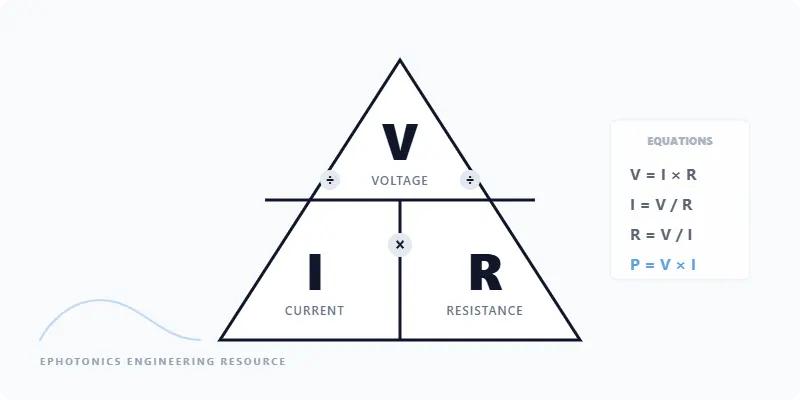
Figure 1: The Ohm's Law Magic Triangle. This visual representation allows for easy transposition of the formula. To find a value, cover the letter in the triangle: covering V leaves I × R; covering I leaves V / R.
Adding Power (Joule's Law)
While Ohm's law defines the relationship between the three main variables, Power (P) tells us how much energy is being consumed or dissipated by a component (often as heat). By combining Ohm's law with Joule's Law (\(P = V \times I\)), we can calculate any value if two are known.
Practical Implications
- Fixed Voltage: If you keep voltage the same but decrease resistance, the current will rise (dangerous for fuses!).
- Fixed Resistance: If you increase the voltage across a resistor, the current flowing through it increases proportionally.
- Heat Dissipation: Power increases with the square of the current (\(P = I^2R\)). Doubling the current quadruples the heat.
Typical Resistance & Power Values
Logarithmic comparison of electrical resistance across common materials
mΩ
Ω
kΩ
MΩ
GΩ
Copper Wire (1m)
Incandescent Bulb
Loudspeaker (RF)
Human Skin (Dry)
ESD Wrist Strap
Cable Insulation
Note: Values are approximations for educational context. Actual resistance varies by temperature and material quality.