Photodiode Responsivity & QE Calculator
Quantum Efficiency · Photocurrent · Noise Equivalent Power
ephotonics
linkedin.com/company/ephotonics
Follow our page for weekly laser engineering guides, photonics tutorials, and new calculator releases directly in your feed.
Follow on LinkedInHow the Responsivity Calculator Works
A photodiode converts incident photons (optical power) into electrons (electrical current). The efficiency of this conversion depends heavily on the wavelength of the light and the material of the sensor. Responsivity (\(R\)) measures the electrical current generated per watt of incident light, while Quantum Efficiency (QE) is the percentage of incident photons that successfully create an electron-hole pair.
Where:
- \(R\) Responsivity in Amperes per Watt (A/W).
- \(QE\) Quantum Efficiency as a decimal (e.g., 0.80 for 80%).
- \(\lambda\) Wavelength of the light in nanometers (nm).
- \(1239.8\) A fundamental constant representing \(\frac{h \cdot c}{q}\) (Planck's constant \(\times\) speed of light \(\div\) elementary charge).
Understanding Noise Equivalent Power (NEP)
In real-world applications, your signal must be stronger than the intrinsic noise of the detector. If no light is hitting the sensor, it still generates a tiny amount of Dark Current (\(I_d\)). The Noise Equivalent Power (NEP) tells you the absolute minimum optical power required to generate a signal equal to this noise floor (a Signal-to-Noise Ratio of 1).
Quick Reference
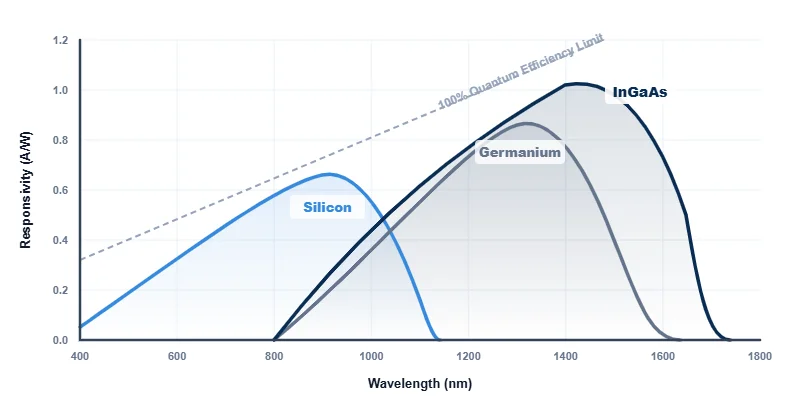
- Silicon (Si): Best for visible light and NIR (400 nm to 1100 nm). Ideal for 850 nm datacom links.
- Indium Gallium Arsenide (InGaAs): Best for Telecom bands (900 nm to 1700 nm). Peak responsivity is extremely high around 1550 nm.
- Cooling matters: Thermoelectric cooling (TEC) significantly reduces dark current, which directly lowers the NEP and improves your minimum detectable power.
- Linearity limit: If you exceed the maximum optical power threshold (saturation), the responsivity drops and the current is no longer linearly proportional to the incoming light.
Typical Peak Responsivity by Material
Average peak Amperes per Watt (A/W) based on standard sensor bandgaps.
Why Calculate Photodiode Parameters?
In optical communication, LIDAR, and laser spectroscopy, detecting light is just as critical as emitting it. Because photodiodes are not perfectly efficient—and because photon energy changes with wavelength—engineers must calculate exactly how much measurable electrical current will be generated by an incoming optical signal to design functional receiver hardware.
- Wavelength Dependence: Responsivity is heavily dependent on the wavelength of light. A Silicon sensor behaves completely differently at 532 nm vs. 900 nm.
- Physics vs. Hardware: Quantum Efficiency (QE) measures the actual physics (photons to electrons). Responsivity (A/W) translates it into practical engineering metrics.
- Noise is the Limit: Your signal is only useful if it sits above the Noise Equivalent Power (NEP).
- Cooling Helps: Using a TEC to cool the photodiode dramatically lowers Dark Current, which lowers NEP and allows you to detect weaker signals.
Why These Specifications Matter in System Design
1. Choosing the Right Material
Every semiconductor has a "bandgap." If a photon's energy is lower than this gap, the material is transparent to it. This is why you cannot use cheap Silicon (Si) detectors for 1550 nm fiber telecom; the photons lack the energy to excite the electrons. Instead, you must switch to InGaAs or Germanium, which have lower bandgaps and high responsivity at infrared wavelengths.
2. Sizing the Transimpedance Amplifier (TIA)
A photodiode outputs a tiny current (microamps or nanoamps). Microcontrollers read voltage, not current. Engineers must pass this photocurrent through a Transimpedance Amplifier (TIA) with a specific resistor value to convert it into a readable voltage. If you don't know your exact Responsivity (A/W), you cannot size your TIA correctly, resulting in either a saturated or undetectable signal.
3. Link Budget & Signal-to-Noise Ratio
In a telecom network or LIDAR system, a laser beam drops dramatically in power before hitting the detector due to fiber attenuation or atmospheric scattering. Calculating the Photocurrent lets you determine if your remaining signal will be successfully interpreted by the receiver, or if it will be lost in the electronic noise.
4. The Noise Floor (NEP)
Even in complete darkness, thermal energy causes a small number of electrons to flow across the diode junction (Dark Current). This creates a "noise floor." The Noise Equivalent Power (NEP) calculation tells you the absolute minimum amount of light you need to overcome this noise, giving you the theoretical detection limit of your optical system.
Related Engineering Tools
Photodiode receivers in telecom use dBm. Convert your signal to linear Watts first to calculate photocurrent.
OD to TransmissionUsing an ND filter in front of your photodiode to prevent saturation? Calculate the precise power drop.
TEC Thermal LoadLower your detector's dark current and NEP by calculating the active cooling required from a Thermoelectric Cooler.