
How the Fiber Latency Calculator Works
In a vacuum, light travels at an absolute speed of approximately 299,792 km/s. However, when light enters a physical medium like the silica glass core of an optical fiber, it slows down. This reduction in speed is determined by the material's Group Refractive Index (n).
Once the true velocity (v) of the light inside the fiber is known, calculating the latency (delay time) is a simple kinematic equation: Time = Distance / Velocity. Conversely, if an engineer requires a specific time delay, they can calculate the exact physical length of the fiber spool needed.
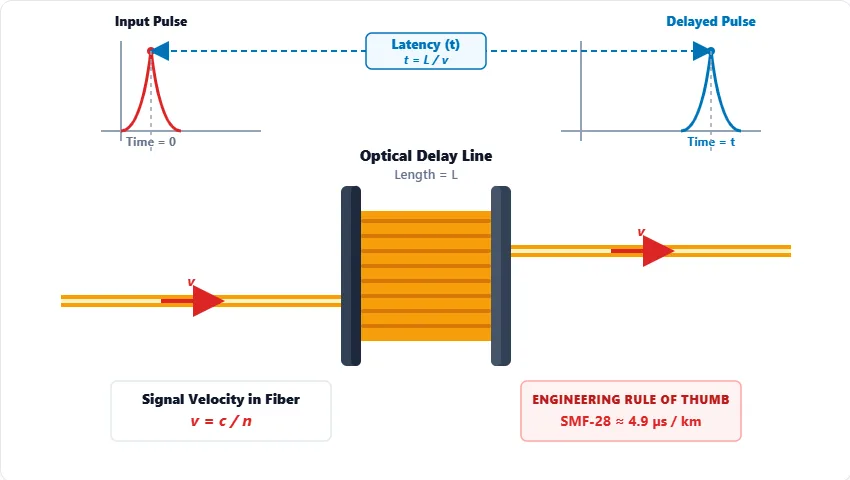
Understanding the Variables:
- t Latency / Delay (Seconds): The time it takes for an optical signal to travel from the input to the output of the fiber.
- L Length (Meters): The total physical length of the optical fiber link.
- v Velocity (m/s): The actual speed of light propagating through the specific fiber core.
- c Speed of Light in Vacuum: The fundamental physical constant (299,792,458 m/s).
- n Group Refractive Index: A dimensionless number representing optical density. (e.g., Corning SMF-28 fiber has an index of 1.4682 at 1550 nm).
Engineering Application: HFT & Optical Delay Lines
This calculation is critical in two major industries. In High-Frequency Trading (HFT), telecom engineers use latency calculations to match the precise "ping time" between competing financial servers by adding spools of fiber to faster networks. In Radar & Photonics Laboratories, researchers use specific lengths of fiber as analog "Delay Lines" to store optical pulses for exact microsecond intervals before processing them.