
How the Wall-Plug Efficiency Calculator Works
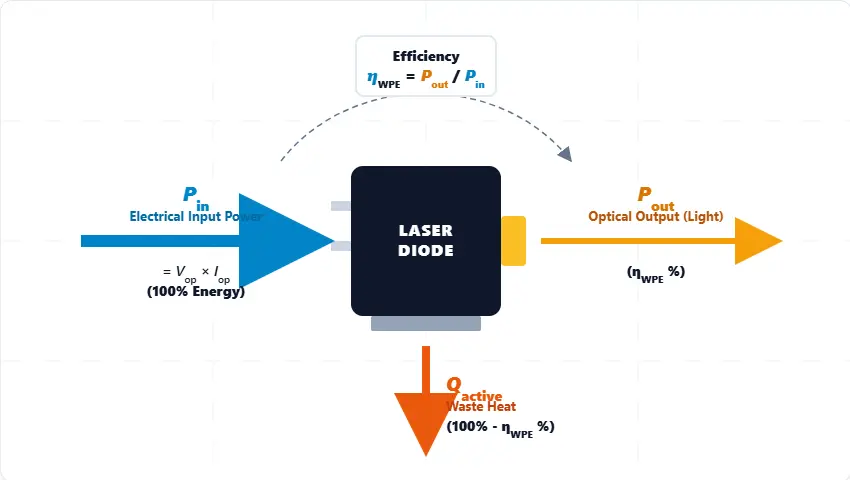
Wall-Plug Efficiency (WPE), also known as overall electro-optical efficiency, measures the ability of a laser diode to convert electrical input power directly into useful optical output power.
Because energy cannot be destroyed, any electrical energy that is not converted into light is expelled as Waste Heat. Calculating the WPE is a critical first step in sizing laser diode drivers and thermal management systems.
ηWPE =
Wall-Plug Efficiency
Pout
Vop · Iop
× 100%
Qactive = (Vop · Iop) − Pout
Generated Waste HeatUnderstanding the Variables:
- ηWPE Wall-Plug Efficiency: The percentage of electrical power converted to light. (e.g., modern high-power diode lasers often range from 40% to 60%).
- Pout Optical Output Power: The actual laser beam power emitted (in Watts).
- Vop Operating Voltage: The forward voltage drop across the diode at the operating current.
- Iop Operating Current: The drive current supplied to the laser diode.
- Qactive Waste Heat: The thermal load generated by the inefficiency of the diode.
Engineering Note: Thermal Rollover
Wall-Plug Efficiency is not constant! As the drive current (Iop) increases, the waste heat (Qactive) raises the junction temperature of the diode. If this heat is not actively managed by a TEC Cooling System, the threshold current will rise and efficiency will collapse—a phenomenon known as thermal rollover.