Optical Q-Factor & Photon Lifetime Calculator
Quality Factor · Linewidth (FWHM) · Cavity Lifetime
Optical Q-Factor & Cavity Lifetime
0
Photon Lifetime (τp): 0 ps
How the Optical Q-Factor Calculator Works
In optics and laser physics, the Quality Factor (Q-factor) is a dimensionless number that describes how well an optical resonator (like a laser cavity or micro-ring resonator) stores energy. A higher Q-factor means the cavity loses energy very slowly, resulting in an incredibly narrow, highly pure frequency spectrum.
Engineers typically determine the Q-factor by measuring the resonant peak using an Optical Spectrum Analyzer (OSA) to find its Full Width at Half Maximum (FWHM) linewidth.
Key Variables
- Q Quality Factor: A unitless ratio representing the resonator's damping and energy storage efficiency.
- λ (Lambda) Center Wavelength: The absolute peak of the resonance, typically measured in nanometers (nm).
- Δλ Wavelength Linewidth: The FWHM (Full Width at Half Maximum) of the resonant peak.
- ν (Nu) Center Frequency: The absolute resonant frequency of the light wave.
- Δν Frequency Bandwidth: The width of the peak in the frequency domain.
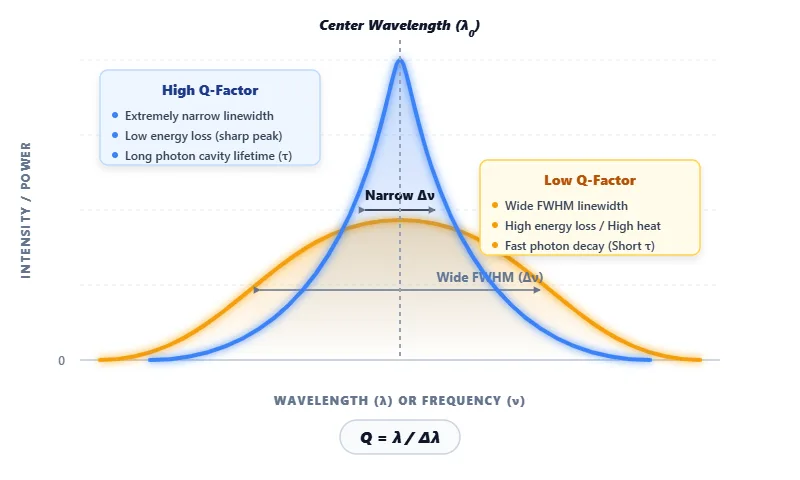
Calculating Photon Cavity Lifetime (τp)
Once the Quality Factor is known, it becomes trivial to determine the Photon Cavity Lifetime. This metric reveals exactly how long a photon survives bouncing back and forth between the mirrors inside the resonator before it escapes or is absorbed by the material.
Because light travels incredibly fast, cavity lifetimes are extraordinarily short. In standard fiber-optic communication lasers, the photon lifetime is generally measured in picoseconds (ps). In ultra-high-Q whispering gallery mode micro-resonators, the lifetime can reach well into the nanoseconds (ns).
Why calculate Optical Q Factor and Photon Lifetime
In the world of photonics and laser engineering measuring the optical quality factor is absolutely critical for understanding how well a system performs. A resonator or laser cavity acts like an echo chamber for light. If the mirrors are highly reflective and the internal materials have very little absorption the light bounces back and forth for a long time. This produces a massive Q factor.
High Q factor cavities are highly sought after because they produce incredibly narrow linewidths allowing for massive precision in spectroscopy telecom multiplexing and quantum optics. Using this calculator allows optical engineers to instantly translate experimental spectrum analyzer data into tangible physics metrics like photon lifetime.
Typical Q Factors in Photonics
A reference guide comparing the typical quality factors and photon lifetimes across various optical cavities.
| Resonator Type | Typical Q Factor | Photon Lifetime |
|---|---|---|
| Plasmonic Nanoparticles | 10 to 100 | < 0.1 picoseconds |
| Standard VCSEL Lasers | 1,000 to 10,000 | 1 to 5 picoseconds |
| Fabry Perot Diode Lasers | ~100,000 | ~50 picoseconds |
| Silicon Micro Rings | 1,000,000 | ~1 nanosecond |
| Silica Microspheres (WGM) | 108 to 109 | > 100 nanoseconds |
| Superconducting RF Cavities | > 1010 | Seconds |
Engineering Applications
1. Narrow Linewidth Lasers
Applications like coherent optical communications and Doppler LIDAR require lasers with incredibly stable center wavelengths. By designing an external laser cavity with a high Q factor engineers ensure the light emitted has a remarkably narrow FWHM linewidth dramatically improving signal resolution.
2. Silicon Photonics and Filters
On chip micro ring resonators are used to filter and drop specific wavelengths of light in dense wavelength division multiplexing. Knowing the exact optical quality factor helps optical designers predict how well the ring will isolate adjacent data channels without crosstalk.
3. Non Linear Optics
Non linear effects like frequency comb generation or second harmonic generation require massive internal light intensity. High Q cavities trap photons for extended lifetimes allowing the internal optical power to build up to the extreme thresholds required to trigger non linear physics.
4. Cavity Quantum Electrodynamics
In quantum physics researchers trap single atoms inside ultra high Q optical cavities. The photon lifetime must be long enough for the trapped photon to interact with the atom before it leaks through the cavity mirrors creating the foundation for quantum computing systems.