
How the Candela to Lumen Calculator Works
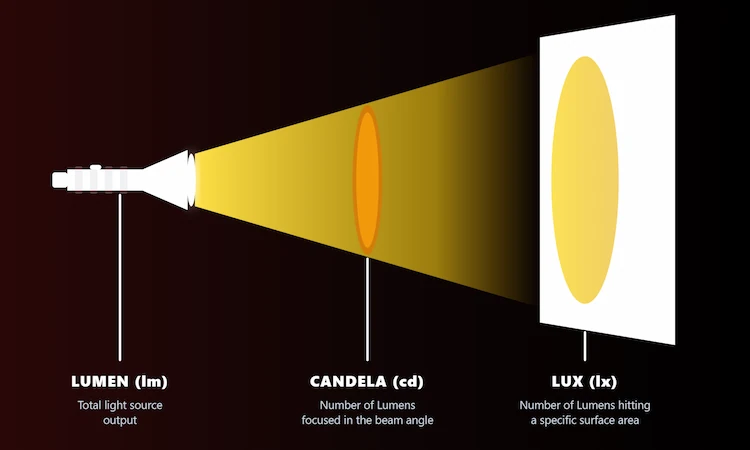
In photometry, a Candela measures how bright a light source appears in one specific direction. A Lumen, on the other hand, measures the total amount of light emitted in a defined beam cone. To convert between the two, you must know the size of the light cone, which is determined by the apex beam angle.
Key Variables
- I Luminous Intensity: Measured in Candelas (cd). It is the amount of light emitted in a specific direction.
- Φ (Phi) Luminous Flux: Measured in Lumens (lm). It is the total visible light emitted over a specific angle.
- Ω (Omega) Solid Angle: Measured in steradians (sr). It represents the 3D geometrical size of the light cone.
How to calculate the Solid Angle (Ω)
The conversion formulas above rely completely on the Solid Angle (Ω). Before converting to lumens or candela, the calculator must convert your 2D beam angle (θ) into a 3D steradian using this geometric formula:
Example: An omnidirectional lightbulb radiates light perfectly in a 360° sphere. If you plug 360° into the formula above, the solid angle is 4π steradians (12.566 sr). Therefore, a 1 candela omnidirectional bulb produces 12.57 lumens of total light.