
How the Optical Density to Transmission Calculator Works
Optical Density (OD) is a logarithmic measurement of how much light is blocked when passing through an optical filter, lens, or material. Because it is logarithmic, OD values are additive: stacking an OD 2 filter and an OD 3 filter results in a total attenuation of OD 5.
T% = 10-OD × 100%
Converting OD to Transmission PercentageTo calculate the amount of light that passes through (Transmission), we use the inverse base-10 logarithm. For every increase of 1 in the OD value, the amount of light transmitted decreases by a factor of 10.
Key Variables
- OD Optical Density: A unitless value representing the "blocking power." High OD means more light is absorbed or reflected.
- T Transmission: The ratio of transmitted light to incident light (expressed as a fraction 0 to 1 or a percentage).
- dB Decibels: A standard telecommunications unit. The conversion is fixed at: 1 OD = 10 dB.
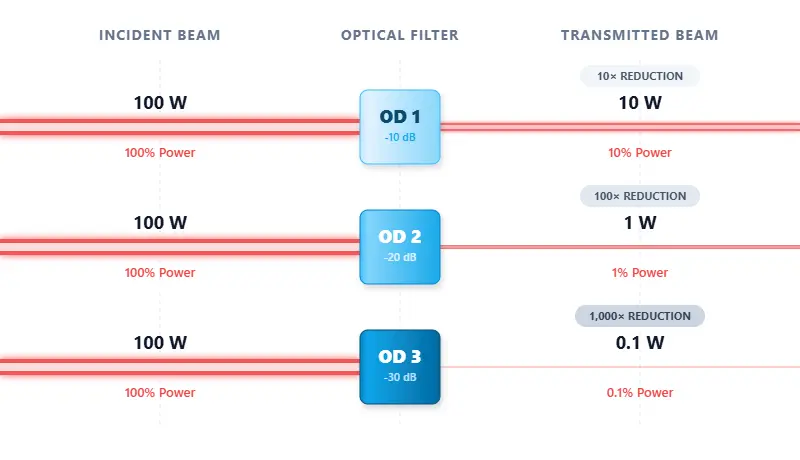
Figure 1: The relationship between OD and transmission. Each whole number increase in Optical Density represents a 10-fold reduction in the light energy that passes through the material.
Mental Math Reference
Use this table for quick conversions without a calculator:
| Optical Density (OD) | Transmission (%) | Attenuation Factor |
|---|---|---|
| OD 0.3 | ~50% | 2× Reduction |
| OD 1.0 | 10% | 10× Reduction |
| OD 2.0 | 1% | 100× Reduction |
| OD 3.0 | 0.1% | 1,000× Reduction |
| OD 4.0 | 0.01% | 10,000× Reduction |
| OD 6.0 | 0.0001% | 1,000,000× Reduction |
Applications
- Laser Safety: Goggles are rated by OD at specific wavelengths to protect eyes from permanent damage.
- Photography: Neutral Density (ND) filters use OD to control exposure in bright light.
- Microscopy: Used to calculate the efficiency of excitation filters and dichroic mirrors.
- Spectroscopy: Measuring the concentration of substances in a liquid based on light absorption.