Laser Power Density Calculator
How it works?
Understanding Peak Intensity
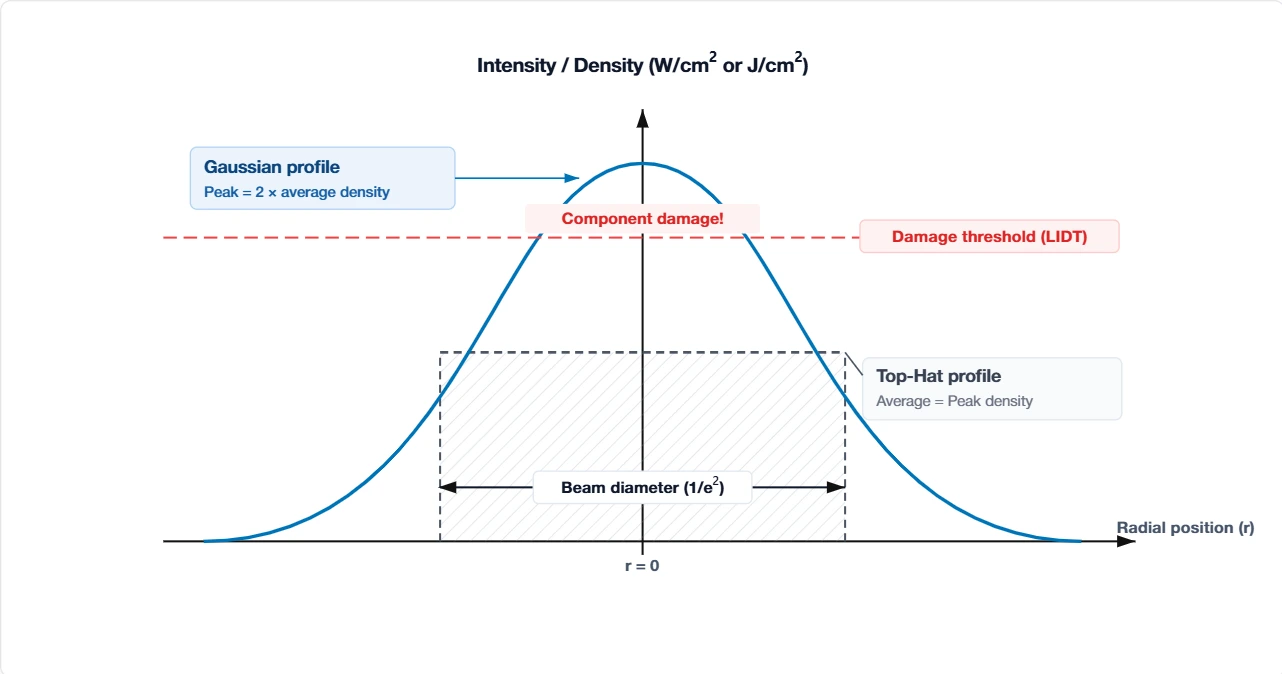
Most laser beams follow a Gaussian ($TEM_{00}$) intensity profile, meaning the energy is concentrated in the center. The "Average" density assumes the energy is spread evenly, which underestimates the intensity at the center by 50%.
To predict laser damage thresholds or cutting speeds accurately, you must calculate the Peak Power Density or Fluence:
Where:
- I : Power Density (Irradiance) in \(W/cm^2\).
- F : Fluence (Energy Density) in \(J/cm^2\).
- P : Average Power (Watts).
- E : Pulse Energy (Joules).
- w : Beam Radius (half of the diameter).
Note: For a "Top Hat" (Flat Top) beam, the energy is uniform, so the factor of "2" is removed from the equation (\( I = P / \pi w^2 \)).
Why calculate Power Density & Fluence?
- Laser Damage (LIDT): Optics will shatter if the Fluence (J/cm²) exceeds the coating limit.
- Ablation Threshold: Materials only vaporize when the Power Density (W/cm²) hits a specific critical mass.
- Medical Safety: MPE (Maximum Permissible Exposure) is strictly defined in W/cm².
- Laser Cleaning: Removing rust requires a specific fluence to sublime oxide without melting the substrate.
The Gaussian Multiplier
Many engineers make the fatal mistake of simply dividing Power by Area (P/A). This gives the average density. However, because most lasers are Gaussian (bell-shaped), the energy at the very center of the beam is twice as intense as the average.
This calculator automatically applies the 2× multiplier for Gaussian beams. Ignoring this factor is the #1 cause of damaged optics in the lab.
1. Selecting Optics (LIDT)
When buying a dielectric mirror, the spec sheet might say "LIDT > 5 J/cm² @ 10ns". If your laser pulses are 500 mJ and your beam is 3mm wide, you must calculate the peak fluence to ensure you don't burn a hole in the mirror on the first shot.
2. Laser Welding vs. Cutting
The difference between welding (melting) and cutting (vaporizing) is Power Density. By focusing the same 1kW laser to a smaller spot, you increase the W/cm² by a factor of 4 (inverse square law), shifting the process from conduction welding to keyhole cutting.
3. Dermatology
In laser tattoo removal, the fluence (J/cm²) determines if the ink pigment shatters. If the fluence is too low, nothing happens. If it is too high, you risk scarring the skin. Precise calculation is a matter of patient safety.
4. Flow Cytometry
In bio-instrumentation, cells pass through a laser focus. The fluorescence signal depends on the saturation intensity ($Isat$). Calculating the irradiance in the focus volume ensures the laser intensity is optimized to saturate the fluorophores without photobleaching them.