
How the Laser Pulse Energy Calculator Works
Most laser power meters measure average power over time. For pulsed lasers, however, the energy is concentrated into brief discrete bursts. To find the energy of a single pulse, divide the total average power by the number of pulses per second.
$$E = \frac{P_{avg}}{f_{rep}}$$
Pulse Energy FormulaWhere:
- \(E\) Energy in Joules (J).
- \(P_{avg}\) Average power in Watts (W).
- \(f_{rep}\) Repetition rate in Hertz (Hz).
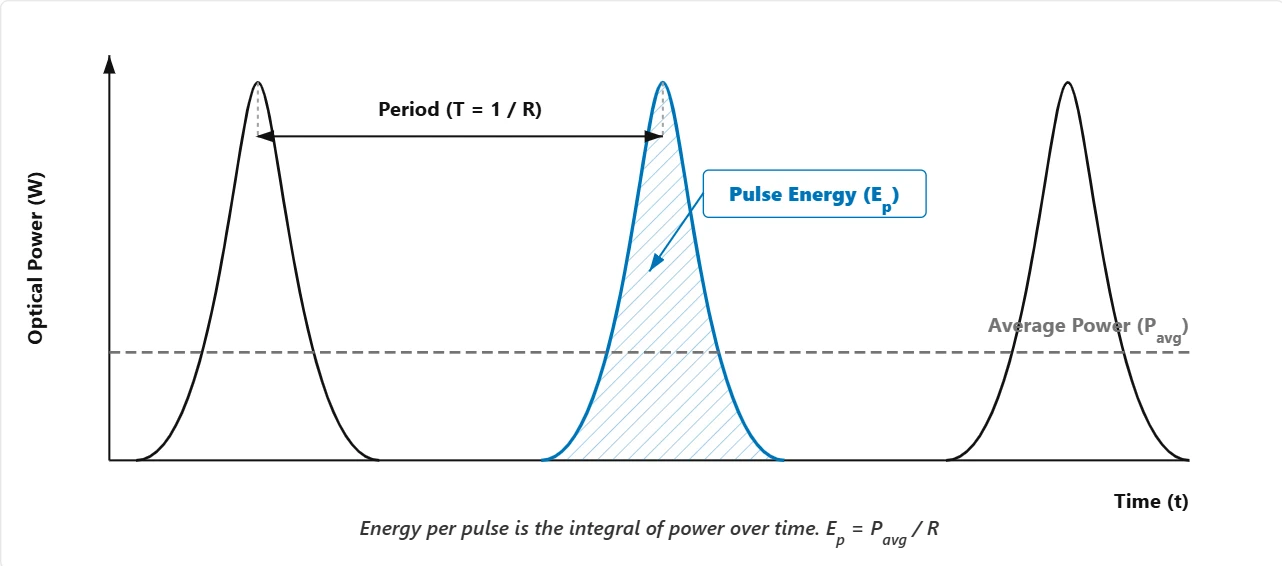
Figure 1: Temporal power profile of a pulsed laser. The Pulse Energy (Ep) represents the integral of optical power over time (shaded area). Because the laser's energy is compressed into brief, periodic bursts spaced by the Period (T = 1/R), the instantaneous peak power is vastly higher than the continuous Average Power (Pavg).
Quick Reference
- Low rep rate = higher energy for the same average power.
- High rep rate = lower energy — energy is spread across more pulses.
- For ablation and cutting, you need higher pulse energy, not just higher average power.
- Optics are rated by fluence (J/cm²) — always verify pulse energy against your optic's LIDT.
Typical pulse energy by application
Logarithmic scale where each column represents a 1000× increase in energy
pJ
nJ
µJ
mJ
J
kJ
MJ
Frequency combs
Mode-locked fiber
LIDAR
Metal marking
Laser cleaning
Tattoo removal
Q-switched Nd:YAG
NIF fusion
Source: typical operating parameters and actual values vary by system configuration