
Converting Wavenumber back to Wavelength
While spectrometers record data in Wavenumbers (cm⁻¹) to keep energy scales linear, engineers building the actual detectors and lasers need to know the physical **Wavelength (nm)**. This calculator bridges the gap between the "chemical fingerprint" and the hardware used to detect it.
Infrared Bands Reference
Common molecular vibration bands and their physical wavelengths.
| Vibration / Band | Wavenumber (cm⁻¹) | Wavelength (nm / µm) |
|---|---|---|
| Hydroxyl (O-H) Stretch | ~3,600 cm⁻¹ | 2,777 nm (2.7 µm) |
| Alkane (C-H) Stretch | ~2,950 cm⁻¹ | 3,389 nm (3.4 µm) |
| Carbon Dioxide (CO₂) | ~2,350 cm⁻¹ | 4,255 nm (4.25 µm) |
| Carbonyl (C=O) | ~1,700 cm⁻¹ | 5,882 nm (5.9 µm) |
| Fingerprint Region Start | 1,500 cm⁻¹ | 6,666 nm (6.7 µm) |
| Silicon-Oxygen (Si-O) | ~1,100 cm⁻¹ | 9,090 nm (9.1 µm) |
| Terahertz Gap Start | 333 cm⁻¹ | 30,000 nm (30 µm) |
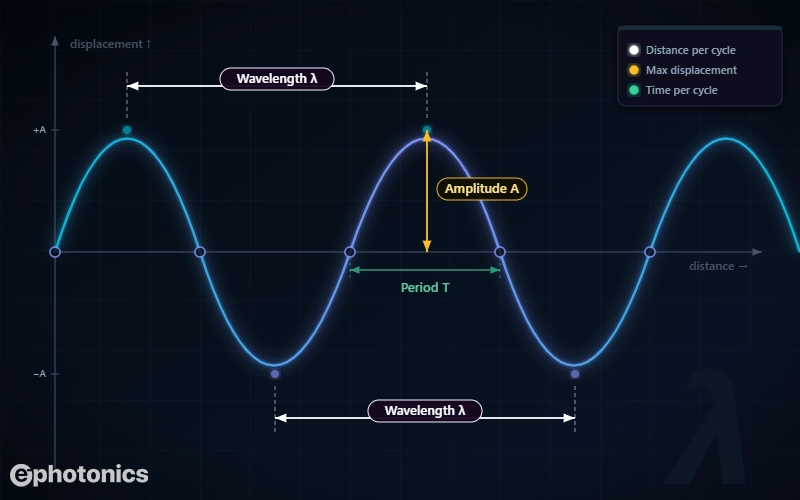
Why convert back to nanometers?
1. Detector Selection
You know your molecule absorbs at 2950 cm⁻¹, but photodetector datasheets specify ranges in microns (e.g., "InGaAs: 0.9 - 1.7 µm"). You must convert the wavenumber to wavelength (3.4 µm) to realize you need a PbSe detector, not InGaAs.
2. Diffraction Grating Math
The physics of diffraction gratings depends on the physical spacing of the grooves relative to the physical wavelength (nλ = d sin θ). You cannot calculate dispersion angles directly from wavenumbers.
3. Laser Tuning
Quantum Cascade Lasers (QCLs) are often sold by "center wavenumber," but the optical cavity length and coating thickness are designed in physical length (microns).
4. Atmospheric Windows
Transmission through the atmosphere is defined by "windows" (e.g., the 8-12 µm thermal window). Converting wavenumbers helps you see if your signal will be absorbed by water vapor or pass through clearly.
Frequently Asked Questions
1 nm = 10,000,000 cm⁻¹ (10⁷ cm⁻¹). This comes from the formula ν̃(cm⁻¹) = 10⁷ ÷ λ(nm). In practice, no real optical photon has a 1 nm wavelength — this is a pure unit reference. Real-world examples: 532 nm (green laser) = 18,797 cm⁻¹, 1064 nm (Nd:YAG) = 9,398 cm⁻¹, 10,600 nm (CO₂ laser) = 943 cm⁻¹.
Use the formula: ν̃(cm⁻¹) = 10⁷ ÷ λ(nm). For example, 800 nm gives 10⁷ ÷ 800 = 12,500 cm⁻¹, and 2,500 nm gives 10⁷ ÷ 2,500 = 4,000 cm⁻¹. Wavelength and wavenumber are simply reciprocals — as wavelength increases, wavenumber decreases proportionally.
500 nm = 20,000 cm⁻¹. This falls in the visible green range and is commonly used as a reference point in Raman spectroscopy excitation sources.
1,000 nm = 10,000 cm⁻¹. This sits at the near-infrared boundary and corresponds to wavelengths detectable by standard silicon and InGaAs photodetectors.
1,550 nm = 6,452 cm⁻¹. This is the standard telecom C-band wavelength used in fiber optic communications, and sits within the near-infrared window where silica fiber has its lowest attenuation.
10,600 nm = 943 cm⁻¹. This is the emission wavelength of the CO₂ laser, one of the most powerful and widely used industrial lasers for cutting, welding, and material processing.
Use: ν̃(cm⁻¹) = 10,000 ÷ λ(µm). For example, 3.4 µm (C-H stretch) = 10,000 ÷ 3.4 = 2,941 cm⁻¹, and 9.6 µm = 10,000 ÷ 9.6 = 1,042 cm⁻¹. This is the most convenient form when working with mid-infrared laser datasheets specified in microns.
Wavenumber is directly proportional to energy (E = hcν̃), which makes spectral peaks appear at consistent, evenly spaced positions regardless of where you are in the spectrum. In nanometers, the same energy gap looks much larger at 10,000 nm than at 1,000 nm — making peak comparisons across wide spectral ranges misleading.
Related Engineering Tools
Convert Wavelength to Frequency (THz). Frequency is the "time-based" cousin of Wavenumber.
Photon EnergyCalculate the exact energy (eV or Joules) carried by a specific wavenumber.
Angstrom to NanometerSwitch between length scales when dealing with crystallography and atomic bonds.