V Number Calculator
Fiber Optics · Normalized Frequency · Cutoff
ephotonics
linkedin.com/company/ephotonics
Follow us for weekly fiber optic engineering tips, V-number tutorials, and new calculator releases.
Follow on LinkedInHow the Fiber V Number Calculator Works
The V Number (or normalized frequency) is a dimensionless parameter that determines the number of modes a step-index fiber can support. It relates the fiber's physical geometry and refractive indices to the wavelength of light.
Understanding the Variables:
- V V Number: The normalized frequency of the fiber.
- a Core Radius: Half of the physical core diameter.
- λ Wavelength: The vacuum wavelength of the incident light.
- ncore / nclad Refractive Indices: The optical properties of the core and cladding.
- NA Numerical Aperture: The light-gathering power of the fiber.
Why calculate the V-Number?
- Single-Mode Limit: Determines the exact wavelength where a fiber stops being single-mode.
- Mode Count: Estimates how many optical modes can travel through a multi-mode fiber.
- Bend Sensitivity: Low V-numbers (< 1.5) indicate weak guidance and high susceptibility to bending loss.
- Design Control: Essential for tailoring core size and NA during fiber fabrication.
The "Normalized Frequency" of Fiber Optics
The V-Number (V) is arguably the most critical parameter in fiber optics because it acts as a gatekeeper. It tells you, with a single number, how light behaves inside the core. It combines the three main variables of a fiber: core radius (a), numerical aperture (NA), and wavelength (λ).
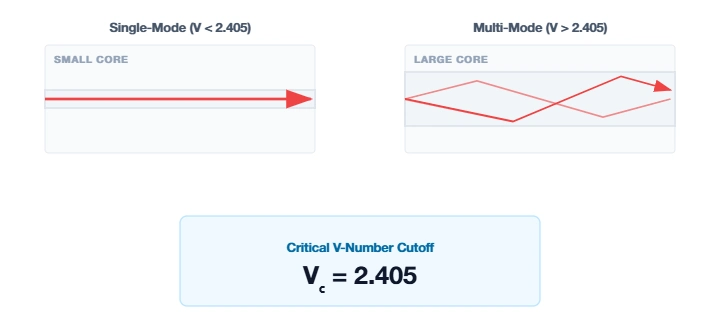
The magic number is 2.405. If your calculated V is below this threshold, physics dictates that only the fundamental mode (LP01) can propagate. Above this number, higher-order modes enter the equation, introducing modal dispersion and signal distortion.
Critical Applications
1. Cutoff Wavelength Calculation
The "cutoff" is simply the wavelength where V = 2.405. Operating below this wavelength risks multi-mode noise; operating too far above it risks high bend loss.
2. Multi-Mode Capacity
For large-core fibers (where V >> 2.405), the number of modes can be approximated as M ≈ V² / 2. This is vital for calculating data capacity in MM fibers.
3. Evanescent Field Power
As V decreases (e.g., V < 1.5), the mode spreads significantly into the cladding. This is used in fiber sensors to detect changes in the external environment.
4. Dispersion Engineering
The V-number determines the waveguide dispersion component. By tuning V (changing core size), engineers can shift the zero-dispersion wavelength.
For standard step-index fibers:
V < 2.405: Single-Mode Operation (Purest signal, no modal dispersion).
V > 2.405: Multi-Mode Operation (Higher power handling, but signal spreads over time).
Learn the derivation, see real-world examples, and understand how V-number dictates fiber cut-off wavelength.