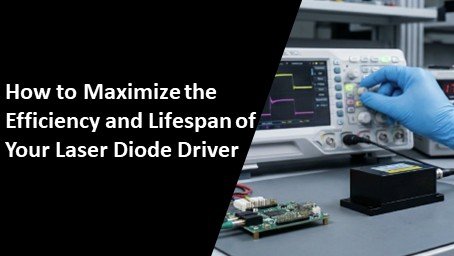
Laser diode drivers play a crucial role in controlling the performance of laser diodes, ensuring they operate efficiently and reliably. A well-maintained laser diode driver can significantly improve the efficiency and lifespan of the entire laser system. Whether you are working in industrial applications, research, or medical devices, maximizing the performance and longevity of your laser diode driver is essential for optimal operation and reduced costs. Here’s how you can achieve that.
Start with correct current regulation
Laser diodes should be driven with a constant-current laser diode driver because small electrical changes can cause large current shifts and overheating. Choose a driver whose operating range matches your diode’s required current and includes enough compliance voltage to regulate across temperature and wiring losses without exceeding the driver’s maximum input rating. Avoid guessing current, too much available current increases the risk of accidental overdrive during setup or faults, while too little current limits optical output and can cause unstable operation near threshold. Monitor the current from laser driver’s monitor pin to be sure you are in the safe range.
Control turn on transients
Many laser diodes fail not during steady operation but during power-up, enable/disable events, or cable reconnects due to overshoot spikes. Use a driver with an ability to soft-start/controlled ramp and a proper enable/interlock so current rises smoothly rather than stepping abruptly. When possible, verify turn-on behavior with appropriate measurement equipment and keep leads short to reduce inductive kick and ringing.
Protect against common electrical faults
Select a laser diode driver with protections that prevent one mistake from becoming a catastrophic diode failure.
Key protections to look for:
- Overcurrent limiting or shutdown so the diode cannot be driven past safe current.
- Reverse polarity protection to survive wiring errors.
- Surge/spike protection to reduce damage from supply transients.
- ESD handling practices (strap, grounded workstation, shorting plug for the diode leads during handling) because electrostatic discharge can silently damage or immediately destroy laser diodes.
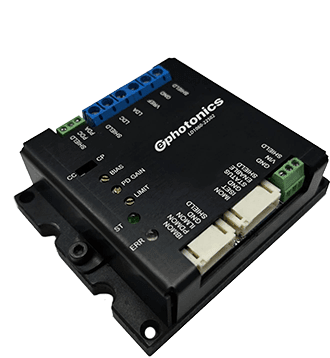
Manage Heat Dissipation Effectively
Heat is one of the biggest lifetime reducers in diode-based systems, so treat thermal design as part of electrical design. Use an appropriately sized heat sink and ensure good thermal contact to the mounting plate with flat surfaces, correct mounting pressure/torque, and suitable thermal interface material. For higher power or enclosed systems, consider active cooling (fan or liquid loop) and monitor temperatures so you can catch problems like clogged airflow, failing fans, or drifting thermal resistance early.
Maintain Proper Power Supply
A clean, stable power source helps the driver regulate correctly and reduces the chance of oscillation, ripple-coupled optical noise, and unexpected resets. Use a power supply with adequate filtering and keep wiring and layout short with good connectors in order to reduce voltage drops and interference. If your application is noise-sensitive (metrology, sensing, spectroscopy), prioritize low-noise driver specs and verify ripple/noise performance in your real setup.
Calibration and setup
Periodically confirm that the driver’s current setpoint is accurate and that safety limits (current limit, interlock behavior) still work as intended. If you use modulation, ensure modulation depth and bandwidth are within what the diode and driver can support without causing thermal cycling or current overshoot. Document your known and mostly used settings (current, compliance voltage, temperature setpoint, modulation parameters) so future maintenance is consistent.
Maintenance, inspection and logging
Dust on heat sinks and fans reduces cooling performance over time; schedule cleaning based on your environment either lab orindustrial. Inspect connectors and cables for looseness, corrosion and strain intermittent connections can create spikes that look like random diode failures. Log key metrics (current, voltage, temperature, optical power if available) so you can spot gradual drift before it becomes downtime
Conclusion
While maintenance and calibration are vital, the most significant factor in your system’s lifespan is the initial hardware selection. A low-quality driver forces you to constantly monitor for thermal drift and transient spikes, turning your engineering team into maintenance technicians.
At ephotonics, we engineer our Laser Diode Drivers to handle the heavy lifting for you. With built-in active current limits, and integrated protections, fast modulations so that our drivers ensure your diodes operate within their safe area of operation automatically.
Don’t leave your system’s reliability to chance. By selecting a driver designed for harsh industrial and precision laboratory environments, you secure the longevity of your laser source from the very first pulse.
Did You Know?
- The 10°C Rule of Death: Most driver failures are caused by electrolytic capacitors drying out. According to the Arrhenius Law, for every 10°C rise in operating temperature, the lifespan of these capacitors is cut exactly in half. Keeping your driver cool is mathematically the best way to extend its life.
- The CTE Mismatch: Thermal cycling (turning the driver on/off repeatedly) is often more damaging than running it 24/7. This is due to the difference in the Coefficient of Thermal Expansion between the PCB, the solder, and the components, which eventually causes microscopic cracks in solder joints [1].
- Voltage Headroom Waste: If you use a 24V power supply to drive a 5V laser diode, your driver is forced to burn off the remaining 19V as pure heat. This forces the internal MOSFETs to operate in their linear region, drastically increasing thermal stress and shortening the unit’s lifespan.
- Brownouts are worse than Blackouts: A sudden power loss usually just shuts a driver down. However, a brownout (voltage dip) is far more dangerous. It can cause the internal logic to desynchronize from the power stage, potentially causing the driver to open the control loop fully and dump a massive current spike before dying [2].