
1. Why does Wavelength Shift with Temperature?
Laser diodes are bandgap devices. As the temperature of the chip increases, two distinct physical mechanisms cause the emission wavelength to "Redshift" (move to longer wavelengths):
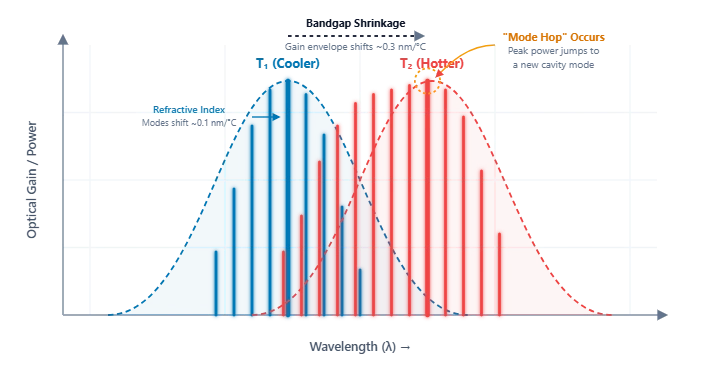
A. Bandgap Shrinkage (Dominant in Multimode)
As the semiconductor lattice heats up, it expands. This expansion lowers the bandgap energy of the material. Since Energy and Wavelength are inversely related (E = hc / λ), lower energy means a longer wavelength.
Typical Shift: ~0.3 nm/°C for standard Fabry-Perot (FP) diodes.
B. Refractive Index Change (Dominant in Single Mode)
Temperature changes the effective refractive index of the optical cavity. This changes the optical path length, selecting a different longitudinal mode.
Typical Shift: ~0.06 nm/°C to 0.1 nm/°C for DFB/DBR lasers.
If you need to tune a diode to a shorter wavelength (Blueshift), you must cool it below room temperature. Caution: If you cool below the dew point of your lab environment, condensation will form on the laser facet or window, causing catastrophic damage. Always seal your mount or use a nitrogen purge when cooling below 15°C.
2. The "Mode Hop" Danger Zone
When tuning a standard Fabry-Perot (FP) laser diode, the wavelength does not shift perfectly smoothly. As the gain curve shifts (due to bandgap shrinkage), it eventually favors a neighboring cavity mode.
When this happens, the laser will suddenly "jump" or "hop" to a new wavelength, often skipping 0.3nm to 1.0nm instantly. This is called a Mode Hop.
For applications requiring continuous scanning without gaps (like gas sensing), you must use a Distributed Feedback (DFB) or Distributed Bragg Reflector (DBR) laser. These diodes have a grating structure etched into the semiconductor that forces single-mode operation, allowing for smooth, continuous temperature tuning without hops.
3. Stability Requires Precision Drivers
Using the calculator, you can see that a temperature change of just 1°C shifts a standard diode by 0.3 nm.
Conversely, this means that if your laser driver allows the temperature to drift by just 0.1°C, your wavelength will drift by 0.03 nm. For high-resolution systems, this instability introduces noise and spectral broadening.
To achieve spectral stability < 0.01 nm, you need a Laser Diode Driver with an integrated high-precision TEC controller capable of maintaining thermal stability better than 0.01°C.
Related Optical Engineering Tools
Wavelength stability directly impacts coherence. Calculate how far your laser stays in phase.
Optical Density to TransmissionEnsure your safety filters block the specific wavelength you just tuned to.
Lens ThicknessCalculate center thickness and sagitta for your collimating optics setup.