
How the Laser Beam Expander Works
A laser beam expander is essentially a reversed telescope. Its primary function in optical engineering is to take a collimated input beam and increase its diameter, resulting in a larger collimated output beam.
The fundamental rule of Gaussian optics dictates that beam diameter and beam divergence are inversely related. By actively expanding the beam diameter, you proportionally reduce its divergence angle, which allows the laser beam to travel significantly longer distances without spreading out and losing power density.
$$ D_{out} = M \cdot D_{in} $$
$$ \theta_{out} = \frac{\theta_{in}}{M} $$
Beam Expansion & Divergence EquationsWhere:
- \(M\) (Magnification Power): The expansion ratio. This is calculated by taking the absolute ratio of the output to input lens focal lengths (\(|f_2 / f_1|\)).
- \(D\) (Beam Diameter): The width of the beam at the lens, typically measured at the 1/e² intensity clip level.
- \(\theta\) (Beam Divergence): The full-angle spread of the laser beam, usually measured in milliradians (mrad).
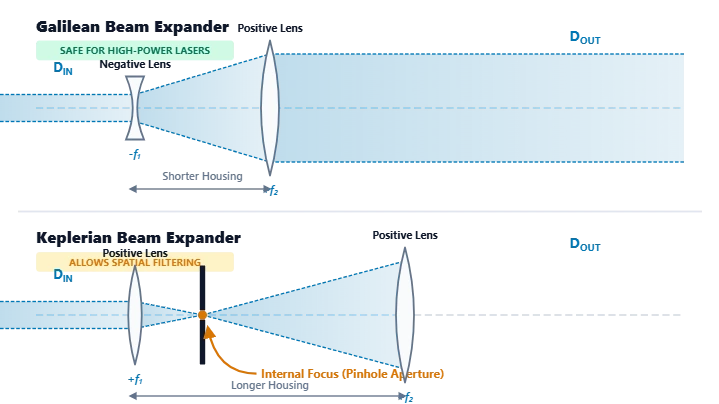
Galilean vs. Keplerian Expander Designs
There are two primary optical designs used to construct a beam expander. Your choice dictates the physical length of your optical train and its power handling limits:
- Galilean Telescope: Uses one negative (concave) input lens and one positive (convex) output lens. Because it does not create an internal focal point, the physical length is shorter. It is heavily preferred for high-power lasers because avoiding an internal focus prevents air breakdown (plasma arcing) inside the expander housing.
- Keplerian Telescope: Uses two positive (convex) lenses, which creates an internal focal point between the lenses. While this makes the housing physically longer, it allows engineers to perform spatial filtering. By placing a microscopic pinhole exactly at the internal focal point, you can strip away stray light and "clean up" the Gaussian beam profile.