
How the Lens Thickness Calculator Works
Lens thickness calculator determines the center and edge thickness of a lens using the Sagitta (Sag) Approximation formula. In ophthalmic and optical engineering, lenses are typically meniscus (curved on both sides). The depth of these curves dictates the overall physical lens thickness required to manufacture the lens.
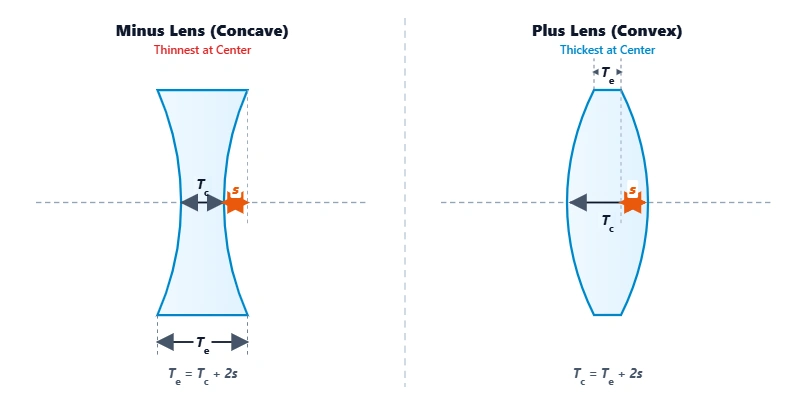
Understanding the Variables:
- r Radius (Aperture): Half of the total lens diameter (in mm). The larger the frame/lens diameter, the exponentially thicker the lens becomes.
- P Dioptric Power: The absolute optical power of the lens.
- n Refractive Index: The density of the lens material. Higher index materials bend light more efficiently, resulting in flatter curves and thinner lenses.
Calculating Total Thickness
Once the Sagitta is known, the total thickness depends on whether the lens converges light (Plus) or diverges light (Minus).
Tedge = Tcenter(min) + s
Minus Lenses (Concave)Thinnest at the center, thickest at the edges.
Tcenter = Tedge(min) + s
Plus Lenses (Convex)Thinnest at the edges, thickest at the center.
Engineering Note: Cylinder & Astigmatism
This tool calculates the thickness at the thickest meridian. If your optical prescription includes Cylinder (Astigmatism) power, the edge thickness will vary dynamically around the perimeter of the lens. This calculator displays the maximum theoretical thickness, which is the critical dimension for determining if the lens will fit safely within a mechanical frame or housing.