Why is Brewster's Angle important?
1. Lossless Laser Windows
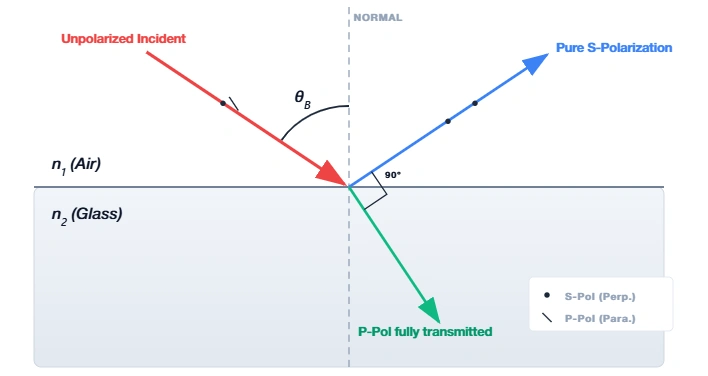
In gas lasers (like HeNe or Argon-ion), internal reflections can kill the laser gain. By placing the tube windows at Brewster's Angle, the laser ensures that P-polarized light suffers zero reflection loss (0%) per pass. This allows the laser to operate at high efficiency without the need for expensive and damage-prone anti-reflective coatings.
2. Polarized Photography
This is the physics behind polarizing filters. Light reflected from non-metallic surfaces (like a lake, a wet road, or a glass window) becomes partially linearly polarized at the surface. By orienting a filter to block this "Brewster reflection," photographers can eliminate glare.
3. High-Contrast Microscopy
Brewster Angle Microscopy (BAM) is a powerful technique for studying thin films on liquid surfaces. Since pure water reflects zero light at the Brewster angle, the background appears perfectly black, allowing any thin film layer to be seen with high contrast.
4. "Pile of Plates" Polarizers
High-power laser systems often cannot use absorptive polarizing films (which would melt). Instead, engineers use a stack of glass plates tilted at Brewster's Angle. Each plate transmits 100% of the P-polarization while reflecting a portion of the S-polarization.
Deep Dive
Full Article
Brewster’s Angle: The Key to Control Light Reflections
Explore the derivation, the Fresnel equations behind the physics, and advanced photonics applications in our comprehensive guide.
→
Never miss a calculation.
Follow ephotonics on LinkedIn for daily updates.
Related Engineering Tools