Fresnel reflection calculator
| Polarization | Reflectance (R) | Transmittance (T) |
|---|---|---|
| S-Pol (Perpendicular) | ---% | ---% |
| P-Pol (Parallel) | ---% | ---% |
| Average (Unpolarized) | ---% | ---% |
How it works?
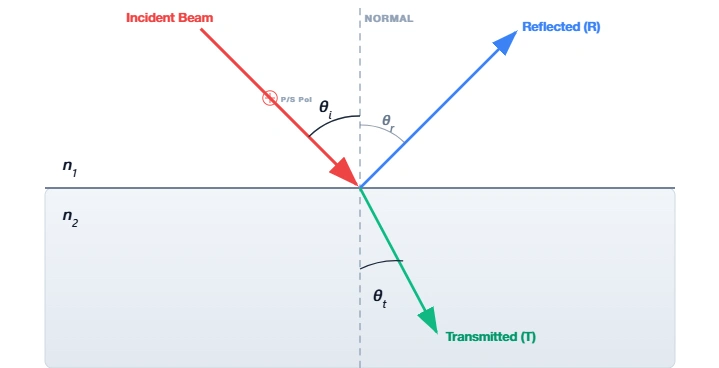
The Fresnel reflection calculator computes the reflectivity and transmissivity at an optical interface. This behavior is governed by **Fresnel's Equations** and depends on Refractive Indices (\( n_1, n_2 \)), Angle of Incidence, and Polarization.
Fresnel Equations
Variable Definitions:
Why calculate Fresnel Reflection?
- Power Loss: Up to 4% is lost at every single glass/air surface.
- Ghost Images: Reflections cause flare and artifacts in imaging systems.
- Safety: High-power back-reflections can damage laser sources.
- AR Coatings: Calculation is essential for designing Anti-Reflective layers.
The "Optical Tax" at Interfaces
Whenever light travels from one medium to another (e.g., from air into a glass lens), a portion of that light bounces back. This phenomenon is known as Fresnel Reflection. While it is the reason we can see our reflection in a window, in optical engineering, it is often a significant problem.
For standard glass (n ≈ 1.5) in air, the reflection loss is about 4% per surface at normal incidence. In a complex microscope or camera lens with 10 elements (20 surfaces), this could theoretically result in a loss of over 50% of the light if left untreated. Understanding and calculating these values allows engineers to maximize transmission efficiency.
Critical Engineering Applications
1. Anti-Reflective (AR) Coatings
The primary use of the Fresnel equations is in the design of thin-film coatings. By calculating the exact reflection based on refractive index, engineers can apply a dielectric layer with a precise thickness to create destructive interference.
2. Fiber Optic Coupling
In telecom, the small gap between two fiber connectors acts as a Fresnel interface. This creates "Fresnel Loss" (typically -0.17 dB) and dangerous back-reflections (Return Loss). Engineers use Index Matching Gel to eliminate the index difference (Δn ≈ 0).
3. High-Power Laser Safety
In multi-kilowatt laser cutting systems, a 4% back-reflection represents hundreds of watts traveling backward. This "back-reflection" can burn out the laser diode. Accurate calculation helps engineers design optical isolators to manage this energy.
4. Brewster Windows
By using this calculator, you will notice that at a specific angle (approx 56° for glass), the reflection for P-polarized light drops to exactly zero. This is Brewster's Angle, used in gas lasers for 100% transmission efficiency.
When light travels from a high-index medium (like glass) to a low-index medium (like air), there is a critical angle where refraction stops completely. Beyond this angle, 100% of the light is reflected back inside. This principle of Total Internal Reflection is exactly what traps light inside optical fibers.